Page Text
            Nuclear Winter
Follow these
evacuation
Principles
The best protection against atomic or hydrogen
bombs is Don't be there! particularly in the ab-
sence of specially designed shelters. In major
cities, this means preattack evacuation.
The best way to survive
the hazards of radioactive
fallout, or any other
threat an enemy may use
against us, is to be
prepared know the facts -
learn what to do, now!"
Fallout is nothing more than
particals of air, made radioactive by
nuclear or thermonuclear explosions.
When an atomic or hydrogen bomb is
exploded close to the ground,
building materials, rocks, and gases
are sucked upward, sometime to a
height of 80,000 feet or more. They
help form the mushroom cloud which is
always seen with one of these
explosions.
Some of these radioactive particles
spill out in the immediate area of
the explosion soon after it occurs,
but others may be carried by the
upper winds for many miles. Sooner or
later, however, they settle to earth.
This is called fold out.
y Is Nothing New...
The Whole World is Radioactive
But normal amounts are not dangerous.
It is only when radioactivity is
present in highly concentrated
amounts, such as those created by
atomic and hydrogen bomb explosions,
that it becomes dangerous.
Radioactive fallout is sometimes
highly concentrated.
If you are exposed to it long er ough
IT WILL HURT YOU!
IT MAY EVEN KILL YOU!
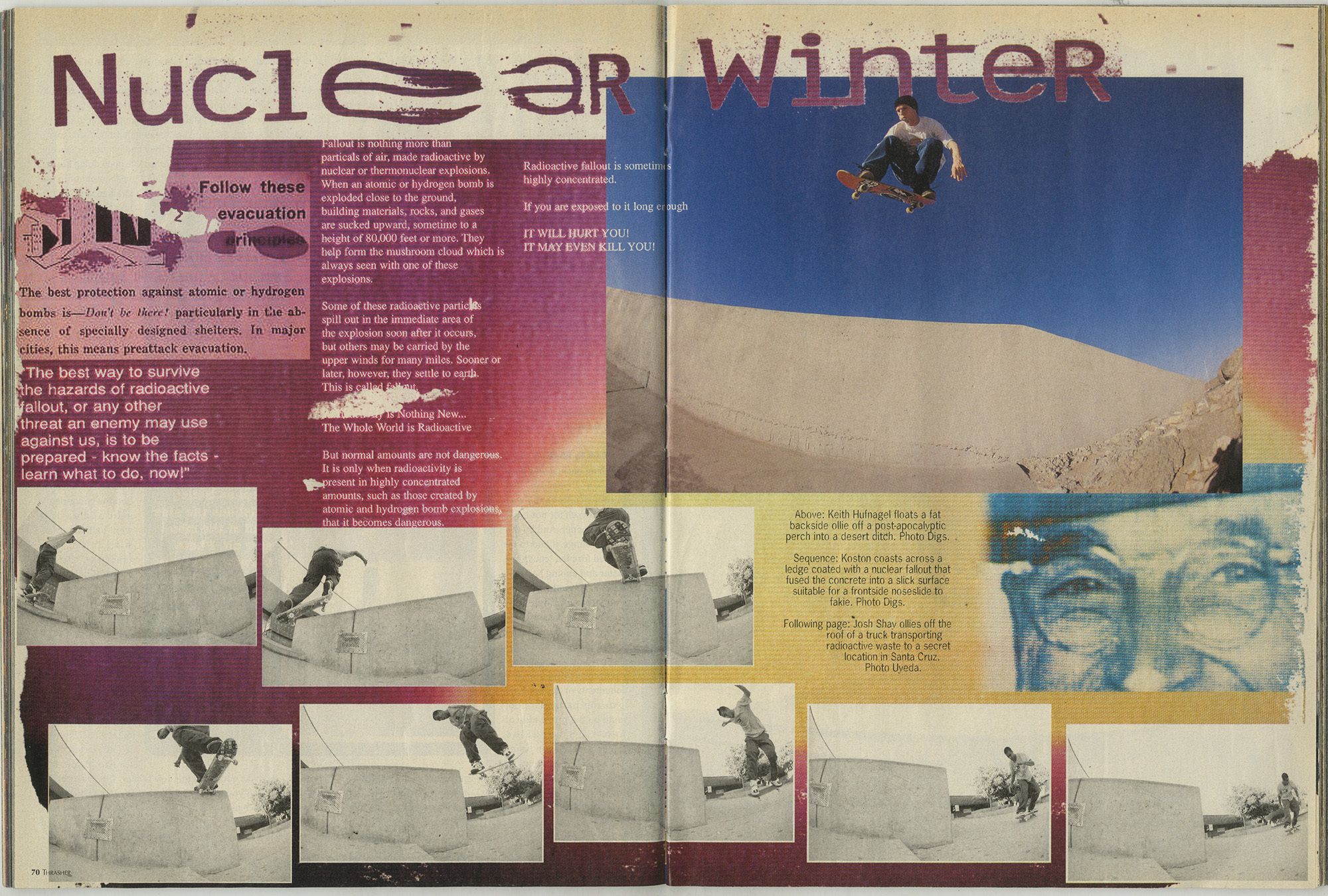
Above: Keith Hufnagel floats a fat
backside ollie off a post-apocalyptic
perch into a desert ditch. Photo Digs.
Sequence: Koston coasts across a
ledge coated with a nuclear fallout that
fused the concrete into a slick surface
suitable for a frontside noseslide to
fakie. Photo Digs.
Following page: Josh Shay ollies off the
roof of a truck transporting
radioactive waste to a secret
location in Santa Cruz.
Photo Uveda.
70 THRASHER