Page Text
            L
AST TIME, I discussed the
nature of a sprained ankle and
briefly outlined a
I a way to treat
the sprain (RICE: Rest, Ice,
Compression, Elevation). This
month I will provide a more in-depth
method for rehabilitating a sprained
ankle. Be aware that this is an
extremely important step in the
healing process. The following exer-
cises will not only help treat a sprained
ankle, but will also help prevent future
ones from occurring.
DEC Ska
You should begin your rehabilitation as soon as you are capable of
walking comfortably. Walk only as much as the pain permits, but do
not attempt to exceed your limits. At first, you may need a cane,
crutches, or an ankle brace for support. During this initial stage of
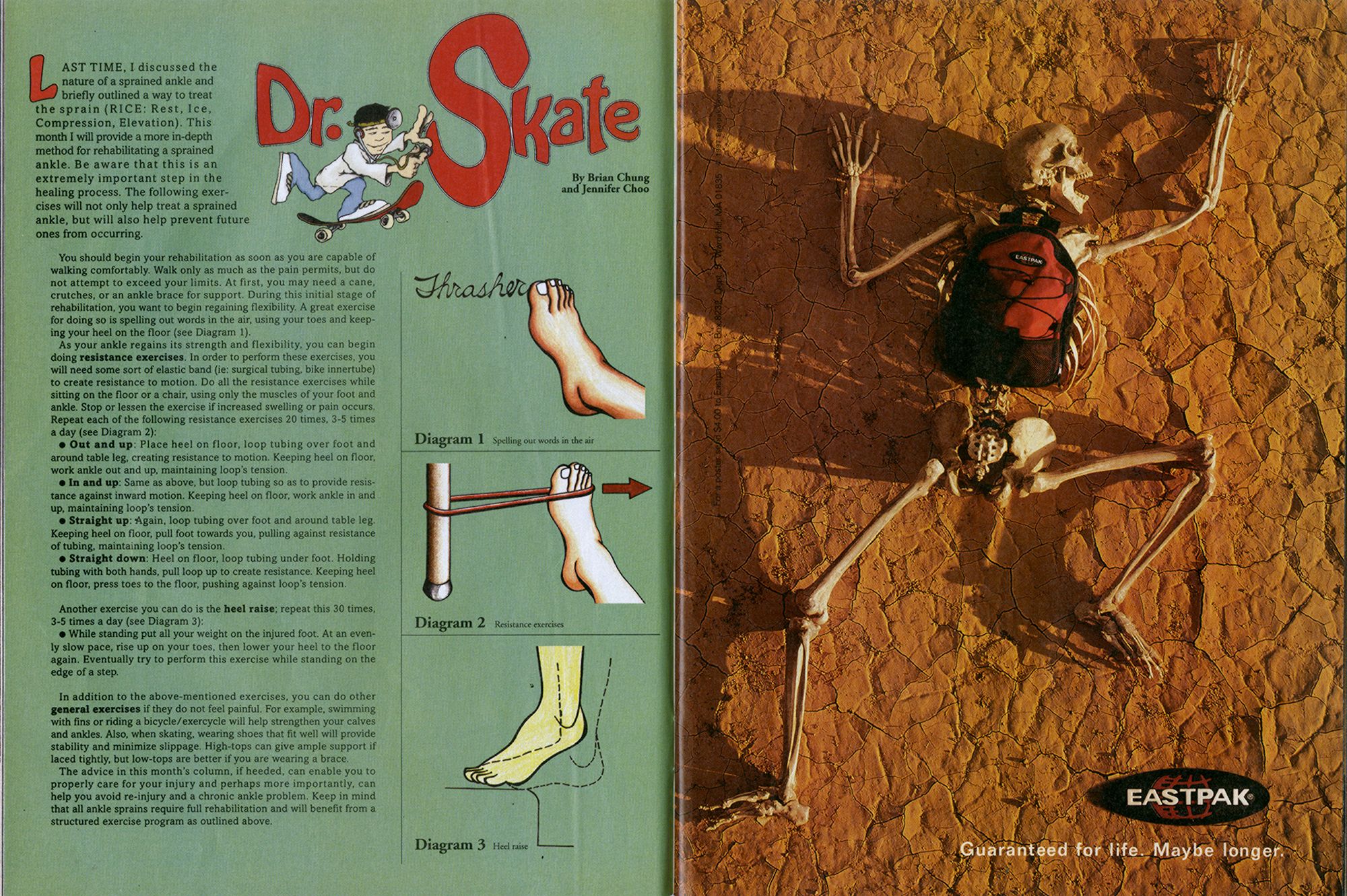
rehabilitation, you want to begin regaining flexibility. A great exercise
for doing so is spelling out words in the air, using your toes and keep-
ing your heel on the floor (see Diagram 1).
As your ankle regains its strength and flexibility, you can begin
doing resistance exercises. In order to perform these exercises, you
will need some sort of elastic band (ie: surgical tubing, bike innertube)
to create resistance to motion. Do all the resistance exercises while
sitting on the floor or a chair, using only the muscles of your foot and
ankle. Stop or lessen the exercise if increased swelling or pain occurs.
Repeat each of the following resistance exercises 20 times, 3-5 times
a day (see Diagram 2):
Out and up: Place heel on floor, loop tubing over foot and
around table leg, creating resistance to motion. Keeping heel on floor,
work ankle out and up, maintaining loop's tension.
In and up: Same as above, but loop tubing so as to provide resis-
tance against inward motion. Keeping heel on floor, work ankle in and
up, maintaining loop's tension.
●Straight up: Again, loop tubing over foot and around table leg.
Keeping heel on floor, pull foot towards you, pulling against resistance
of tubing, maintaining loop's tension.
Straight down: Heel on floor, loop tubing under foot. Holding
tubing with both hands, pull loop up to create resistance. Keeping heel
on floor, press toes to the floor, pushing against loop's tension.
Another exercise you can do is the heel raise; repeat this 30 times,
3-5 times a day (see Diagram 3):
● While standing put all your weight on the injured foot. At an even-
ly slow pace, rise up on your toes, then lower your heel to the floor
again. Eventually try to perform this exercise while standing on the
edge of a step.
In addition to the above-mentioned exercises, you can do other
general exercises if they do not feel painful. For example, swimming
with fins or riding a bicycle/exercycle will help strengthen your calves
and ankles. Also, when skating, wearing shoes that fit well will provide
stability and minimize slippage. High-tops can give ample support if
laced tightly, but low-tops are better if you are wearing a brace.
The advice in this month's column, if heeded, can enable you to
properly care for your injury and perhaps more importantly, can
help you avoid re-injury and a chronic ankle problem. Keep in mind
that all ankle sprains require full rehabilitation and will benefit from a
structured exercise program as outlined above.
Kafe
Thrasher
By Brian Chung
and Jennifer Choo
Diagram 1 Spelling out words in the air
Diagram 2 Resistance exercises
EASTPAK
EASTPAK
Diagram 3 Heel raise
Guaranteed for life. Maybe longer.