Page Text
            Der Skate
Allow me to introduce myself and some of my
objectives. My name is Brian Moonkyong Chung, and
I am currently an undergraduate senior at UC
Berkeley. I look forward to receiving my Bachelor of
Science degree in Psychology at the end of this
semester, after which I plan to pursue an education in
sports medicine. I have also been skateboarding for
the past twelve years. During this time. I have injured
myself on numerous occasions. Unfortunately, since
during most of these years I did not possess medical
insurance, obtaining proper medical advice was
expensive. Assuming that most of Thrasher's patrons
are skateboarders, who therefore share and suffer
similar injuries, I think that the medical advice I give
will be helpful and convenient.
My purpose in writing this article is dual. First, I
intend to educate people about the human body and
how it functions. I specifically plan to discuss the
physiological aspects of skateboarding, as well as
the nature of skateboard-related injuries. Secondly, as
I have previously mentioned, I will provide the read-
er with medical advice that is both free and useful. To
the best of my knowledge, I will present validated
information about the prevention, treatment, and
rehabilitation of skateboard injuries. Ultimately. I
hope my articles will succeed in enriching your skate-
boarding experience.
Now that I have introduced myself and my objec
tives, let's move on to this month's topic, ankle
sprains. Sprains are injuries that usually occur at
joints, and within these joints, there are fibrous bands
of connective tissue that join bones to bones or bones
to cartilage. These bands of connective tissue are
ligaments, which serve to provide support and
strength to joints. However, the amount of support
that ligaments can provide is limited; thus, when the
limit is surpassed, a sprain results. Therefore, a
sprained ankle can be defined as an injury that occurs
when too much force is exerted on the ankle joint and
results in the tearing/rupturing of the ligament(s).
In skateboarding, this type of injury can happen
in one of various ways. For example, you could be
trying a kickflip or just a simple ollie, and you might
slide your front foot too far up on your board. When
you land, your foot folds under the nose of the board,
and you sprain your ankle. First, you may feel a "pop"
at the ankle (refer to diagram 1). In the past, when I
have sprained my ankle, I could here the "pop." It
sounds similar to opening a bottle of Snapple.
Immediately, you feel pain, and you will probably
fibula
(outer bone of l
posterior
talofibular ligament
cakanofibular
notice that bearing weight on
the injured ankle is more diffi-
cult. Shortly afterwards, you will
notice swelling and bruising. An
ankle sprain occurring with the foot invert-
ed, as described previously, is referred to as a
lateral sprain (meaning your foot is turned
too far inward or towards the midline of your
body). Other types of ankle sprains include medi-
cal and syndesmosis sprains, both of which are not as
common as lateral sprains
Since lateral sprains are the most common, our
discussion will focus on this type of sprain. Up to
three ligaments can be damaged in a lateral sprain.
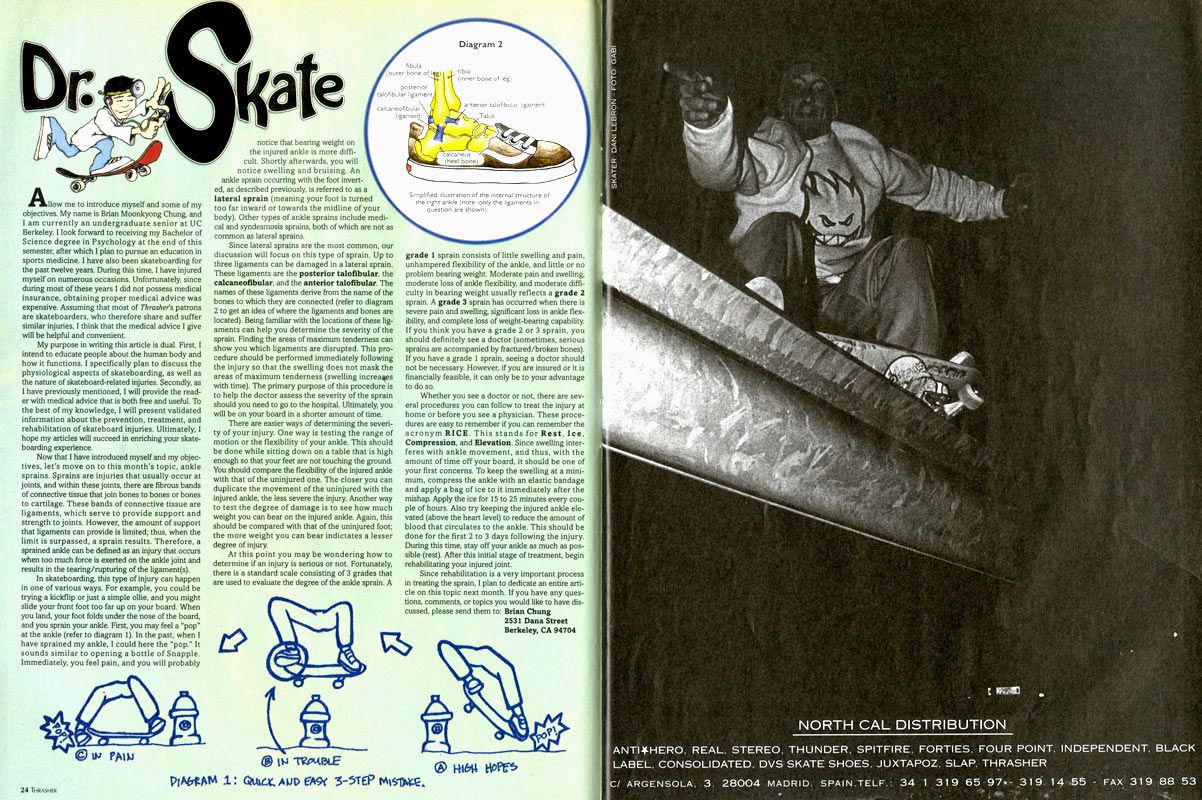
These ligaments are the posterior talofibular, the
calcaneofibular, and the anterior talofibular. The
names of these ligaments derive from the name of the
bones to which they are connected (refer to diagram
2 to get an idea of where the ligaments and bones are
located). Being familiar with the locations of these lig-
aments can help you determine the severity of the
sprain. Finding the areas of maximum tenderness can
show you which ligaments are disrupted. This pro-
cedure should be performed immediately following
the injury so that the swelling does not mask the
areas of maximum tenderness (swelling increases
with time). The primary purpose of this procedure is
to help the doctor assess the severity of the sprain
should you need to go to the hospital. Ultimately, you
will be on your board in a shorter amount of time.
ty of your injury. One way is testing the range of
There are easier ways of determining the severi-
motion or the flexibility of your ankle. This should
enough so that your feet are not touching the ground.
be done while sitting down on a table that is high
You should compare the flexibility of the injured ankle
with that of the uninjured one. The closer you can
duplicate the movement of the uninjured with the
injured ankle, the less severe the injury. Another way
to test the degree of damage is to see how much
weight you can bear on the injured ankle. Again, this
should be compared with that of the uninjured foot;
the more weight you can bear indictates a lesser
degree of injury
At this point you may be wondering how to
determine if an injury is serious or not. Fortunately,
there is a standard scale consisting of 3 grades that
are used to evaluate the degree of the ankle sprain. A
Diagram 2
tba
(inner bone of leg)
anterior talofbulargament
calcaneus
theel bonej
Simplified lustration of the internal structure of
the right ankle (note only the igaments in
question are shown)
grade 1 sprain consists of little swelling and pain,
unhampered flexibility of the ankle, and little or no
problem bearing weight. Moderate pain and swelling
moderate loss of ankle flexibility, and moderate diffi
culty in bearing weight usually reflects a grade 2
sprain. A grade 3 sprain has occurred when there is
severe pain and swelling, significant loss in anide flex-
ibility, and complete loss of weight-bearing capability
If you think you have a grade 2 or 3 sprain, you
should definitely see a doctor (sometimes, serious
sprains are accompanied by fractured/broken bones).
If you have a grade 1 sprain, seeing a doctor should
not be necessary. However, if you are insured or it is
financially feasible, it can only be to your advantage
to do so
Whether you see a doctor or not, there are sev-
eral procedures you can follow to treat the injury at
home or before you see a physician. These proce-
dures are easy to remember if you can remember the
acronym RICE. This stands for Rest, Ice.
Compression, and Elevation. Since swelling inter-
feres with ankle movement, and thus, with the
amount of time off your board, it should be one of
your first concerns. To keep the swelling at a mini-
mum, compress the ankle with an elastic bandage
and apply a bag of ice to it immediately after the
mishap. Apply the ice for 15 to 25 minutes every cou-
ple of hours. Also try keeping the injured ankle ele-
vated (above the heart level) to reduce the amount of
blood that circulates to the ankle. This should be
done for the first 2 to 3 days following the injury.
During this time, stay off your ankle as much as pos-
sible (rest). After this initial stage of treatment, begin
rehabilitating your injured joint
Since rehabilitation is a very important process
in treating the sprain, I plan to dedicate an entire arti-
cle on this topic next month. If you have any ques-
tions, comments, or topics you would like to have dis-
cussed, please send them to: Brian Chung
2531 Dana Street
Berkeley, CA 94704
24 THRASHER
IN PAIN
D
IN TROUBLE
DIAGRAM 1: QUICK AND EASY 3-STEP MISTAKE.
POP!
HIGH HOPES
NORTH CAL DISTRIBUTION
ANTI HERO. REAL. STEREO, THUNDER, SPITFIRE, FORTIES, FOUR POINT, INDEPENDENT, BLACK
LABEL, CONSOLIDATED. DVS SKATE SHOES, JUXTAPOZ, SLAP, THRASHER
C/ ARGENSOLA, 3. 28004 MADRID, SPAIN. TELF.: 34 1 319 65 97 319 14 55 FAX 319 88 53