Page Text
            the AVALANCHE MAN
Living in a yurt on the top of the noto-
rious Devil's Peak in Alaska is an
intrepid meteorologist named Sam
Skinner. Through a series of unfortu-
nate circumstances, this man has
become the world's first and only pro-
fessional avalanche surfer. We caught
up with him at the Grizzly Moose tavern
in downtown Juneau for a couple of
lagers and an informal interview.
Tell us about your job.
Well, by profession, I'm a meterologist. I
man one of NMS's remote altitude stations on
a year round basis. Basically, I collect
information from the equipment I man
and bounce it via satellite back to
Anchorage. The station is located
at 10,000 ft on the backside of
Devil's Peak, so, as you can
imagine, I'm pretty much in
the middle of nowhere..
How did you get start-
ed snowboarding?
That's an interesting
story. Used to be that a
'copter would come get
me on a weekly basis.
Then, in the 80's, the
secretary of the interior,
James Watt, slashed the
NMS budget. No more
heli rides back to town.
They sent me an old Burton
Backhill and told me to use it
instead. At first I didn't know
what it was, so I thought I was
going to be trapped until spring.
So, you're telling me you learned to snow-
board on the steepest, most exposed moun-
tain in North America?
Unfortunately, yes. I had some pretty scary
moments at the beginning. Thank God for that
rope sticking out of the nose of the board.
Without that thing I would have been fucked. I
survived, though.
How did you become the Avalanche Man?
By accident, really. I was cruising down i
Beelzebub's Gullet, a chute on the west face
when a giant slab at least ten feet thick and one
hundred feet wide came sliding down after me.
I heard the deep "Craaack" sound, turned my
head and saw all hell breaking loose. I just
pointed it and the rest is history.
I understand you have developed some spe-
cial techniques to get a slide going.
Yeah, a friend of mine is a ski patroller and
he's showed me all sorts of ways to get a good
slide going. The easiest is cutting the slope
when you drop in, but that only works after a
I'd think that would scare you out of living big snowfall, so you're at the mercy of the ele
on the mountain.
No, it's wierd. That was the most intense
moment of my life. I experienced a sort of
epiphany and deciced that nothing in life could
come as close to the feeling that I experienced
at that moment. All the slides I've
surfed since have been an attempt to recap-
ture it. To me, avalanche surfing is the purest,
most soulful form of self-expression available
to man. Think about it, you become one with
the energy of the mountain, harnessing the
power of kinetic energy iselt, to guide you to
safety. A good avalanche rider flows with the
slide rather than fighting it.
ments. The best way is to use dynamite. You
charge off the cornice with the fuse burning.
throw it in mid-air, and, if you're lucky, land in a
good slide. My ski patroller buddy hooks me
up with the dynamite. I've got a friend in the
army and he's going to get me some C-4.1
want to set up a slalom course down the
mountain with the C-4 as gates which I'd
detonate via remote on the way down.
How did you go Pro?
My friend Bob suggested
that I enter this contest
called the X-treme
Challenge held in
Colorado each year. I
didn't think I'd be
good enough, but I
gave it a whirl.
Since I was an
unknown, I had to
go last. I dropped in
tossing five sticks
of dynamite and set
off the biggest slide
ever seen in the lower
48. Everyone watching
from the base got
buried, judges included,
so I never got scored, but I
think it was perhaps the most
technically challenging run ever
attempted. One of the survivors was
a rep for a board company called
Detonator and he hooked me up on the
spot. I've been pro ever since, but I'm banned
from competition which is unfair.
Any last words?
Yes. I think this is the sport of the future. I
strongly recommend trying it when the oppor-
tunity arises. Head to the backcountry and let it
slide. Until you've been covered up by a class
4 avalanche, you haven't snowboarded.
-Robin Steele
110 THR
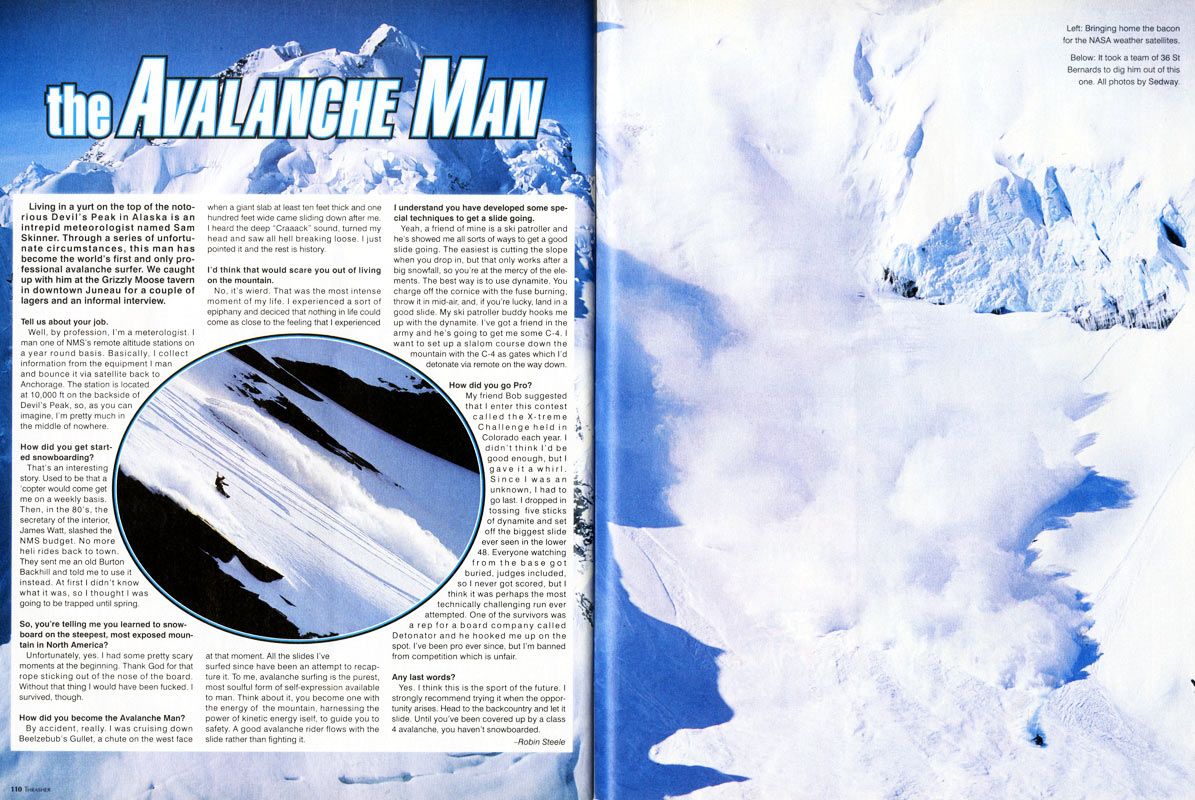
Left: Bringing home the bacon
for the NASA weather satellites.
Below: It took a team of 36 St
Bernards to dig him out of this
one. All photos by Sedway.