Page Text
            CAB
INTERVIEW BY BRYCE KANIGHTS
PACING HIMSELF THROUGH THREE
decades of skateboarding,
Steve Caballero has won con-
tests in the 70s, 80s and 90s.
Excelling in the areas of park,
vert, mini and street, Cab has
proven himself adaptable to
the changing sands of time.
JIMMY'Z
SHOP
How long have you been skating?
Since about 1978, eighteen years. I first
got sponsored in 1979 by Campbell Skate-
park. My first sponsor was a park, and my
very first board sponsor was Powell-Peralta,
and I've stayed with them ever since 1979.
Why do you think that is?
I don't know, I've always been satisfied
with riding for Powell. There's been a few
disagreements here and there, but that was
only because I was young and I was trying
to make choices that I thought were right.
I almost quit two times. One time I wanted
to start my own company, and George and
Stacy were just, "No, it's not right."
Why didn't you?
Well, the only reason why is because I
love competition, and I knew that if I start-
ed my own company, I would have to quit
skating, because if I wanted to succeed, I'd
put all my effort into the company and not
be a pro rider, because if you're doing that.
then someone else's running your company.
you're not, because there's just no way. So,
it could be a fake company, and I didn't
want a fake company. If I'm going to have a
company, I want it to be my own company
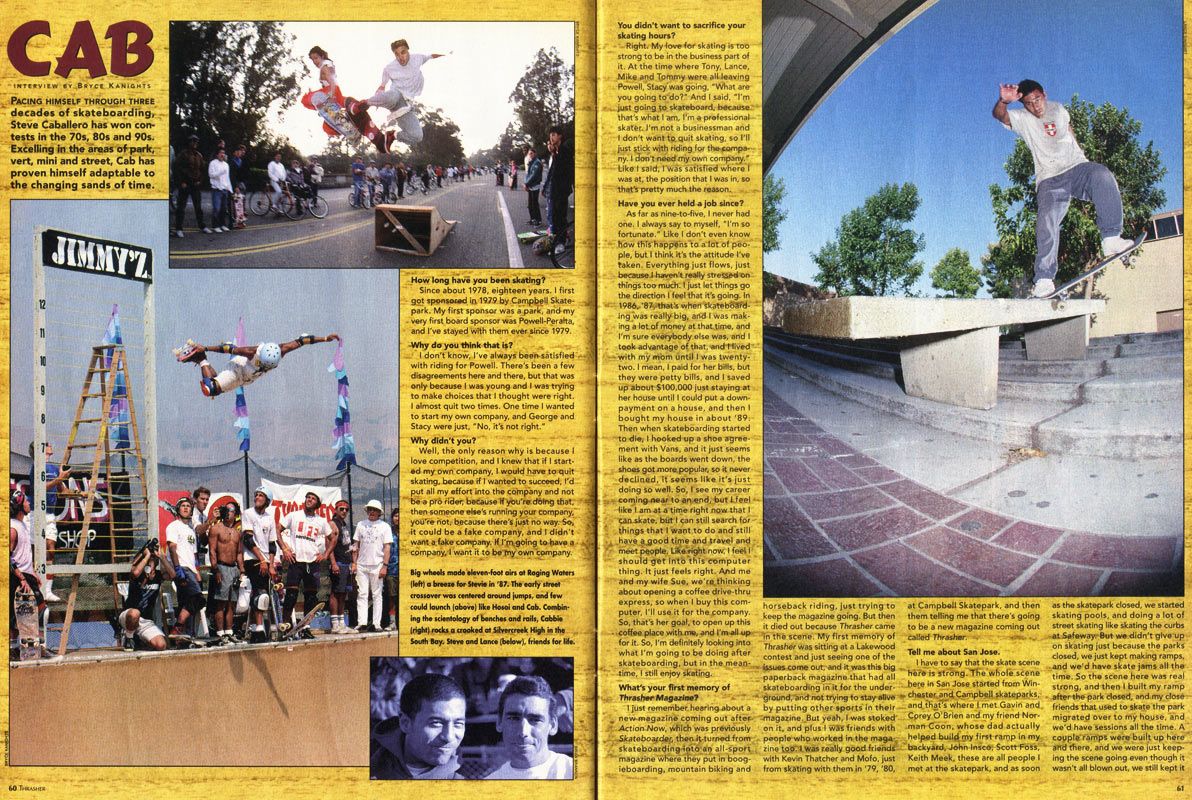
Big wheels made eleven-foot airs at Raging Waters
(left) a breeze for Stevie in '87. The early street
crossover was centered around jumps, and few
could launch (above) like Hosoi and Cab. Combin-
ing the scientology of benches and rails, Cabbie
(right) rocks a crooked at Silvercreek High in the
South Bay. Steve and Lance (below), friends for life.
You didn't want to sacrifice your
skating hours?
Right. My love for skating is too
strong to be in the business part of
it. At the time where Tony, Lance,
Mike and Tommy were all leaving
Powell, Stacy was going. "What are
you going to do?" And I said, "I'm
just going to skateboard, because
that's what I am, I'm a professional
skater. I'm not a businessman and
I don't want to quit skating, so I'll
just stick with riding for the compa
ny. I don't need my own company.
Like I said, I was satisfied where
was at, the position that I was in, so
that's pretty much the reason...
Have you ever held a job since?
As far as nine-to-five, I never had.
one. I always say to myself, "I'm so
fortunate. Like I don't even know
how this happens to a lot of peo
ple, but I think it's the attitude I've
taken. Everything just flows, just
because I haven't really stressed on
things too much just let things go
the direction I feel that it's going. In
1986, 87, that's when skateboard-
ing was really big, arid I was mak-
ing a lot of money at that time, and
I'm sure everybody else was, and I
took advantage of that, and lived
with my mom until I was twenty-
two. I mean, I paid for her bills, but
they were petty bills, and I saved
up about $100,000 just staying at
her house until I could put a down-
payment on a house, and then I
bought my house in about '89-
Then when skateboarding started
to die, I hooked up a shoe agree
ment with Vans, and it just seems
like as the boards went down, the
shoes got more popular, so it never
declined, It seems like it's just
doing so well. So, I see my career
coming near to an end, but Lfeel.
like Lam at a time right now that I
can skate, but I can still search for
things that I want to do and still
have a good time and travel and
meet people, Like right now, I feel
should get into this computer
thing. It just feels right. And me
and my wife Sue, we're thinking
about opening a coffee drive-thru
express, so when I buy this com-
puter, I'll use it for the company.
So, that's her goal, to open up this
coffee place with me, and I'm all up
for it. So, I'm definitely looking into
what I'm going to be doing after
skateboarding, but in the mean-
time, I still enjoy skating.
What's your first memory of
Thrasher Magazine?
Tjust remember hearing about a
new magazine coming out after
Action Now, which was previously
Skateboarder, then it turned from
skateboarding into an all-sport
magazine where they put in boog-
ieboarding, mountain biking and
horseback riding, just trying to
keep the magazine going. But then
it died out because Thrasher came
in the scene. My first memory of
Thrasher was sitting at a Lakewood
contest and just seeing one of the
issues come out, and it was this big
paperback magazine that had all
skateboarding in it for the under
ground, and not trying to stay alive
by putting other sports in their
magazine. But yeah, I was stoked
on it, and plus I was friends with
people who worked in the maga
zine tool was really good friends
with Kevin Thatcher and Mofo, just
from skating with them in '79, '80,
at Campbell Skatepark, and then
them telling me that there's going
to be a new magazine coming out
called Thrasher
Tell me about San Jose.
I have to say that the skate scene
here is strong. The whole scene
bere in San Jose started from Win-
chester and Campbell skateparks,
and that's where In
Imet Gavin and
Corey O'Brien and my friend Nor
man Coon, whose dad actually
helped build my first ramp in my
backyard, John Insco; Scott Foss,
Keith Meek, these are all people I
met at the skatepark, and as soon
as the skatepark closed, we started
skating pools, and doing a lot of
street skating like skating the curbs
at Safeway But we didn't give up
on skating just because the parks
closed, we just kept making ramps,
and we'd have skate jams all the
time. So the scene here was real
strong, and then I built my ramp
after the park closed, and my close
friends that used to skate the park
migrated over to my house, and
we'd have sessions all the time. A
couple ramps were built up here
and there, and we were just keep
ing the scene going even though it
wasn't all blown out, we still kept it
60 THR