Page Text
            That day my life turned a corner. I was formally on
Powell-Peralta. My father said he would let me continue
because magazines started to call, and companies were
putting money into me. Suddenly I was somebody.
Things started to blur after a while. I won contest
after contest-around 35 or 40 of them. But every
time I won, I developed a bigger fear of losing. People
would make jokes about how easy if must have been for
me to win. My father would chuckle and tell me not to
bother coming home if I ever lost. They'd all laugh, and
I'd cringe. Judges would tell me how bored everyone
was because they never saw anyone beat me; one told
me he was waiting for that one slip, so he could give
someone else a chance. My fear grew until I'd go out
and just do enough to make sure no one else would top
my run. No more, no less. It was like I had a big empty
castle that I could never actually live in because I had to
stand out front and guard. Not only had the sensation
of winning gone but the whole thing tasted sour. After
every contest, people came up to shake my hand and
pat me on the back, and I felt like a fraud. Those rich
guys who get to the top, then blow themselves away...
I know that feeling. By that time, I was 16 or 17. I fun-
neled all my energy for so long into one goal, had gotten there, and was
bummed. I was at odds with my family for the sport I had chosen. Since I
had gotten some fame, I started to struggle with the realization that peo-
ple whom I had never met expected things from me. That somehow I
wasn't "one of them" anymore. The girls I met were more interested in
what it was like to be in magazines than anything else. It was like being
caught in some expensive trap that I had paid for, and I couldn't get out.
My first goal was to win a contest. I got that. Then I wanted to see my
name on a sticker, a shirt, a board... I got all of that. Each time I thought I
got somewhere else, I realized I hadn't gone anywhere. I finally decided my
goal was to dominate freestyle for a complete decade. The very word
"decade" seemed awesome. Finally, I remember walking around after my
last contest in San Francisco, dazed. Ten years of domination! The Mullen.
decade! Still, nothing. Nothing happened. Nobody cared but Barry, so I
took him to dinner. That's about all there was to it. I threw or gave away
almost every trophy they handed me. That was the point when I was about
to give it all up-the public side of my skating. I mean. That was in '91 or
92. Then Mike Ternasky came into the picture.
Before I get into the present, there is another time worth mentioning.
Again, in winter '83 or '84, my father told me my skating would end when
school started. Time to grow up and go to college... I remember telling
that to Stacy. Things seemed hopeless. Then I lost the only pro contest of
my career that spring. I was going to go out a loser. That woke me up.
When the Del Mar finals came in August, everybody seemed to know it
RNIA PL
CALIFORNIA
CALIFORN
50 CALIF
IA PLAZ
50 CALIFA PLAZA
CALIFON LAZA
ALIFORNIA
was my last contest. The magazines
printed it as my retirement. I remem-
ber making it through the last few
tricks of my final run, knowing I was
going to win. Usually I would kind of
black-out during contests. Once I
remember having to ask someone how
my run went when I walked off the
course. But this time I just wanted to
remember, I guess. So when it was all
over, I went home and put everything
from that trip into a shoe box. Weeks
passed. Every now and then I'd stand.
on a board and try something. I was
losing it. I was watching myself decay.
I guess my father was watching me
decay, too. I don't know exactly what
made him change his mind. I think
Fausto helped. But my father finally
told me I was allowed to skate again,
and a year later I could compete. That
whole ordeal taught me a lot. My skat-
ing was everything to me, and when it
was taken away, I collapsed. Like these
old married couples: when one dies
the other soon follows. I always hated
those rotten old men who got drunk
and bored their wives about what
heroes they were back in the good old
days. The truth was that there never
were any good old days; they had
never done anything with their lives. But I was wrong. That sense of accom
plishment you get whenever you push your limits is sort of a universal crav
ing... The existential needs fulfilled by climbing the rungs of progression are
the same for everyone, no matter how talented you may be or how presti-
gious your sport. You don't have to be Tyson to feel like a champion. But
Tyson may not feel like a winner, even when everyone else thinks he is;
only he knows. Nobody can give you that feeling. You have to earn it.
Skating blew up from around '86 to '91. I felt like a rock star during
those times. I had agents that got me contracts doing all kinds of stuff. I flew
on the Concorde. I rode in limos and had to be "protected" by security
guards. I did demos with Dr J and all kinds of athletes. I did Broadway shows
with dancers and spotlights. I skated on stage with rock stars and comedi-
ans and runway models. I was in movies, music videos, and on talk shows. I
did a lot. Those were fun years. But sometimes money and fame are the
hardest tests of what people really are. It's easy to lose touch with yourself.
A couple of my friends got lost in that fame. I got to be just famous enough
to realize that anonymity is priceless in every sense.
Anyway, after winning my last San Francisco contest, I told myself that my
public skating career was over. I was tired. That's when Mike Ternasky
started coming around. Mike made a bet with Rocco that he could get me
into skating street-just like Trading Places. So Mike talked me into riding
for Plan B when I was at a point where I didn't feel part of anything any-
more. He pushed me like no one really had since my friend Barry, and he did
it at a time when I needed it most. Questionable was the first attempt at
"street skating" I really made. I kept getting in trouble with him because I
would put the plastic skid plates back on my board to make me feel at
home again. Mike was one of the most giving people I've ever met. To me
he was an example of someone who really found God.
Like I said, I'm Linus: my skating is still right here. I'm not at all what I once
was. It's humbling where I am today. Old dogs, new tricks... But I'm happy.
and I like where I am. I have a lot of real friends in skateboarding. I have
good memories. And I still enjoy skating. I don't know how long this will last.
I am definitely aging. Everyone wonders what they'll be like when they get
older. Every now and then, I get visions of being this pigeon-toed old man
with a pack of pens in his chest pocket-some kind of scientist, I imagine.
One day I want to become a physicist or an inventor, I suppose. That could
be inside me, too. But for now, I'll just keep going as long as I can.
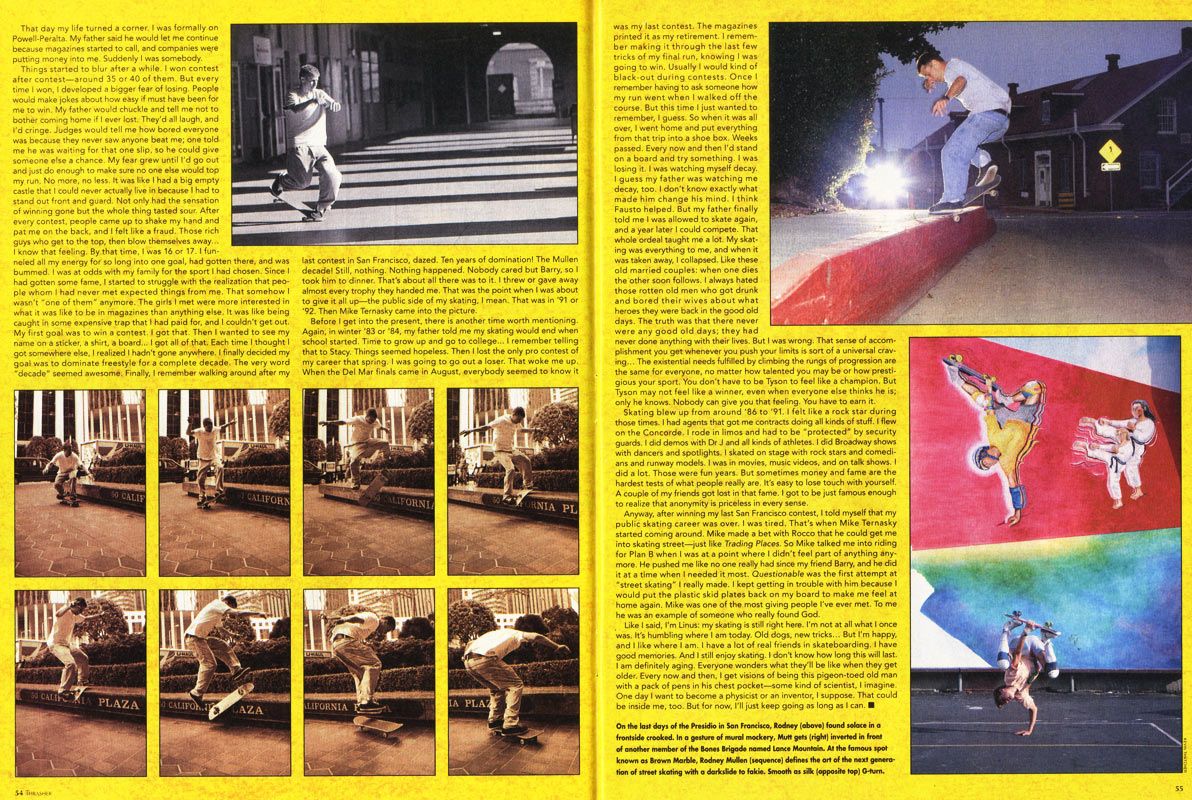
On the last days of the Presidio in San Francisco, Rodney (above) found solace in a
frontside crooked. In a gesture of mural mockery, Mutt gets (right) inverted in front
of another member of the Bones Brigade named Lance Mountain. At the famous spot
known as Brown Marble, Rodney Mullen (sequence) defines the art of the next genera
tion of street skating with a darkslide to fakie. Smooth as silk (opposite top) G-turn.
T
**
54 THE