Page Text
            Dog
tails
from the Alva Chronicles
My lifestyle revolves around skateboarding.
Without it. I would not have enjoyed my time
on this planet as much as I have. I've lived to
see many good and bad days in the three
decades since I started skateboarding. Some
of my finest memories come directly from
being focused on surfing and skateboarding.
At the end of the sixties, the sidewalk surf.
ing craze was at the peak of its popularity. My
dreams were being filled with the subliminal
draw of the wave-like drops on the schoolyard
banks of Revere and Bellagio. I occasionally
got to see Super-8 footage of my heroes on
the competition teams, riding the banks in
striped T-shirts and baggies. No shoes in the
true surf tradition was the norm. My friends
John Davison, Ted Deerhurst, and I finally
decided to ride our bikes to Revere and check
out the sessions we had heard so much about.
Sure enough, when we arrived the banks
looked ominous, their smooth, black asphalt in
pristine form. This was at a rare time (about
'69-70), when the schoolyards were relatively
new, and kept in excellent condition. The
banks were ten to fifteen feet and glassy all
year round. Not only did the main yard have
two killer bowl angle banks, but the internal
area also provided an array of excellent combo
courses. Basically it was a skater's paradise,
the first real skatepark.
In the beginning, there was no one around
for us to watch or learn any lines from Our
boards and trucks, not to mention loose ball
bearing tires, constantly had to be fine-tuned
in order to ride. That's why we always rode
bikes with the boards on the handlebars. You
never knew when your board would disinte
grate underneath your feet.
We gradually started to frequent the banks
and develop our own style. We were emulat
ing all of our heroes from the surfing mags
Wayne Lynch, Nat Young end Midget Farrely
were my Aussie idols and I proceeded to do
my best at carving and slashing the short
board style of the sixties all over the banks.
Similar to surfing though, the drop came
first. You had to push along a foot-wide rim
at the top and then cut a steep angle straight
down, through an abrupt transition (about a
fifteen foot drop, or bigger in your mind when
you're twelve, then slingshot yourself across
the flat and up the next bank into whatever
high speed maneuver you could manage. As
time went on we gradually improved with suc
cessive experimentation, Most of our moves
involved high-speed footwork. Slide variations
and multiple 360's were also challenging
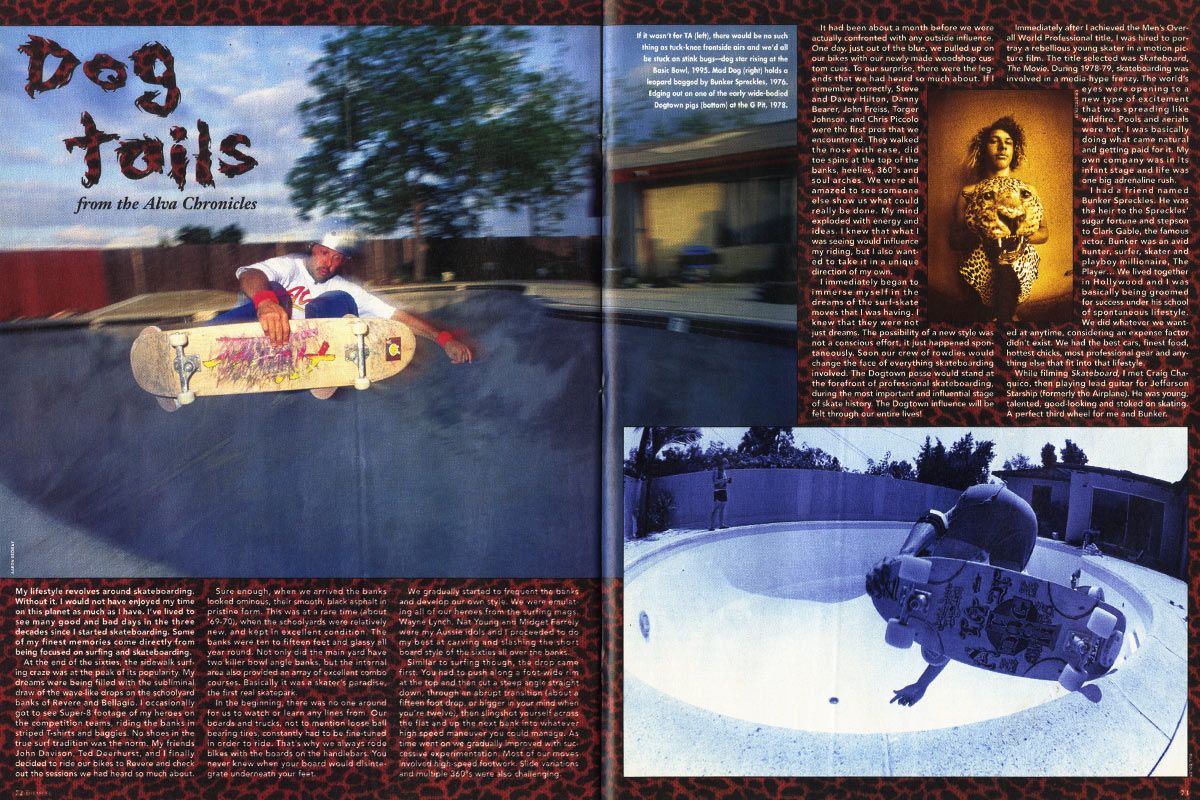
If it wasn't for TA (left), there would be no such
thing as tuck-knee frontside airs and we'd all
be stuck on stink bugs-dog ster rising at the
Basic Bowl, 1995. Mad Dog (right) holds a
leopard bagged by Bunker Spreckles, 1976.
Edging out on one of the early wide-bodied
Dogtown pigs (bottom) at the G Pit, 1978.
It had been about a month before we were
actually confronted with any outside influence.
One day, just out of the blue, we pulled up on
our bikes with our newly made woodshop cus
tom cues. To our surprise, there were the leg.
ends that we had heard so much about. If I
remember correctly, Steve
and Davey Hilton, Danny
Bearer, John Freiss, Torger
Johnson, and Chris Piccolo
were the first pros that we
encountered. They walked
the nose with ease, did
toe spins at the top of the
banks, heelies, 360's and
soul arches. We were all
amazed to see someone
else show us what could
really be done. My mind
exploded with energy and
ideas. I knew that what I
was seeing would influence
my riding, but I also want.
ed to take it in a unique
direction of my own.
I immediately began to
immerse myself in the
dreams of the surf-skate
moves that I was having. I
know that they were not
just dreams. The possibility of a new style was
not a conscious effort, it just happened spon-
taneously. Soon our crew of rowdies would
change the face of everything skateboarding
involved. The Dogtown posse would stand at
the forefront of professional skateboarding,
during the most important and influential stage
of skate history. The Dogtown influence will be
felt through our entire lives!
Immediately after I achieved the Men's Over-
all World Professional title, I was hired to por
tray a rebellious young skater in a motion pic
ture film. The title selected was Skateboard,
The Movie. During 1978-79, skateboarding was
involved in a media-hype frenzy. The world's
eyes were opening to a
new type of excitement
that was spreading like.
wildfire. Pools and aerials
were hot. I was basically
doing what came natural
and getting paid for it. My
own company was in its
infant stage and life was
one big adrenaline rush.
I had a friend named
Bunker Spreckles. He was
the heir to the Spreckles'
sugar fortune and stepson
to Clark Gable, the famous
actor. Bunker was an avid
hunter, surfer, skater and
playboy millionaire, The
Player... We lived together
in Hollywood and I was
basically being groomed
for success under his school
of spontaneous lifestyle.
We did whatever we want-
ed at anytime, considering an expense factor
didn't exist. We had the best cars, finest food,
hottest chicks, most professional gear and any.
thing else that fit into that lifestyle.
While filming Skateboard, I met Craig Cha-
quico, then playing lead guitar for Jefferson
Starship (formerly the Airplane). He was young.
talented, good-looking and stoked on skating.
A perfect third wheel for me and Bunker.