Page Text
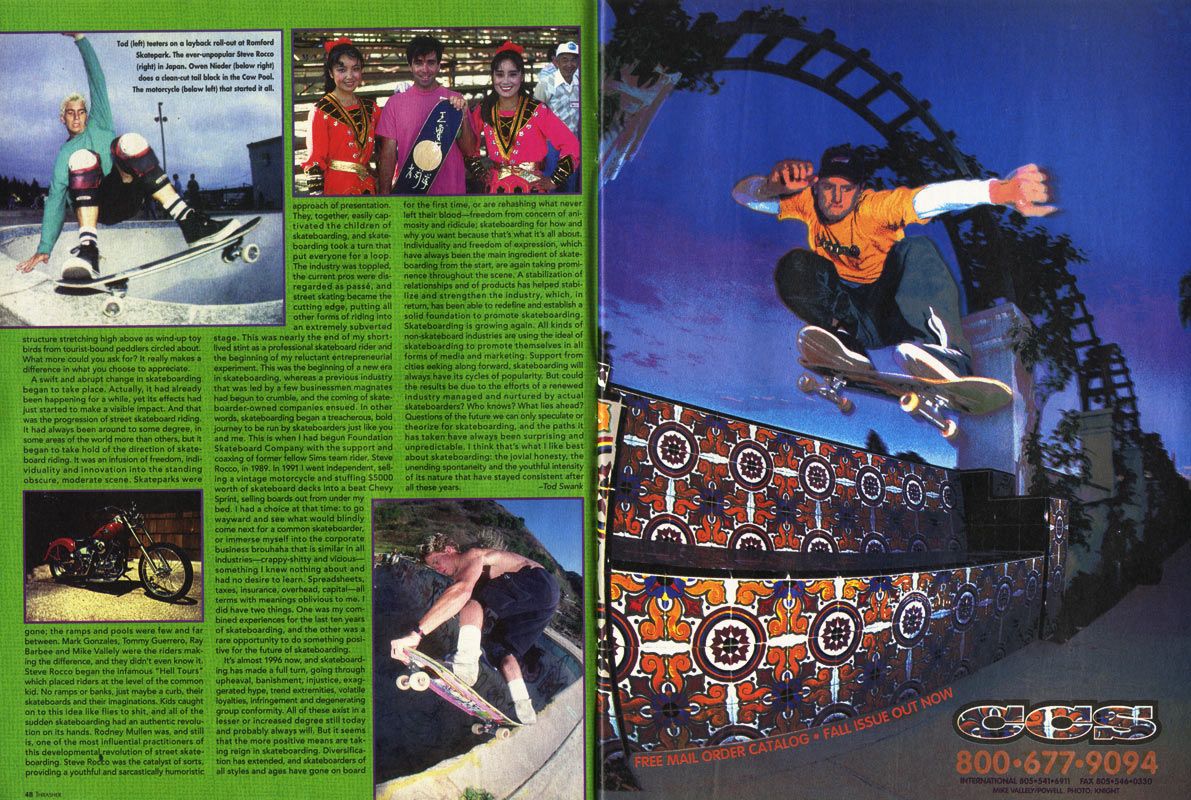
            Tod (left) teeters on a layback roll-out at Romford
Skatepark. The ever-unpopular Steve Rocco
(right) in Japan. Owen Nieder (below right)
does a clean-cut tail block in the Cow Pool.
The motorcycle (below left) that started it all.
structure stretching high above as wind-up toy
birds from tourist-bound peddlers circled about.
What more could you ask for? It really makes a
difference in what you choose to appreciate.
A swift and abrupt change in skateboarding
began to take place. Actually, it had already
been happening for a while, yet its effects had
just started to make a visible impact. And that
was the progression of street skateboard riding.
It had always been around to some degree, in
some areas of the world more than others, but it
began to take hold of the direction of skate-
board riding. It was an infusion of freedom, Indi-
viduality and innovation into the standing
obscure, moderate scene. Skateparks were
gone; the ramps and pools were few and far
between. Mark Gonzales, Tommy Guerrero, Ray
Barbee and Mike Vallely were the riders mak-
ing the difference, and they didn't even know it.
Steve Rocco began the infamous "Hell Tours"
which placed riders at the level of the common
kid. No ramps or banks, just maybe a curb, their
skateboards and their imaginations. Kids caught
on to this idea like flies to shit, and all of the
sudden skateboarding had an authentic revolu-
tion on its hands. Rodney Mullen was, and still
is, one of the most influential practitioners of
this developmental revolution of street skate-
boarding. Steve Rocco was the catalyst of sorts,
providing a youthful and sarcastically humoristic
48 HO
approach of presentation.
They, together, easily cap-
tivated the children of
skateboarding, and skate-
boarding took a turn that
put everyone for a loop.
The industry was toppled,
the current pros were dis-
regarded as passé, and
street skating became the
cutting edge, putting all
other forms of riding into
an extremely subverted
stage. This was nearly the end of my short.
lived stint as a professional skateboard rider and
the beginning of my reluctant entrepreneurial
experiment. This was the beginning of a new era
in skateboarding, whereas a previous industry
that was led by a few businessmen magnates
had begun to crumble, and the coming of skate
boarder-owned companies ensued. In other
words, skateboarding began a treacherous, bold
journey to be run by skateboarders just like you
and me. This is when I had begun Foundation
Skateboard Company with the support and
coaxing of former fellow Sims team rider, Steve
Rocco, in 1989. In 1991 I went independent, sell-
ing a vintage motorcycle and stuffing $5000
worth of skateboard decks into a beat Chevy
Sprint, selling boards out from under my
bed. I had a choice at that time: to go
wayward and see what would blindly
come next for a common skateboarder,
or immerse myself into the corporate
business brouhaha that is similar in all
Industries--crappy-shitty and vicious
something I knew nothing about and
had no desire to learn. Spreadsheets,
taxes, insurance, overhead, capital-all
terms with meanings oblivious to me. 1
did have two things. One was my com-
bined experiences for the last ten years
of skateboarding, and the other was a
rare opportunity to do something posi
tive for the future of skateboarding.
It's almost 1996 now, and skateboard-
ing has made a full turn, going through
upheaval, banishment, injustice, exag
gerated hype, trend extremities, volatile
loyalties, Infringement and degenerating
group conformity. All of these exist in a
lesser or increased degree still today
and probably always will, But it seems
that the more positive means are tak-
ing reign in skateboarding. Diversifica-
tion has extended, and skateboarders of
all styles and ages have gone on board
for the first time, or are rehashing what never
left their blood-freedom from concern of ani-
mosity and ridicule; skateboarding for how and
why you want because that's what it's all about.
Individuality and freedom of expression, which
have always been the main ingredient of skate-
boarding from the start, are again taking promi-
nence throughout the scene. A stabilization of
relationships and of products has helped stabi-
lize and strengthen the industry, which, in
return, has been able to redefine and establish a
solid foundation to promote skateboarding.
Skateboarding is growing again. All kinds of
non-skateboard industries are using the ideal of
skateboarding to promote themselves in all
forms of media and marketing. Support from
cities eeking along forward, skateboarding will
always have its cycles of popularity. But could-
the results be due to the efforts of a renewed
industry managed and nurtured by actual
skateboarders? Who knows? What lies ahead?
Questions of the future we can only speculate or
theorize for skateboarding, and the paths it
has taken have always been surprising and
unpredictable. I think that's what I like best
about skateboarding: the jovial honesty, the
unending spontaneity and the youthful intensity
of its nature that have stayed consistent after
all these years
-Tod Swank
0-0-0-
FREE MAIL ORDER CATALOG FALL ISSUE OUT NOW
B
800-677-9094
INTERNATIONAL B05-541-6911 FAX 805-546-0330
MORE VALLELY/POWELL. PHOTO, KONIGHT