Page Text
            Supersuckers
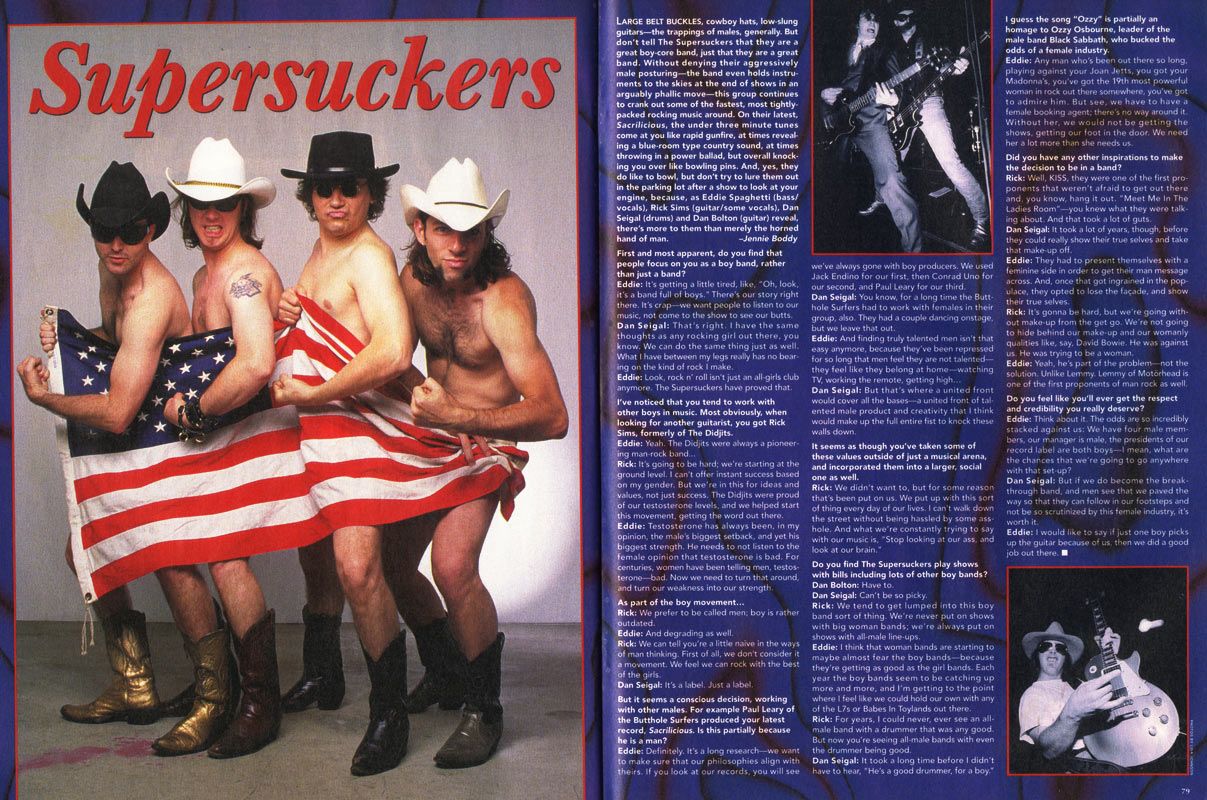
LARGE BELT BUCKLES, cowboy hats, low-slung
guitars-the trappings of males, generally. But
don't tell The Supersuckers that they are a
great boy-core band, just that they are a great
band. Without denying their aggressively
male posturing-the band even holds instru-
ments to the skies at the end of shows in an
arguably phallic move-this group continues
to crank out some of the fastest, most tightly-
packed rocking music around. On their latest,
Sacrilicious, the under three minute tunes
come at you like rapid gunfire, at times reveal-
ing a blue-room type country sound, at times
throwing in a power ballad, but overall knock-
ing you over like bowling pins. And, yes, they
do like to bowl, but don't try to lure them out
in the parking lot after a show to look at your
engine, because, as Eddie Spaghetti (bass/
vocals), Rick Sims (guitar/some vocals), Dan
Seigal (drums) and Dan Bolton (guitar) reveal,
there's more to them than merely the horned
hand of man.
-Jennie Boddy
First and most apparent, do you find that
people focus on you as a boy band, rather
than just a band?
Eddie: It's getting a little tired, like, "Oh, look,
it's a band full of boys." There's our story right
there. It's crap-we want people to listen to our
music, not come to the show to see our butts.
Dan Seigal: That's right. I have the same
thoughts as any rocking girl out there, you
know. We can do the same thing just as well.
What I have between my legs really has no bear-
ing on the kind of rock I make.
Eddie: Look, rock n' roll isn't just an all-girls club
anymore. The Supersuckers have proved that.
I've noticed that you tend to work with
other boys in music. Most obviously, when
looking for another guitarist, you got Rick
Sims, formerly of The Didjits.
Eddie: Yeah. The Didjits were always a pioneer-
ing man-rock band...
Rick: It's going to be hard; we're starting at the
ground level. I can't offer instant success based
on my gender. But we're in this for ideas and
values, not just success. The Didjits were proud
of our testosterone levels, and we helped start
this movement, getting the word out there.
Eddie: Testosterone has always been, in my
opinion, the male's biggest setback, and yet his
biggest strength. He needs to not listen to the
female opinion that testosterone is bad. For
centuries, women have been telling men, testos-
terone-bad. Now we need to turn that around,
and turn our weakness into our strength.
As part of the boy movement...
Rick: We prefer to be called men; boy is rather
outdated.
Eddie: And degrading as well.
Rick: We can tell you're a little naive in the ways
of man thinking. First of all, we don't consider it
a movement. We feel we can rock with the best
of the girls.
Dan Seigal: It's a label. Just a label.
But it seems a conscious decision, working
with other males. For example Paul Leary of
the Butthole Surfers produced your latest
record, Sacrilicious. Is this partially because
he is a man?
Eddie: Definitely. It's a long research--we want
to make sure that our philosophies align with
theirs. If you look at our records, you will see
we've always gone with boy producers. We used
Jack Endino for our first, then Conrad Uno for
our second, and Paul Leary for our third.
Dan Seigal: You know, for a long time the Butt-
hole Surfers had to work with females in their
group, also. They had a couple dancing onstage.
but we leave that out.
Eddie: And finding truly talented men isn't that
easy anymore, because they've been repressed
for so long that men feel they are not talented-
they feel like they belong at home-watching
TV, working the remote, getting high...
Dan Seigal: But that's where a united front
would cover all the bases-a united front of tal-
ented male product and creativity that I think
would make up the full entire fist to knock these
walls down.
It seems as though you've taken some of
these values outside of just a musical arena,
and incorporated them into a larger, social
one as well.
Rick: We didn't want to, but for some reason
that's been put on us. We put up with this sort
of thing every day of our lives. I can't walk down
the street without being hassled by some ass-
hole. And what we're constantly trying to say
with our music is, "Stop looking at our ass, and
look at our brain,"
Do you find The Supersuckers play shows
with bills including lots of other boy bands?
Dan Bolton: Have to.
Dan Seigal: Can't be so picky.
Rick: We tend to get lumped into this boy
band sort of thing. We're never put on shows
with big woman bands; we're always put on
shows with all-male line-ups.
Eddie: I think that woman bands are starting to
maybe almost fear the boy bands-because
they're getting as good as the girl bands. Each
year the boy bands seem to be catching up
more and more, and I'm getting to the point
where I feel like we could hold our own with any
of the L7s or Babes In Toylands out there.
Rick: For years, I could never, ever see an all-
male band with a drummer that was any good.
But now you're seeing all-male bands with even
the drummer being good.
Dan Seigal: It took a long time before I didn't
have to hear, "He's a good drummer, for a boy."
I guess the song "Ozzy" is partially an
homage to Ozzy Osbourne, leader of the
male band Black Sabbath, who bucked the
odds of a female industry.
Eddie: Any man who's been out there so long.
playing against your Joan Jetts, you got your
Madonna's, you've got the 19th most powerful
woman in rock out there somewhere, you've got
to admire him. But see, we have to have a
female booking agent; there's no way around it.
Without her, we would not be getting the
shows, getting our foot in the door. We need
her a lot more than she needs us.
Did you have any other inspirations to make
the decision to be in a band?
Rick: Well, KISS, they were one of the first pro-
ponents that weren't afraid to get out there
and, you know, hang it out. "Meet Me In The
Ladies Room"-you knew what they were talk-
ing about. And that took a lot of guts.
Dan Seigal: It took a lot of years, though, before.
they could really show their true selves and take
that make-up off.
Eddie: They had to present themselves with a
feminine side in order to get their man message
across. And, once that got ingrained in the pop-
ulace, they opted to lose the façade, and show
their true selves.
Rick: It's gonna be hard, but we're going with-
out make-up from the get go. We're not going
to hide behind our make-up and our womanly
qualities like, say, David Bowie. He was against
us. He was trying to be a woman.
Eddie: Yeah, he's part of the problem-not the
solution. Unlike Lemmy. Lemmy of Motörhead is
one of the first proponents of man rock as well.
Do you feel like you'll ever get the respect
and credibility you really deserve?
Eddie: Think about it. The odds are so incredibly
stacked against us: We have four male mem-
bers, our manager is male, the presidents of our
record label are both boys-I mean, what are
the chances that we're going to go anywhere.
with that set-up?
Dan Seigal: But if we do become the break-
through band, and men see that we paved the
way so that they can follow in our footsteps and
not be so scrutinized by this female industry, it's
worth it.
Eddie: I would like to say if just one boy picks
up the guitar because of us, then we did a good
job out there.
79