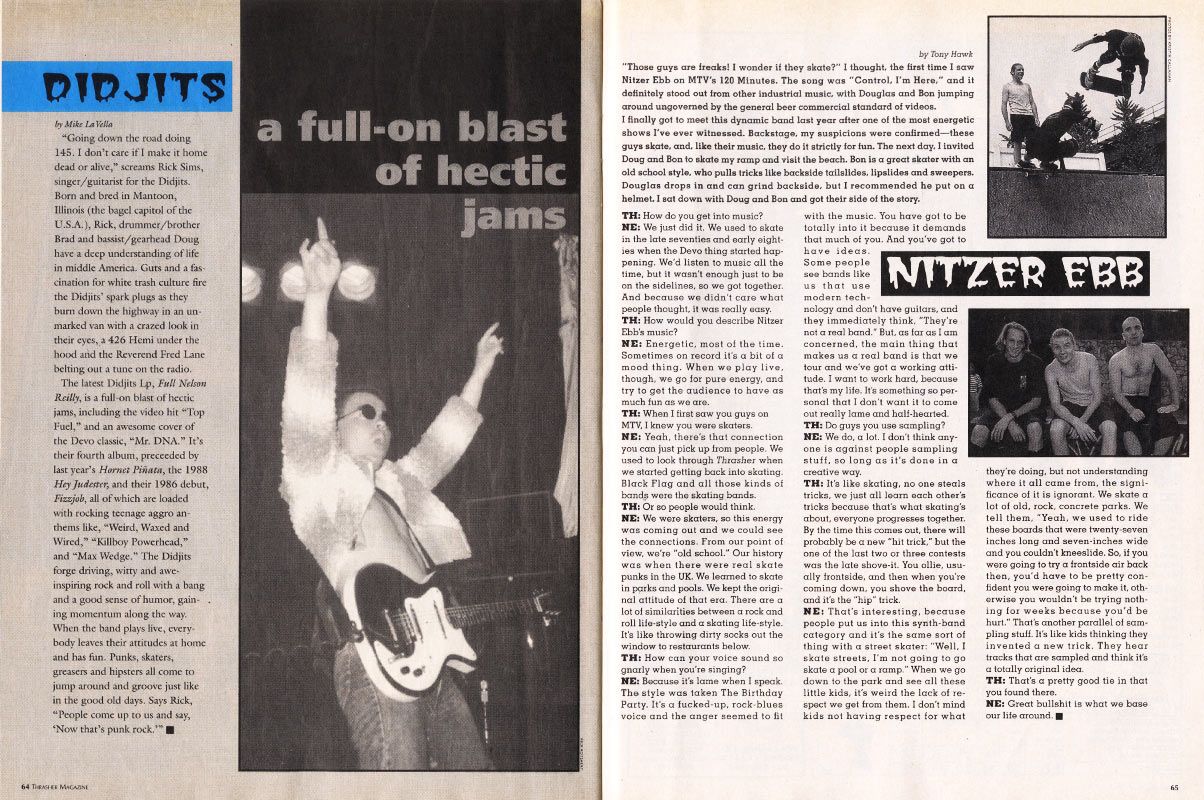
Page Text
            DIDJITS
by Mike La Vella
"Going down the road doing
145. I don't care if I make it home
dead or alive," screams Rick Sims,
singer/guitarist for the Didjits.
Born and bred in Mantoon,
Illinois (the bagel capitol of the
U.S.A.), Rick, drummer/brother
Brad and bassist/gearhead Doug
have a deep understanding of life
in middle America. Guts and a fas-
cination for white trash culture fire
the Didjits' spark plugs as they
burn down the highway in an un-
marked van with a crazed look in
their eyes, a 426 Hemi under the
hood and the Reverend Fred Lane
belting out a tune on the radio.
The latest Didjits Lp, Full Nelson
Reilly, is a full-on blast of hectic
jams, including the video hit "Top
Fuel," and an awesome cover of
the Devo classic, "Mr. DNA." It's
their fourth album, preceeded by
last year's Hornet Piñata, the 1988
Hey Judester, and their 1986 debut,
Fizzjob, all of which are loaded
with rocking teenage aggro an-
thems like, "Weird, Waxed and
Wired," "Killboy Powerhead,"
and "Max Wedge." The Didjits
forge driving, witty and awe-
inspiring rock and roll with a bang
and a good sense of humor, gain-
ing momentum along the way.
When the band plays live, every-
body leaves their attitudes at home
and has fun. Punks, skaters,
greasers and hipsters all come to
jump around and groove just like
in the good old days. Says Rick,
"People come up to us and say,
"Now that's punk rock.
a full-on blast
of hectic
jams
by Tony Hawk
"Those guys are freaks! I wonder if they skate?" I thought, the first time I saw
Nitzer Ebb on MTV's 120 Minutes. The song was "Control, I'm Here," and it
definitely stood out from other industrial music, with Douglas and Bon jumping
around ungoverned by the general beer commercial standard of videos.
I finally got to meet this dynamic band last year after one of the most energetic
shows I've ever witnessed. Backstage, my suspicions were confirmed-these
guys skate, and, like their music, they do it strictly for fun. The next day. I invited
Doug and Bon to skate my ramp and visit the beach. Bon is a great skater with an
old school style, who pulls tricks like backside tailslides, lipslides and sweepers.
Douglas drops in and can grind backside, but I recommended he put on a
helmet. I sat down with Doug and Bon and got their side of the story.
TH: How do you get into music?
NE: We just did it. We used to skate
in the late seventies and early eight-
ies when the Devo thing started hap-
pening. We'd listen to music all the
time, but it wasn't enough just to be
on the sidelines, so we got together.
And because we didn't care what
people thought, it was really easy.
TH: How would you describe Nitzer
Ebb's music?
NE: Energetic, most of the time.
Sometimes on record it's a bit of a
mood thing. When we play live,
though, we go for pure energy, and
try to get the audience to have as
much fun as we are.
TH: When I first saw you guys on
MTV, I knew you were skaters.
NE: Yeah, there's that connection
you can just pick up from people. We
used to look through Thrasher when
we started getting back into skating.
Black Flag and all those kinds of
bands were the skating bands.
TH: Or so people would think.
NE: We were skaters, so this energy
was coming out and we could see
the connections. From our point of
view, we're "old school." Our history
was when there were real skate
punks in the UK. We learned to skate
in parks and pools. We kept the origi-
nal attitude of that era. There are a
lot of similarities between a rock and
roll life-style and a skating life-style.
It's like throwing dirty socks out the
window to restaurants below.
TH: How can your voice sound so
gnarly when you're singing?
NE: Because it's lame when I speak.
The style was taken The Birthday
Party. It's a fucked-up, rock-blues
voice and the anger seemed to fit
with the music. You have got to be
totally into it because it demands
that much of you. And you've got to
have ideas.
Some people
see bands like
us that use
modern tech-
NITZER EBB
nology and don't have guitars, and
they immediately think. "They're
not a real band." But, as far as I am
concerned, the main thing that
makes us a real band is that we
tour and we've got a working atti-
tude. I want to work hard, because
that's my life. It's something so per-
sonal that I don't want it to come
out really lame and half-hearted.
TH: Do guys you use sampling?
NE: We do, a lot. I don't think any-
one is against people sampling
stuff, so long as it's done in a
creative way.
TH: It's like skating, no one steals
tricks, we just all learn each other's
tricks because that's what skating's
about, everyone progresses together.
By the time this comes out, there will
probably be a new "hit trick," but the
one of the last two or three contests
was the late shove-it. You ollie, usu-
ally frontside, and then when you're
coming down, you shove the board,
and it's the "hip" trick.
NE: That's interesting, because
people put us into this synth-band
category and it's the same sort of
thing with a street skater: "Well, I
skate streets, I'm not going to go
skate a pool or a ramp." When we go
down to the park and see all these
little kids, it's weird the lack of re-
spect we get from them. I don't mind
kids not having respect for what
they're doing, but not understanding
where it all came from, the signi-
ficance of it is ignorant. We skate a
lot of old, rock, concrete parks. We
tell them, "Yeah, we used to ride
these boards that were twenty-seven
inches long and seven-inches wide
and you couldn't kneeslide. So, if you
were going to try a frontside air back
then, you'd have to be pretty con-
fident you were going to make it, oth-
erwise you wouldn't be trying noth-
ing for weeks because you'd be
hurt." That's another parallel of sam-
pling stuff. It's like kids thinking they
invented a new trick. They hear
tracks that are sampled and think it's
a totally original idea.
TH: That's a pretty good tie in that
you found there.
NE: Great bullshit is what we base
our life around.
64 THRASHER MAGASINE
65