Page Text
            DESTINATION:
In Brasil, we write it with an S (for skate).
Although the biggest country of Latin
America is well known for its explosive
inflation rates, the carnival and soccer,
skateboarding in Brasil got a meteoric
increase in the late years and deserves to
be known by all skaters for a better under-
standing. Try to imagine a
country with a tropical
climate, the biggest
36 Ma
પુસ
external debt in the world, 4.500 miles of beaches, an oscillatingmitation rate that
never gets under 100% a year 60% of population between 10 and 30 years old, the
largest part of Amazon forest and an incredible number of skateparks!
Skateboarding in Brasil started in the early 70s when the first boards invaded this
side of the planet and a few guys began to practice. Spots appeared and talents were
born. But, like most skaters of the world, Brasilians dreamed of California. Since
board riding began in the "land of Samba the American way of skating exerted
Chard influence on alouest every boy with a deck under feet. Reading (or at least
trying to the Imported nags Skateboarder and Action Now they got to know about
the parks, the rippers, the products the tricks, the brands and the contests of Uncle
Sam's skate world.
But even at that time, Brasil already had its own heroes. A skater used to feel
lucky when he got sponsored and/or got some famous product "Made in the USA
The best riders of the few existing teams found fame in the first magazine, Brasil
Skate (1977) guys like Formiga, Jun, Bola 7, Kao Tai, Cesinha, Marcelo Neiva,
Tchap-Ichura and others got rad photos in the mag's only three issues Like in
North America, Brasilian skateboarding was seen by the mass media as a fash
ion, just a fad. And the fashion died...but skating didn't
The real skaters never left their boards, but found hard problems: spots go
closed or destroyed, factories and shops went out of business and it was
tough to get skate products, Beyond that, the Brasilian government taxes
300% on almost every kind of import. So, if they wanted to skate, they
had to make it themselves the skate fate was in the skaters hands.
Some skaters started to produce skate parts, accessories and safety
equipment having a business is difficult work in a third world coun
try. Still, the number of skaters started to increase slowly. There were
just a few people making products in the houseyards, but now they
at least had hardware to skate on. Most of the successful business-
men were or had been skaters. They knew what the skaters
needed and got to make some money. In the mid-80s skate
boarding in Brasil blew up. There were two mags (Yeah! and
Overall, more and more events and larger crowds at each
one. Several pros became idols for the bulk of the kids.
In 1986, at the Münster Masterships, the Brasilian team
(Edsinho and Fred Hillwegg on vertical and freestylers
Lúcio Flávio, Rogério Antigo and Paulo Folha) showed
the high level of skating from the Southern Hemi-
sphere and got the title of third best country, losing to
the USA and France,
All this success brought (not so) new problems to
the sport. American trademarks were regis-
tered or, more precisely, copied by some of
the Brasilian skate factories. Unfortunately,
Brasil has no participation in the international
accords about brands and patent laws. So,
STORY BY LUIZ CALADO PHOTOGRAPHY BY BLOCK
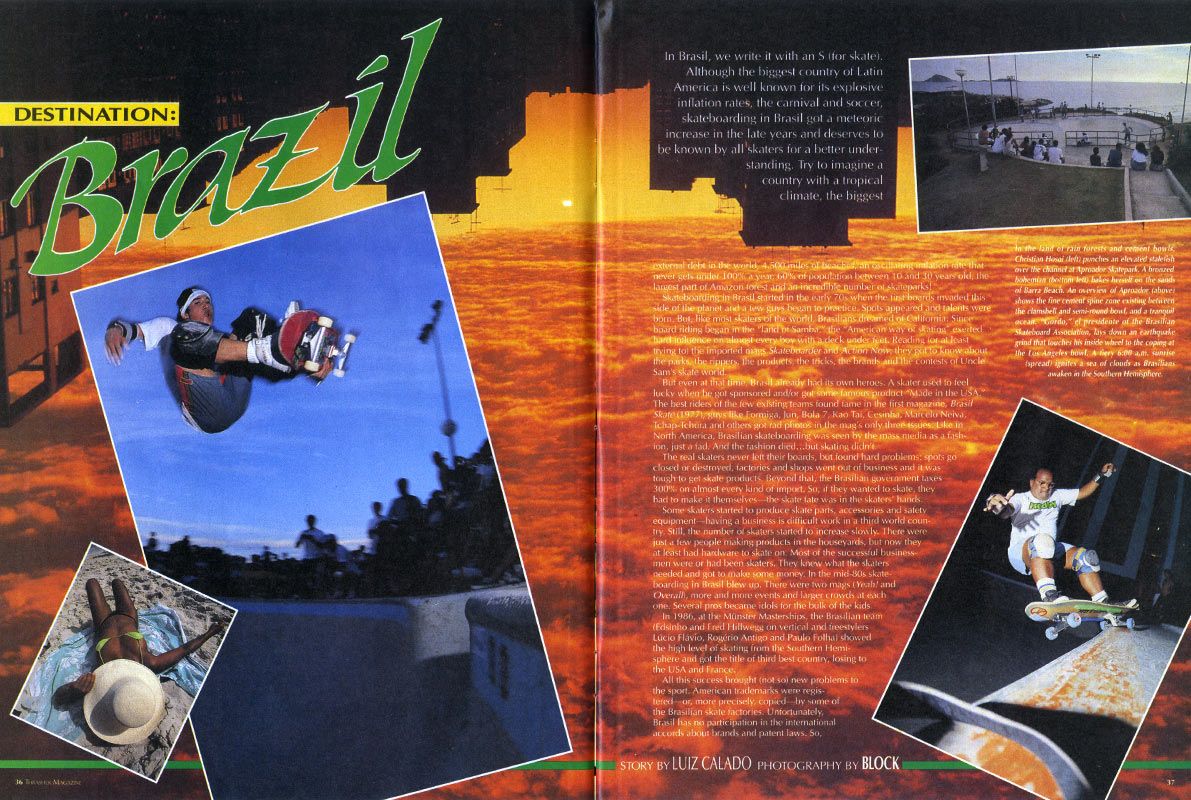
In the land of rain forests and cement bowls
Christian Hosai deft punches an elevated stalelish
over the chinned at Aproador Statepark. A bronzed
bohemian (bottom lett bakes heen on the sands
of Barra Beach. An overview of Aproador (above
shows the fine cement spine zone existing between
the clamshell and semi-round boul, and a tranquil
ocean Gordo, el presidente of the Brasilian
Skateboard Association, lays down an earthquake
grind that louches his inside wheel to the coping at
the Los Angeles bowl. A fiery 6:00 am. sunrise
(spread) ignites a sea of clouds as Brasilians
awaken in the Southern Hemisphere
Dres