Page Text
            CALEONARD
Skateboarders, in their humble glory, have unlocked the mysteries of STEP
wingless flight. In fact, they go so far beyond that nowadays it's impossible to ever
catch up to all the flip-flops, switch-stances and reverts. Therefore,
STEP
let us examine the basics of the ollie in its purest form. The ollie
revolution has pillaged the ranks of board manipulation and left no deck unturned.
Skaters who can't ollie these days are functionally illiterate. Those who can, know
that the "ollie pop"
is a launching pad
PRESENTATION
to the stratosphere. Thrasher asked a few top fly-boys to spill the beans on their
slight-of-foot technique and, once and for all, to answer today's obligatory question.
"How high can you ollie? TOMMY GUERRERO: Do you seriously want to know the
only way to learn allies? Straight up practice. Trial and error. Place your front foot
way back for high ollies. Bring your arms up and your
knees way up into your chest. Flick the front foot out to
level it off. I remember Rodney Mullen used to wind up so low
TO
to the ground that before he would pop he would place his
front hand flat on the nose of his board. A shorter tail is
better for ollies, about 6%. For me. 6½" is
getting crazy. How high can I ollie?
Not as high as the rest.
The key is the timing, from when you
slap your tail to when you slide
your foot up. It's kind of like
getting used to a
clutch on a car.
-Ray Barbee
12
SPECIAL
CHRISTIAN HOSOI: If you're brand new to the science of ollies, start out on carpet or grass. Stand between two walls or picnic tables and practice pop-
BY ping using your hands to lift your body. Do little ones at first and slowly go higher. It's important to get the timing right so your front foot never
leaves the board. Once you've blasted a few, try rolling on cement. Put your front foot in the middle of the board and the hall of your back foot in the
middle of the tail. Then whack the tail nice and hard (the harder you whack, the higher
it goes). Tuck your front foot up so it's tight to your
I legs and use the side of your foot to push the board
horizontal. At the same time, lift your back foot up and the board will follow from the
force of the whack. It's all in the tail. Remember to feel the rhythm of hitting your tail.
tucking your front foot up, throwing your
front foot forward, lifting the back leg and
then landing on all four wheels. That's the
simple version. I can ollie over seven boards
HOW
stacked wheels to wheels. JIM THIEBAUD: When I was learning to ollie, the streets
were a playground and their limits fell almost as often as I did. I ollied Coke cans
stacked-up, rain gutters, small planter boxes, sidewalks, vagrants, fire hydrants. I
started skating ramps more often and trying ollies on them. I learned one of the three
most enlightening discoveries of my life: Don't touch things that are red hot, don't for-
get to eat or you will starve to death, and try to get on top of your
ollies on ramps. Straight up and down and right over your
board: Jason Jessee-style. Mark Gonzales. Tommy Guerrero. I
1050HIA
OLLIE
BEGINNER'S
SYMPOSIUM
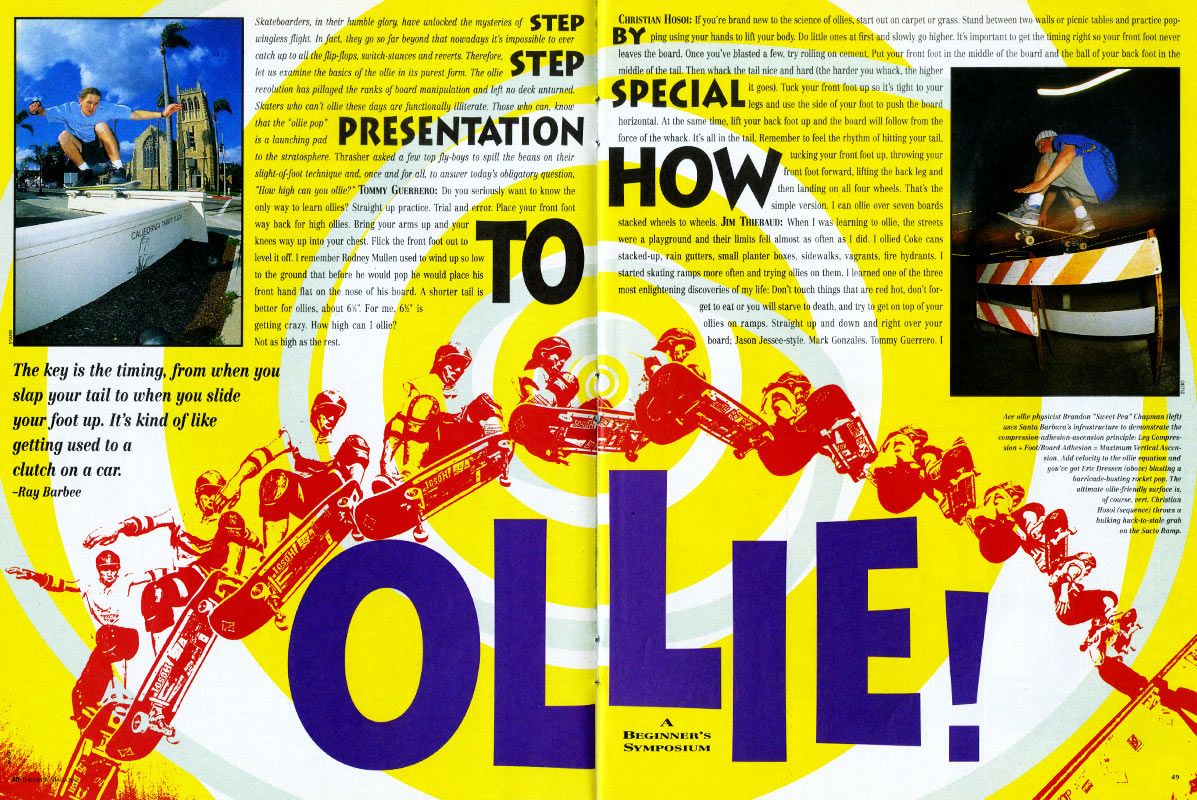
Ace ollie physicist Brandon "Sweet Pea" Chapman (left)
ses Santa Barbara's infrastructure to demonstrate the
compression-adhesion ascension principle: Leg Compres
sion + Foot/Board Adhesion - Maximum Vertical Ass
sion. Add relority to the olie equation and
you've got Eric Dresses (above) blasting a
barricade-busting rocket pop. The
ultimate olie-friendly surface is,
of course, vert. Christian
Husui (sequence) throws a
hulking hack-to-stale grab
on the Sarto Ramp.