Page Text
            TIME WARPED
(From page 78) After an hour and a half
of red tape, John would be reinstat-
ed as a first semester sophomore
and would start attending class at
the end of August with the rest of
the sophomore class. On the drive
home, John's mind began to wan-
der. He found himself looking at the
city in a way he hadn't in a while,
looking at it for all the potential
skate spots that cried for session-
ing. He stopped to watch some
skaters sessioning the curbs and
islands of a parking lot. He felt both
an outsider and yet in touch with
these young shredders. The old
feelings came back, the urge to
skate and to join in the fun. He
walked closer to the session and
sat down on the curb to watch. The
skaters ignored him as if he wasn't
even there, possibly hoping he
wasn't some sort of undercover cop
getting ready to bust them. John
couldn't control himself. He shouted
approval and tried to offer tips when
the skaters blew a trick. Finally, one
came over to John and asked if he
was a skater. As John started telling
his story, the skaters came over to
listen and question what it was like
"back then."
Brrruuuzzzzzzzzzzmuuum! The
band saw hummed as Dr. Fingart
cut apart John's skate. He cut thin
slices: one piece for the electron
microscope, another for molecular
analysis and one for chemical anal-
ysis. Very little of the wood deck
survived; the few splinters he found
in the metal and plastic glob looked
scorched and were somewhat hard-
ened from heat, most likely from the
impact. The wheels exhibited prop-
erties of ceramics. Apparently the
metal in the bearings, the urethane
and the concrete dust had come
together under heat to form a new,
pliable composite. Dr. Fingart
hypothesized that this new compos
ite became so hard and smooth
that it was frictionless, able to with-
stand heat and destruction. It could
have propelled John much faster
than a normal wheel. The truck also
exhibited new and unique proper-
ties. Somehow, by repeated blows,
the axle had become magnetized,
and this magnetic force existed in
both the steel of the axle and in the
aluminum hangers. A unique prop-
erty of this magnetism was that the
aluminum was more negatively
charged while the steel was more
positively charged. If these charged
metals then passed over a similarly
charged surface, they would pro-
duce an electrical current and quite
conceivably act like a linear accel-
erator. The implication was that
John could have traveled close to
the speed of light and generated an
electrical current strong enough to
create a warp in time. At some
80 THRASHER MAGAZINE
point he could have literally passed
himself, freezing time until some
outside event broke his current and
released him from limbo.
"Well John, how did you make
out at the campus today?"
"I'm going to be reinstated. They
want me to repeat the first se-
mester or two to see if I retained.
everything I learned and then they'll
decide my curriculum."
All through dinner, John kept
thinking about the skaters he met
and how much he wanted to skate
again. Going through the channels,
he came across Sk8TV. What had
started years ago as a show for
kids on Nickelodeon had become
prime-time fare on NBC. It was kind
of like Monday Night Football,
except it was on Wednesdays.
Each week featured a different con-
test along with other stories. The
more John watched, the more he
wanted to skate. "Tomorrow, after
I'm done with Dr. Fingart, I'm going
to get a new skate," he thought.
It was a restless night for John,
one that seemed like it would never
end. Occasionally he would dose
off, then wake up and check his
clock to see what time it was. Even
tually he fell asleep after rereading
five-year-old Thrashers.
"You're up early today..."
"Yeah, I have to meet Dr. Fingart
at his office at 9:00 this morning,
and I don't want to be late."
"Is he tutoring you?"
"No. He's really interested in
helping me discover what hap-
pened. Got to run. See you later."
Dr. Fingart looked like a cross
between Indiana Jones and the
Ghostbusters: sleeveless T, khaki
shorts, knee-high khaki socks and
heavy hiking boots. He had a utility
belt with assorted tools, ropes, a
couple flashlights and some other
miscellaneous stuff. On the ground
was a backpack that was literally a
giant battery pack. He was loading
another backpack with scientific
gear as John arrived.
John felt like a kid on Christmas
Eve. He knew something big was
going to happen but didn't know
what it would be.
"So. Dr. Fingart, what did my
skate tell you?"
"Well, quite possibly that you
traveled at the speed of light and
that you created a ripple in time for
yourself."
"Speed of light? I'm no rocket
scientist, but even I know that if I
fell off the skate at the speed of
light, I'd be a little cinder. Besides,
how could I even stay on at that
speed?"
"Staying on would be easy.
Haven't you ever heard stories of
mothers lifting cars to rescue.
babies? It seems a little silly, but
because of fear and adrenaline, it
happens. I would assume that
when you grabbed on to your
board, the adrenaline gave you
incredible strength. In fact, didn't
you have stress fractures in your
fingertips?"
"Yes. I did. That sort of seems
possible, but I blacked out. How
could I have held on then?"
"Did you really black out? And it
you did, when? If you traveled at
the speed of light, your brain may
not have been able to accept the
stress. Like a person who has no
recollection of a terrible event, your
brain may have shut down in some
way to protect itself. Also, if you
were going that fast, any body
movements you made would be in
slow motion. That may be why it
took five years for you to fall."
"Say all that is true, why wasn't I
more seriously hurt?"
"In that state, your body would
relax and take the impact better. If
your board is any indication of how
you stopped, that sudden decelera-
tion would have created shock
waves that would have acted like a
brake, slowing you down until you
hit. You may have been found
three-quarters of a mile into the
pipe from the entrance, but that
spot is also two-thirds of a mile up
from the branch. That's a lot of
room for slowing down. Why don't
you relax for a bit. I can't give you
the definitive answer until I have a
chance to run some tests anyway."
The two arrived at the pipe, load-
ed up their gear and began the hike
down the line. John tried to retrace
his path as best as he could, while
Dr. Fingart took measurements and
checked for electromagnetic fields.
When they reached the branch, the
powerful spotlights of Dr. Fingart
showed much more detail. They
discovered tracks worn into the
concrete by John's wheels. This
meant two things: first, it explained
how the wheels had so much con-
crete in them, and second, how the
board was able to stay stable even
though John may not have been
mentally able to. The metal spall
from the trucks was much greater
than John was able to see when he
first came.
"These fillings are very highly
charged. Notice how some are
actually embedded in the surface.
Watch how they stand at attention
when I pass this magnet over them.
I now feel that is possible you trav
eled at the speed of light, possibly
faster."
"Okay, I'm traveling at light
speed, I pass myself somehow and
freeze time. How come I stop up
there on the wall, not down here at
the intersection of the trails?"
"This is a bit philosophical but,
time stops for you mentally and
physiologically but not physically.
Your body and mind stop aging, but
you and the skate are still moving,
following these tracks. Coming
down here, you told me you
remembered getting disoriented,
dizzy, sick and then nothing. The
disorientation occurred upon reach
ing light speed, at this point the
physiological slowdown begins.
What mentally seems like seconds
may actually have been months
passing. The blacking out and theo-
retical loss of control would also
take months in real time to occur
while for you it seemed like sec-
onds. Another secondary event
comes into play now. Earthquakes
and tremors. There has been no
seismic activity in this area in the
last five years except for a minor
tremor that occurred 10 months
before your return. The tremor and
your loss of control takes you out of
the tracks and heading for that wall
and the crack in the seam. The
tremor has caused a misalignment
and has for you, created a brake.
John, have you ever seen films of
fighter jets landing on an aircraft
carrier? They drop hooks to catch
drag lines. When they do, they
decelerate from a couple of hun-
dred miles an hour to nothing in a
very short distance.
"Okay, if that's what happened,
how come I didn't splat into the wall
like the deck?"
"At this point, your blackout has
caused your body to go limp.
Because you're still moving in slow
motion in comparison to your
momentum, you haven't fallen off.
The kids who found you reported
seeing a bright flash before they
heard you impact. That flash was a
combination of the board impacting
as well as the deceleration from
light speed. A visual shock wave of
sorts. This blast also directed you
away from the wall into free flight.
Most likely your limp body and
loose clothes created additional
drag, further slowing you down. It is
entirely possible that you may have.
bounced or rolled, further slowing
you down before landing on your
back and sliding to a stop."
"Wow, that is incredible! Do you
think I'd remember everything if I
under went hypnosis?"
"There wouldn't be much to
remember. You were in total dark-
ness; to your mind, only a couple of
minutes passed. You might remem-
ber impacting, but that is unlikely
since you probably blacked out by
then. Maybe now you'll be able to
get back to a normal life again."
"So now what happens?"
"I plan to write my findings and
submit them to the scientific com-
munity, maybe get a research grant
out of it. Who knows, if you do well
in school and if I get a grant, maybe
you could work as an assistant...
only time will tell."
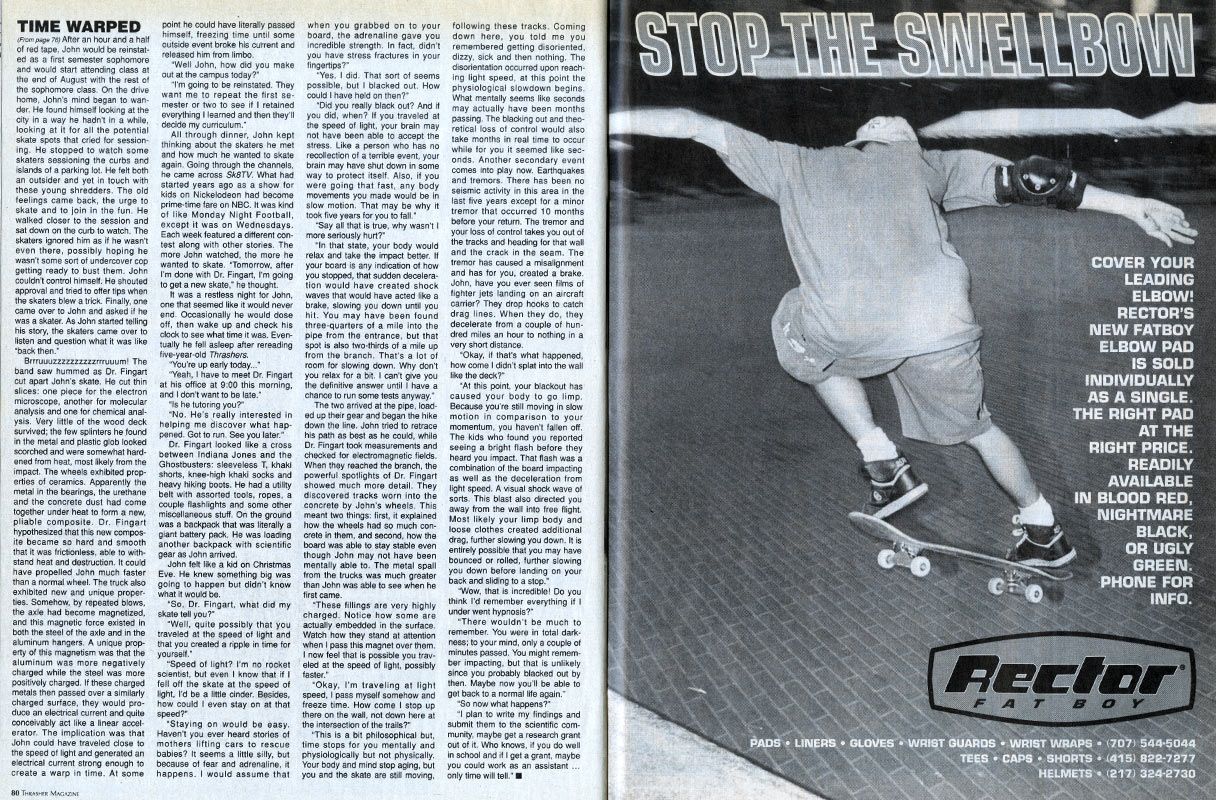
STOP THE SWELLBOW
CC
COVER YOUR
LEADING
ELBOW!
RECTOR'S
NEW FATBOY
ELBOW PAD
IS SOLD
INDIVIDUALLY
AS A SINGLE.
THE RIGHT PAD
AT THE
RIGHT PRICE.
READILY
AVAILABLE
IN BLOOD RED,
NIGHTMARE
BLACK,
OR UGLY
GREEN.
PHONE FOR
INFO.
Rector
FAT BOY
PADS LINERS GLOVES WRIST GUARDS
WRIST WRAPS (707) 544-5044
TEES CAPS SHORTS (415) 822-7277
HELMETS (217) 324-2730