Page Text
            AEROSOL
KIDS
by Morgan Walker
Call it aerosol art, spray-can art or wildstyle writ-
ing, but don't use the "G-word" around Phase 2,
one of the pioneers of this elusive art form, or
you'll get a quick lesson in esthetic politics. Phase
was one of the originators of aerosol expression at
Its beginnings in New York City. He is credited with
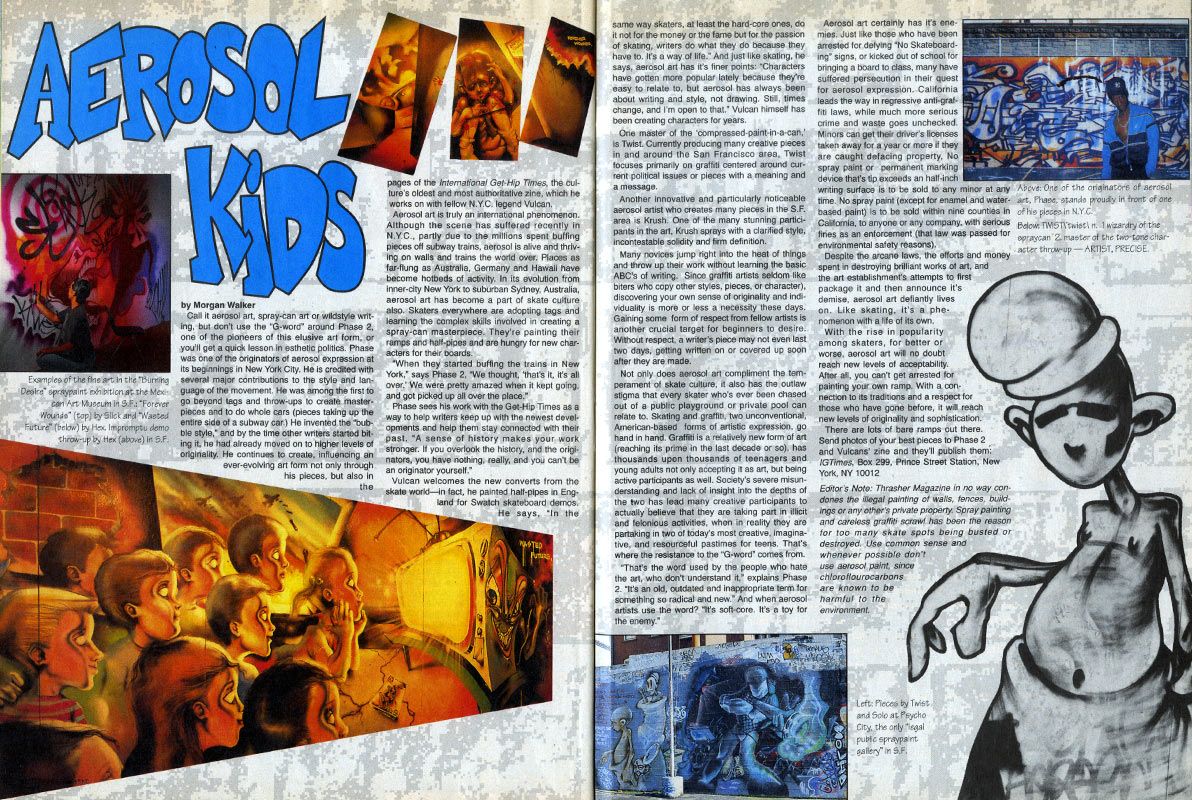
Examples of the fine art in the "Burning several major contributions to the style and lan-
Desire spraypaint inhibition at the Mexiguage of the movement. He was among the first to
can Art Museum in SF "Forever go beyond tags and throw-ups to create master
Wounde" (top) by Slick and "Wasted pieces and to do whole cars (pieces taking up the
Future" (below) by Hex Impromptu demo entire side of a subway car.) He invented the "bub-
throw-up by Hex (above) In 5.F.
ble style, and by the time other writers started bit-
ing it, he had already moved on to higher levels of
originality. He continues to create, influencing an
ever-evolving art form not only through
his pieces, but also in
the
pages of the International Get-Hip Times, the cul-
ture's oldest and most authoritative zine, which he
works on with fellow N.Y.C. legend Vulcan.
Aerosol art is truly an international phenomenon.
Although the scene has suffered recently in
N.Y.C., partly due to the millions spent buffing
pieces off subway trains, aerosol is alive and thriv
ing on walls and trains the world over. Places as
far-flung as Australia, Germany and Hawall have
become hotbeds of activity. In its evolution from
Inner-city New York to suburban Sydney, Australia,
aerosol art has become a part of skate culture
also. Skaters everywhere are adopting tags and
leaming the complex skills involved in creating a
spray-can masterpiece. They're painting their
ramps and half-pipes and are hungry for new char-
acters for their boards.
"When they started buffing the trains in New
York," says Phase 2, "We thought, that's it, it's all
over. We were pretty amazed when it kept going.
and got picked up all over the place."
Phase sees his work with the Get-Hip Times as a
way to help writers keep up with the newest devel
opments and help them stay connected with their
past. "A sense of history makes your work
stronger. If you overlook the history, and the origi-
nators, you have nothing, really, and you can't be
an originator yourself."
Vulcan welcomes the new converts from the
skate world-in fact, he painted half-pipes in Eng-
land for Swatch skateboard demos.
He says, "In the
same way skaters, at least the hard-core ones, do
it not for the money or the fame but for the passion
of skating, writers do what they do because they
have to. It's a way of life." And just like skating, he
says, aerosol art has it's finer points: "Characters
have gotten more popular lately because they're
easy to relate to, but aerosol has always been
about writing and style, not drawing. Still, times
change, and I'm open to that." Vulcan himself has
been creating characters for years.
One master of the 'compressed-paint-in-a-can,
is Twist. Currently producing many creative pieces
in and around the San Francisco area, Twist
focuses primarily on graffiti centered around cur-
rent political issues or pieces with a meaning and
a message.
Another innovative and particularly noticeable
aerosol artist who creates many pieces in the S.F.
area is Krush. One of the many stunning partici-
pants in the art, Krush sprays with a clarified style,
incontestable solidity and firm definition.
Many novices jump right into the heat of things
and throw up their work without learning the basic
ABC's of writing. Since graffiti artists seldom like
biters who copy other styles, pieces, or character).
discovering your own sense of originality and indi-
viduality is more or less a necessity these days.
Gaining some form of respect from fellow artists is
another crucial target for beginners to desire.
Without respect, a writer's piece may not even last
two days, getting written on or covered up soon
after they are made.
Not only does aerosol art compliment the tem-
perament of skate culture, it also has the outlaw
stigma that every skater who's ever been chased
out of a public playground or private pool can
relate to. Skating and graffiti, two unconventional,
American-based forms of artistic expression, go
hand in hand. Graffiti is a relatively new form of art
(reaching its prime in the last decade or so), has
thousands upon thousands of teenagers and
young adults not only accepting it as art, but being
active participants as well. Society's severe misun-
derstanding and lack of insight into the depths of
the two has lead many creative participants to
actually believe that they are taking part in illicit
and felonious activities, when in reality they are
partaking in two of today's most creative, Imagina-
tive, and resourceful pastimes for teens. That's
where the resistance to the "G-word" comes from.
"That's the word used by the people who hate
the art, who don't understand it," explains Phase
2. "It's an old, outdated and inappropriate term for
something so radical and new." And when aerosol
artists use the word? "It's soft-core. It's a toy for
the enemy."
Aerosol art certainly has it's ene
mies. Just like those who have been
armrested for delying "No Skateboard-
ing" signs, or kicked out of school for
bringing a board to class, many have
suffered persecution in their quest
for aerosol expression. California
leads the way in regressive anti-graf
fiti laws, while much more serious
crime and waste goes unchecked.
Minors can get their driver's licenses
taken away for a year or more if they
are caught defacing property. No
spray paint or permanent marking
device that's tip exceeds an half-inch
writing surface is to be sold to any minor at any Above: One of the originators of aerosol
time. No spray paint (except for enamel and water art, Phase, stands proudly in front of one
based paint) is to be sold within nine counties in of his pieces in NYC.
Califomia, to anyone or any company, with serious Below TM5Twisti n. 1 wizardry of the
firies as an enforcement (that law was passed for
opraycan 2 master of the two tone char
environmental safety reasons),
acter throw-up-ARTIST, PRECISE
Despite the arcane laws, the efforts and money
spent in destroying brilliant works of art, and
the art establishment's attempts to first
package it and then announce it's
demise, aerosol art defiantly lives
on. Like skating. It's a phe-1
nomenon with a life of its own.
With the rise in popularity
among skaters, for better or
worse, aerosol art will no doubt
reach new levels of acceptability.
After all, you can't get arrested for
painting your own ramp. With a con-
nection to its traditions and a respect for
those who have gone before, it will reach
new levels of originality and sophistication.
There are lots of bare ramps out there.
Send photos of your best pieces to Phase 2
and Vulcans' zine and they'll publish them:
IGTimes, Box 299, Prince Street Station, New
York, NY 10012
Editor's Note: Thrasher Magazine in no way con-
dones the illegal painting of walls, fences, build-
ings or any other's private property. Spray painting
and careless graffiti scrawl has been the reason
for too many skate spots being busted or
destroyed. Use common sense and
whenever possible don't
use aerosol paint, since
chloroflourocarbons
are known to be
harmful to the
environment.
Left: Pleces by Twist.
and Solo at Psycho
City, the only "legal
public spraypaint
gallery" in SF