Page Text
            it's a tail grab one-footed
gaytwist-to-backside
revert
Either way, both include a back-
side revert, the ingredient that
Mr. Vertical Insanity himself,
Tony Hawk, dubs the gnarliest
component currently going.
Everybody has an opinion,
and Remy Stratton believes Bod
Boyle's frontside ollie tailgrabs
to back truck hang-up yank-in
are just beautiful. Then there's
Neal Hendrix, who gets turned
on by Bucky Lasek's 360' back-
side ollies, Mike Frazier's nose-
grind tailgrab varials and Chris
Miller's six-foot frontside ollie-
to-axle smack, to name but a
few. Furthermore, Mike Crum
cites Danny Way's ollie impossi-
ble indy grabs, Bucky Lasek's
ollie impossible tailgrabs-to-
nose, Danny Mayer's body varial
540's and everything that Tony
Hawk does as particularly rad
and bitchin'. Another Mike,
Senor McGill, states that
frontside stalefish-to-tail and
backside ollies 270'-to-Smith
impress the heck out of him.
From the house of Kasai, Lester
can't help but point out that
Danny Way has made a few
900's. And in the same vein,
Mike Frazier nods to Buster Hal-
terman's slob fastplants that
traverse the width of the ramp,
Tony Hawk's cross channel ollie
540's, Jeff Kendall's Smith-verts
and Justin Lynch's ollie-to-fakie
at heights of six feet and up.
Then there's the guys who
dig speed and commitment
above all else. Just ask Chris
Miller. "In my opinion," he says,
"high speed lip tricks are the
most exciting. Mike Prosenko
couldn't agree more. "I like
tricks that cover the whole
ramp: lip tricks or airs, rad lines
and combinations that are flow
ing and fast," he says. "The
way someone does a trick can
make it insane." Bod Boyle's
philosophy is it's not what you
do, it's the way that you do it.
For him, the most demented
moves are "those tricks where
people push them to extreme
extremes, not one particular
trick." Rob Roskopp is even
more open-minded; he fancies
"everything that's done fast."
WIDTH, BREADTH,
GIRTH, GOOD COPING
FRUIT JUICE
Next question, what makes a
ramp killer? Obviously, a
50 THRASHER MAGAZINE
respectable ramp will
have as few kinks as pos
sible for that ultra-
smooth Cadillac glide
ride. The secret, accord-
ing to Mike McGill, who
has sampled quite a few
halfpipes in his time, is
"lots of 2x4s and 2x6s
underneath and three
layers of plywood, which
in turn will let you skate
very fast without hardly
exhausting yourself."
Another crucial consider-
ation is the amount of
vertical, which will dictate
how lucrative a ramp is
for airs and lip tricks.
Most estimates put the
optimum amount of vert
at a foot and a half and
the transition somewhere
in the ten foot range.
Lester Kasai is a guy who
knows what it means to
fly. "Two feet of vert is
too much and one foot is
not enough. Somewhere
in between is best for the
right pitch," he says.
Another important aspect
in achieving ramp nirvana
is the factor of width.
Neal Hendrix believes a
ramp should be wide
enough so you don't
have to go back and
forth all the time. Like-
wise, a few accessories
here and there help to
liven up the fun, but too
many escalators, channels
and extensions can clut-
ter all but the widest
ramps real fast. Bod Boyle
says, "Any obstacles on
the ramp make it better,
as long as the ramp is
wide enough for them."
The slip versus grip
ratio is something that
Ray Underhill considers
closely before passing
judgement on any ram-
pular surface; it has to
slide on command, but
not at any other time. Lit-
tle things like counter-
sunk screws that don't
stick up and coping that
sticks out evenly all the
way around make a big
difference to guys like
Wade Speyer, Steve Dou-
glas and Dave Le Roux.
Other skaters want all the
options. Jason Jessee likes
a ramp with "lots of fruit
drinks and people hand-
ing out cashier's checks."
And Remy Stratton likes
to see hourly ice cream
truck stops and porta
potties, but he'll settle for
a good solid structure.
But probably the most
important aspect of any
halfpipe habitat is the
atmosphere, at least
that's what Buster Halter-
man, Colin McKay, Mike
Frazier, Mark Cernicky
and Tony Hawk think.
THE MAG WILL
SELF-DESTRUCT
AS SOON AS YOU
READ THIS
Don't ask Jeff Grosso to
name the best ramp he's
skated in the past year;
he's been working out at a
top secret ramp complex
under high security clear-
ance and can't disclose
any names, locations or
dimensional information.
He can only say it has a
tad more vert than transi-
tion to give you plenty of
time to get weightless
before you get to the top.
Steve Caballero, who
was not privy to Grosso's
information, endorses a
humble halfpipe in New
Zealand at an indoor park
called Skate Station as the
premiere structure he sam-
pled over the past year. "It
didn't have any features, it
was just a basic ramp," he
says, "not too small, not
too big. The coping was
perfect for ollies and it slid
great for lip tricks. The
transitions were strong
and perfect, so you were
able to keep a high speed
going. The coping stuck
out perfect for the amount
of vert."
Coping plays a prime
place in Ray Underhill's
appreciation of a ramp:
also. Ray remembers the
G&S
EASTERN
SKATES BARD'SUPPOSINGS
Toulouse Skatepark in
France as having especially
excellent coping: "just big
enough for comfortable lip
tricks and just out enough
for good launch of nollie
and fakie ollie-type tricks."
Steel is the preferred
coping material amongst
most hard riding vertical
veterans. Just ask Bryce
Kanights, proprietor of
Studio 43, which has a
Tim Payne-built big ramp
with all the trimmings. For
Bryce and many others,
steel is king. It delivers "a
controlled grind and pro-
vides a solid feel for pivots
It lasts long and sounds
bitchin' on Madonnas,
body jars and lien-to-tails.
It tells people on the deck
to stay back. PVC is not for
me, Kanights says. "It's
gotta be steel. Aluminum
dents, especially when it's
real thin, and it's stickier,
it's slower."
The cement burl of pool
coping is another popular
item among the vertical
set. Jason Jessee and Lori
Rigsby praise its virtues in
any type of perpendicular
plywood situation. "Pool
coping makes a rampi
killer," says Rigsby. Rob
Roskopp takes the back-
yard bowl philosophy one
step further-give him a
vertical ramp that resem-
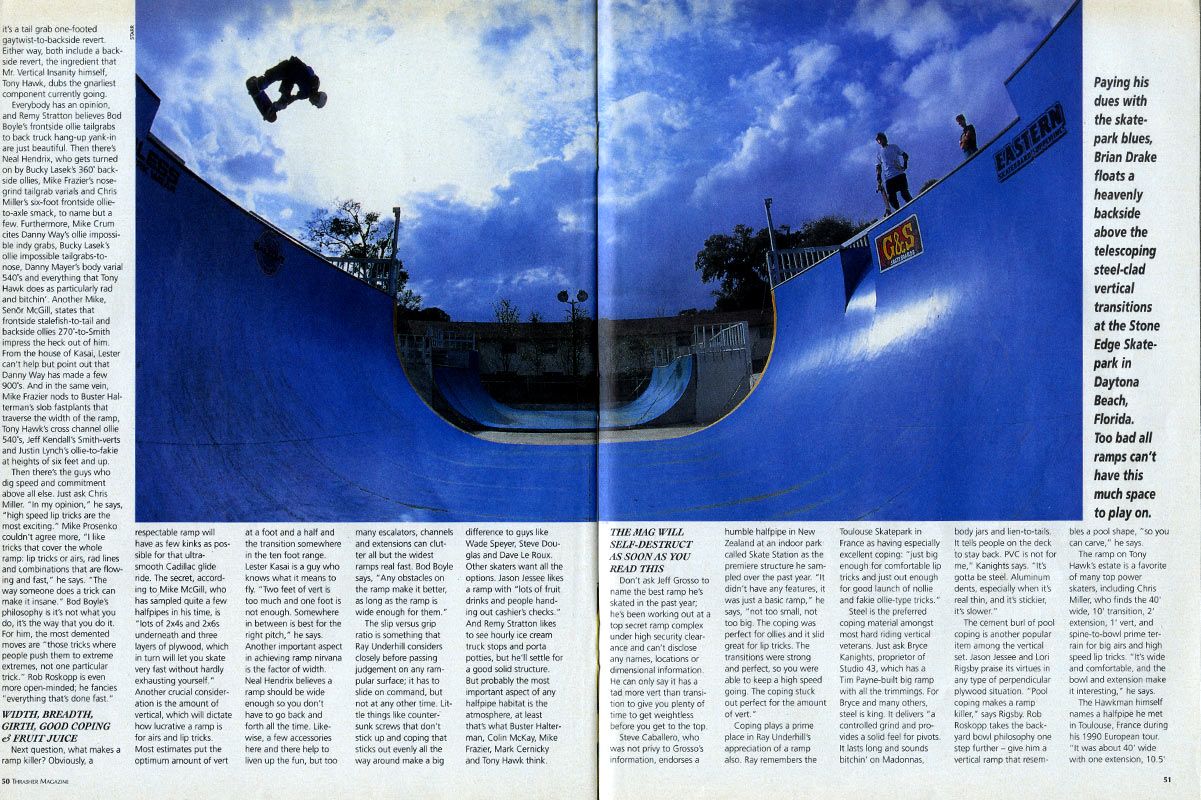
Paying his
dues with
the skate-
park blues,
Brian Drake
floats a
heavenly
backside
above the
telescoping
steel-clad
vertical
transitions
at the Stone
Edge Skate-
park in
Daytona
Beach,
Florida.
Too bad all
ramps can't
have this
much space
to play on.
bles a pool shape, so you
can carve," he says.
The ramp on Tony
Hawk's estate is a favorite
of many top power
skaters, including Christ
Miller, who finds the 40
wide, 10' transition, 2'
extension, 1' vert, and
spine-to-bowl prime ter-
rain for big airs and high
speed lip tricks. "It's wide
and comfortable, and the
bowl and extension make
it interesting," he says.
The Hawkman himself
names a halfpipe he met
in Toulouse, France during
his 1990 European tour.
"It was about 40' wide
with one extension, 10.5"