Page Text
            THE PI
BY
H.W.
MOSS
HE DOVE OVER THE PEOPLE IN THE FRONT ROW LIKE AN ARROW, RIGHT ONTO HIS FACE.
INSTED
FOR T
JU
THE DAI ABC
WOLD DIF
Schmitt
Stix
ร
B
BAD DREA
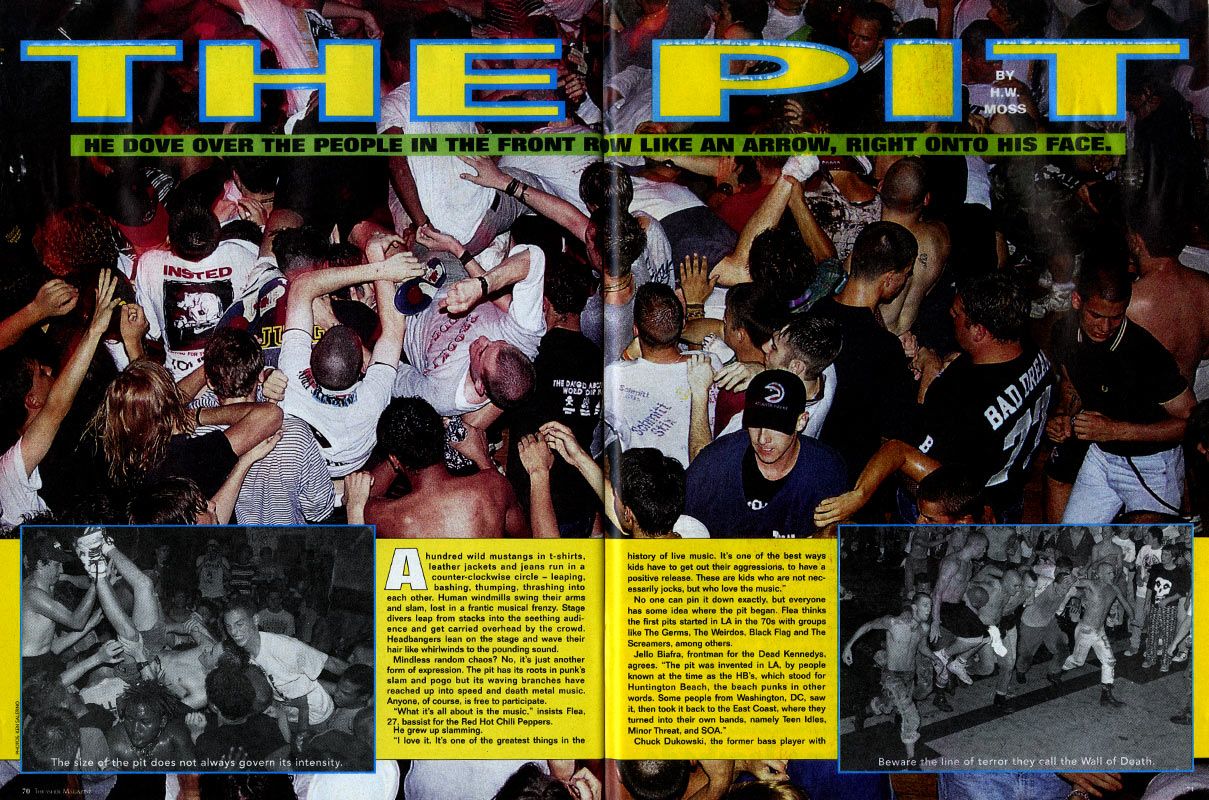
The size of the pit does not always govern its intensity.
A
hundred wild mustangs in t-shirts.
leather jackets and jeans run in a
counter-clockwise circle leaping.
bashing, thumping, thrashing into
each other. Human windmills swing their arms
and slam, lost in a frantic musical frenzy. Stage
divers leap from stacks into the seething audi-
ence and get carried overhead by the crowd.
Headbangers lean on the stage and wave their
hair like whirlwinds to the pounding sound.
Mindless random chaos? No, it's just another
form of expression. The pit has its roots in punk's
slam and pogo but its waving branches have
reached up into speed and death metal music.
Anyone, of course, is free to participate.
"What it's all about is the music." insists Flea,
27, bassist for the Red Hot Chili Peppers.
He grew up slamming.
"I love it. It's one of the greatest things in the
history of live music. It's one of the best ways
kids have to get out their aggressions, to have a
positive release. These are kids who are not nec-
essarily jocks, but who love the music."
No one can pin it down exactly, but everyone
has some idea where the pit began. Flea thinks
the first pits started in LA in the 70s with groups
like The Germs, The Weirdos, Black Flag and The
Screamers, among others.
Jello Biafra, frontman for the Dead Kennedys.
agrees. "The pit was invented in LA, by people
known at the time as the HB's, which stood for
Huntington Beach, the beach punks in other
words. Some people from Washington, DC, saw
it, then took it back to the East Coast, where they
turned into their own bands, namely Teen Idles,
Minor Threat, and SOA."
Chuck Dukowski, the former bass player with
Beware the line of terror they call the Wall of Death.
70 TMA