Page Text
            RAMP WORLD
00
ENVIRONMENTAL
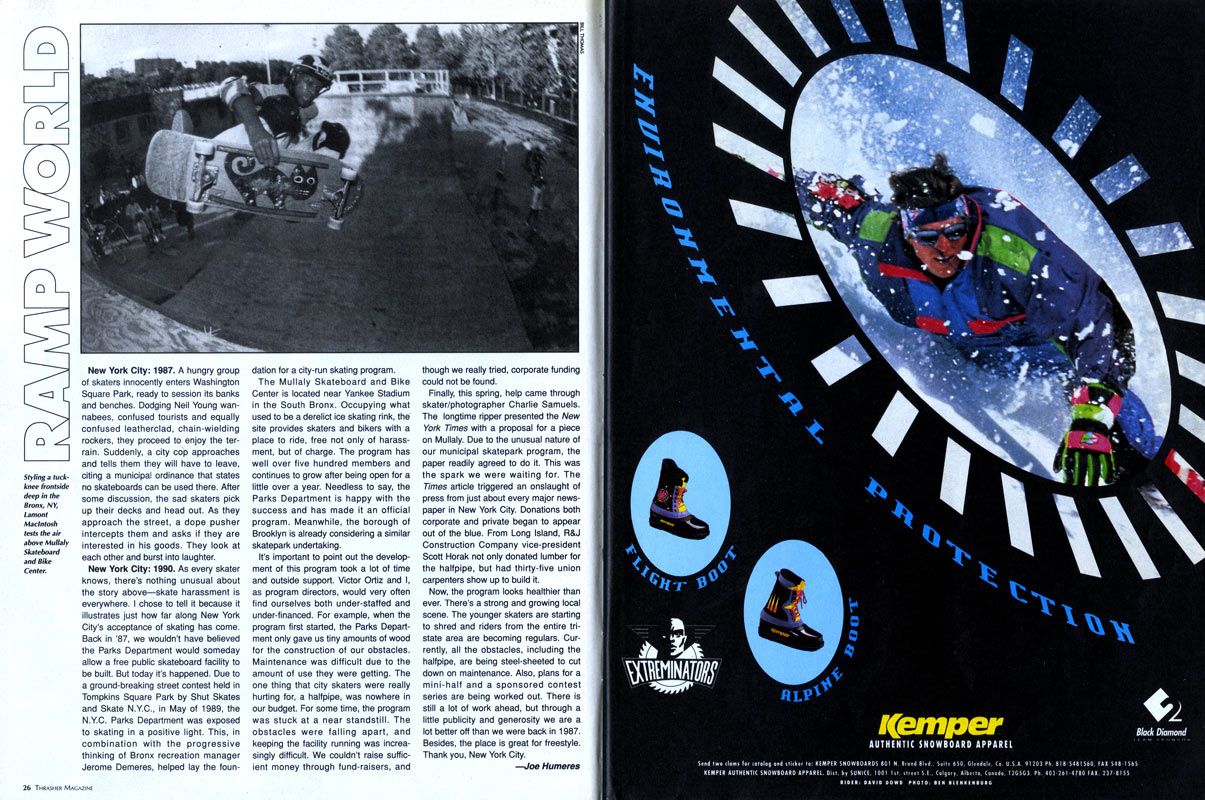
Styling a tuck-
knee frontside
deep in the
Bronx, NY,
Lamont
Macintosh
tests the air
above Mullaly
Skateboard
and Bike
Center
New York City: 1987. A hungry group
of skaters innocently enters Washington
Square Park, ready to session its banks
and benches. Dodging Neil Young wan-
nabees, confused tourists and equally
confused leatherclad, chain-wielding
rockers, they proceed to enjoy the ter
rain. Suddenly, a city cop approaches
and tells them they will have to leave,
citing a municipal ordinance that states
no skateboards can be used there. After
some discussion, the sad skaters pick
up their decks and head out. As they
approach the street, a dope pusher
intercepts them and asks if they are
interested in his goods. They look at
each other and burst into laughter.
New York City: 1990. As every skater
knows, there's nothing unusual about
the story above-skate harassment is
everywhere. I chose to tell it because it
illustrates just how far along New York
City's acceptance of skating has come.
Back in '87, we wouldn't have believed
the Parks Department would someday
allow a free public skateboard facility to
be built. But today it's happened. Due to
a ground-breaking street contest held in
Tompkins Square Park by Shut Skates
and Skate N.Y.C., in May of 1989, the
N.Y.C. Parks Department was exposed
to skating in a positive light. This, in
combination with the progressive
thinking of Bronx recreation manager
Jerome Demeres, helped lay the foun-
26 THRASHER MAGAZINE
dation for a city-run skating program.
The Mullaly Skateboard and Bike
Center is located near Yankee Stadium
in the South Bronx. Occupying what
used to be a derelict ice skating rink, the
site provides skaters and bikers with a
place to ride, free not only of harass-
ment, but of charge. The program has
well over five hundred members and
continues to grow after being open for a
little over a year. Needless to say, the
Parks Department is happy with the
success and has made it an official
program. Meanwhile, the borough of
Brooklyn is already considering a similar
skatepark undertaking.
It's important to point out the develop
ment of this program took a lot of time
and outside support. Victor Ortiz and I,
as program directors, would very often
find ourselves both under-staffed and
under-financed. For example, when the
program first started, the Parks Depart-
ment only gave us tiny amounts of wood
for the construction of our obstacles.
Maintenance was difficult due to the
amount of use they were getting. The
one thing that city skaters were really
hurting for, a halfpipe, was nowhere in
our budget. For some time, the program
was stuck at a near standstill. The
obstacles were falling apart, and
keeping the facility running was increa-
singly difficult. We couldn't raise suffic-
lent money through fund-raisers, and
though we really tried, corporate funding
could not be found.
Finally, this spring, help came through
skater/photographer Charlie Samuels.
The longtime ripper presented the New
York Times with a proposal for a piece
on Mullaly. Due to the unusual nature of
our municipal skatepark program, the
paper readily agreed to do it. This was
the spark we were waiting for. The
Times article triggered an onslaught of
press from just about every major news-
paper in New York City. Donations both
corporate and private began to appear
out of the blue. From Long Island, R&J
Construction Company vice-president
Scott Horak not only donated lumber for
the halfpipe, but had thirty-five union
carpenters show up to build it.
Now, the program looks healthier than
ever. There's a strong and growing local
scene. The younger skaters are starting
to shred and riders from the entire tri-
state area are becoming regulars. Cur-
rently, all the obstacles, including the
halfpipe, are being steel-sheeted to cut
down on maintenance. Also, plans for a
mini-half and a sponsored contest
series are being worked out. There is
still a lot of work ahead, but through a
little publicity and generosity we are a
lot better off than we were back in 1987.
Besides, the place is great for freestyle.
Thank you, New York City.
-Joe Humeres
FLIGHT
BOOT
EXTREMINATORY
ALPINE
BOOT
PROTECTION
Kemper
AUTHENTIC SNOWBOARD APPAREL
Send two clams for catalog and sticker to: KEMPER SNOWBOARDS 801 N. Brand Blvd., Suite 650, Glendale, Co. U.S.A. 91203 Ph. 818-5481560, FAX 548-1565
KEMPER AUTHENTIC SNOWBOARD APPAREL. Dist. by SUNICE, 1001 1st street S.E., Calgary, Alberta, Condo, 120503. Ph. 403-261-4780 FAX. 237-8155
Black Diamond