Page Text
            THE CULT
The boys in T
he boys in The Cult can't seem to
make up their minds. At their best, they strike with genuine thunder
and fire. At their worst, their music is a bloated, pathetically confused
reminder of better days. The only remaining holdover from Britain's
1982 positive punk generation (Spandau Ballet, Bauhaus, guitarist
Billy Duffy's erstwhile Theater of Hate), the band has evolved into
a creature of immense promise and severe schizophrenia. One hand
wants to encompass the fiery gloom of their days as Southern Death
Cult, Death Cult and finally. The Cult, much-acclaimed for their Dream-
time and Love albums. The other wants to proclaim itself "British
Rock's Great White Hope"-having relocated to L.A., the worldwide
capital of "dumb rock." (Remember fans, Gitter's from New York and
Boston, Ted)
Regardless, they retain a degree of heart and soul that keeps them
from being written off as a total joke. Attribute it to vocalist lan Astbury
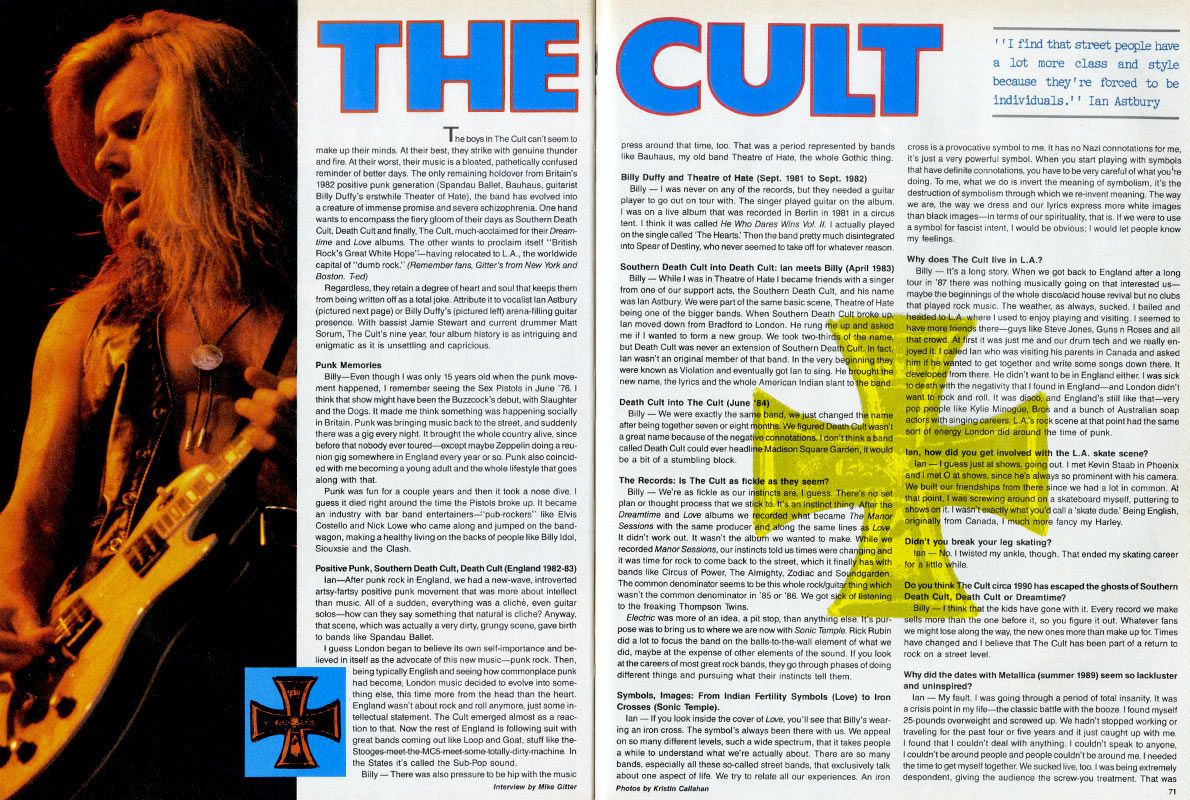
(pictured next page) or Billy Duffy's (pictured left) arena-filling guitar
presence. With bassist Jamie Stewart and current drummer Matt
Sorum, The Cult's nine year, four album history is as intriguing and
enigmatic as it is unsettling and capricious.
Punk Memories
Billy-Even though I was only 15 years old when the punk move-
ment happened, I remember seeing the Sex Pistols in June "76. 1
think that show might have been the Buzzcock's debut, with Slaughter
and the Dogs. It made me think something was happening socially
in Britain. Punk was bringing music back to the street, and suddenly
there was a gig every night. It brought the whole country alive, since
before that nobody ever toured-except maybe Zeppelin doing a reu-
nion gig somewhere in England every year or so. Punk also coincid-
ed with me becoming a young adult and the whole lifestyle that goes
along with that.
Punk was fun for a couple years and then it took a nose dive. I
guess it died right around the time the Pistols broke up. It became
an industry with bar band entertainers-pub-rockers" like Elvis
Costello and Nick Lowe who came along and jumped on the band-
wagon, making a healthy living on the backs of people like Billy Idol,
Siouxsie and the Clash.
Positive Punk, Southern Death Cult, Death Cult (England 1982-83)
lan-After punk rock in England, we had a new-wave, introverted
artsy-fartsy positive punk moverment that was more about intellect
than music. All of a sudden, everything was a cliché, even guitar
solos-how can they say something that natural is cliche? Anyway,
that scene, which was actually a very dirty, grungy scene, gave birth
to bands like Spandau Ballet.
I guess London began to believe its own self-importance and be-
lieved in itself as the advocate of this new music-punk rock. Then,
being typically English and seeing how commonplace punk
had become, London music decided to evolve into some-
thing else, this time more from the head than the heart.
England wasn't about rock and roll anymore, just some in-
tellectual statement. The Cult emerged almost as a reac-
tion to that. Now the rest of England is following suit with
great bands coming out like Loop and Goat, stuff like the-
Stooges-meet-the-MCS-meet-some-totally-dirty-machine. In
the States it's called the Sub-Pop sound.
Billy
There was also pressure to be hip with the music
Interview by Mike Gitter
press around that time, too. That was a period represented by bands
like Bauhaus, my old band Theatre of Hate, the whole Gothic thing.
Billy Duffy and Theatre of Hate (Sept. 1981 to Sept. 1982)
Billy I was never on any of the records, but they needed a guitar
player to go out on tour with. The singer played guitar on the album.
I was on a live album that was recorded in Berlin in 1981 in a circus
tent. I think it was called He Who Dares Wins Vol. II. I actually played
on the single called 'The Hearts.' Then the band pretty much disintegrated
into Spear of Destiny, who never seemed to take off for whatever reason.
Southern Death Cult into Death Cult: lan meets Billy (April 1983)
Billy While I was in Theatre of Hate I became friends with a singer
from one of our support acts, the Southern Death Cult, and his name
was lan Astbury. We were part of the same basic scene, Theatre of Hate
being one of the bigger bands. When Southern Death Cult broke up
lan moved down from Bradford to London. He rung me up and asked
me if I wanted to form a new group. We took two-thirds of the name,
but Death Cult was never an extension of Southern Death Cult. In fact,
lan wasn't an original member of that band. In the very beginning they
were known as Violation and eventually got lan to sing. He brought the
new name, the lyrics and the whole American Indian slant to the band.
Death Cult into The Cult (June '84)
Billy-We were exactly the same band, we just changed the name
after being together seven or eight months. We figured Death Cult wasn't
a great name because of the negative connotations. I don't think a band
called Death Cult could ever headline Madison Square Garden, it would
be a bit of a stumbling block.
The Records: Is The Cult as fickle as they seem?
Billy We're as fickle as our instincts are, I guess. There's no set
plan or thought process that we stick to. It's an instinct thing. After the
Dreamtime and Love albums we recorded what became The Manor
Sessions with the same producer and along the same lines as Love.
It didn't work out. It wasn't the album we wanted to make. While we
recorded Manor Sessions, our instincts told us times were changing and
it was time for rock to come back to the street, which it finally has with
bands like Circus of Power, The Almighty, Zodiac and Soundgarden..
The common denominator seems to be this whole rock/guitar thing which
wasn't the common denominator in '85 or '86. We got sick of listening
to the freaking Thompson Twins.
Electric was more of an idea, a pit stop, than anything else. It's pur
pose was to bring us to where we are now with Sonic Temple. Rick Rubin
did a lot to focus the band on the balls-to-the-wall element of what we
did, maybe at the expense of other elements of the sound. If you look
at the careers of most great rock bands, they go through phases of doing
different things and pursuing what their instincts tell them.
Symbols, Images: From Indian Fertility Symbols (Love) to Iron
Crosses (Sonic Temple).
lan-If you look inside the cover of Love, you'll see that Billy's wear-
ing an iron cross. The symbol's always been there with us. We appeal
on so many different levels, such a wide spectrum, that it takes people.
a while to understand what we're actually about. There are so many
bands, especially all these so-called street bands, that exclusively talk
about one aspect of life. We try to relate all our experiences. An iron
Photos by Kristin Callahan
I find that street people have
a lot more class and style
because they're forced to be
individuals. Ian Astbury
cross is a provocative symbol to me. It has no Nazi connotations for me,
it's just a very powerful symbol. When you start playing with symbols
that have definite connotations, you have to be very careful of what you're
doing. To me, what we do is invert the meaning of symbolism, it's the
destruction of symbolism through which we re-invent meaning. The way
we are, the way we dress and our lyrics express more white images
than black images-in terms of our spirituality, that is. If we were to use
a symbol for fascist intent, I would be obvious; I would let people know
my feelings.
Why does The Cult live in L.A.?
Billy It's a long story. When we got back to England after a long
tour in '87 there was nothing musically going on that interested us-
maybe the beginnings of the whole discolacid house revival but no clubs
that played rock music. The weather, as always, sucked. I bailed and
headed to L.A where I used to enjoy playing and visiting. I seemed to
have more friends there-guys like Steve Jones, Guns n Roses and all
that crowd. At first it was just me and our drum tech and we really en-
joyed it. I called lan who was visiting his parents in Canada and asked
him if he wanted to get together and write some songs down there. It
developed from there. He didn't want to be in England either. I was sick
to death with the negativity that I found in England-and London didn't
want to rock and roll. It was disco, and England's still like that-very
pop people like Kylie Minogue, Bros and a bunch of Australian soap
actors with singing careers. L.A.'s rock scene at that point had the same
sort of energy London did around the time of punk.
lan, how did you get involved with the L.A. skate scene?
lan-I guess just at shows, going out. I met Kevin Staab in Phoenix
and I met O at shows, since he's always so prominent with his camera.
We built our friendships from there since we had a lot in common. At
that point, I was screwing around on a skateboard myself, puttering to
shows on it. I wasn't exactly what you'd call a 'skate dude.' Being English,
originally from Canada, I much more fancy my Harley.
Didn't you break your leg skating?
lan-No. I twisted my ankle, though. That ended my skating career
for a little while.
Do you think The Cult circa 1990 has escaped the ghosts of Southern
Death Cult, Death Cult or Dreamtime?
Billy I think that the kids have gone with it. Every record we make
sells more than the one before it, so you figure it out. Whatever fans
we might lose along the way, the new ones more than make up for Times
have changed and I believe that The Cult has been part of a return to
rock on a street level.
Why did the dates with Metallica (summer 1989) seem so lackluster
and uninspired?
lan My fault. I was going through a period of total insanity. It was
a crisis point in my life-the classic battle with the booze. I found myself
25-pounds overweight and screwed up. We hadn't stopped working or
traveling for the past four or five years and it just caught up with me.
I found that I couldn't deal with anything. I couldn't speak to anyone.
couldn't be around people and people couldn't be around me. I needed
the time to get myself together. We sucked live, too. I was being extremely
despondent, giving the audience the screw-you treatment. That was
I
71