Page Text
            We started out at 45 and now 65 is boring.
When you start at 45 it's scary because of the
noises and vibrations, then you start to feel like you're
floating. Seventy used to make my teeth chatter
but you get used to it. It definitely fulfills
the need for the speed.
H
ISTORY
Laydown skating has roots that reach
from the icy alpine sport of luge sled-
ding to the soul and speed of seventies
skate action to the pavement peril of road
racing. The instinctual desire to lay down
and let loose comes from that first brush
with a skateboard when you're two years
old and just sit on the thing and push
around. The only organized event ever
created for these Mad Maxes of the skate
set was held in the late seventies on Signal
Hill, a steep quarter-mile drag strip just out-
side Long Beach, Ca (until one bloody Sun-
day in 1979 when there were so many wrecks
it was postponed indefinitely.) Most of the the
old Signal Hill boys have hung up their sleds-
speed vehicles of such design ranging from lay-
down padded rails to virtual rolling coffins.
THE LUGISTS
Ken Kinnee of Thousand Oaks, CA used
to skate with the boys in pools and parks,
but now he's into what he calls land luge.
He has always been "the bad guy with the
tattoos," and now he's also the guiding
force behind Max Racing, one of the most
dedicated luge crews around. Bob Pereyra
used to drive Formula Atlantic race cars
back when Danny Sullivan was a tire
changer. Ken, Bob and his brother Greg.
started Max Racing.
"We were at the top of Mulholland one
day and just sort of dared each other to
stand up and skate down the road," says
Ken. "We each made it about halfway.
Then we decided to try it sitting down, and
by the next day we were going for it hard.
At first we had to sit up for every corner
because you couldn't lay down that long.
We kept progressing. We were on television
a couple times, then Roger Hickey called us."
Roger Hickey comes closest to being
called the father of the sport of skate luge
because of his extensive background and
innovation in technique and board design.
Oh, he's also practically unbeatable. Ken
elaborates: "He came out and just made
our mouths drop. We had been using the
444
same set of bearings for six months, never
even figured out the wheels-ours were
trash. Roger had boxes of whaels from his
sponsor; we didn't even know what a spon-
sor was or how to get one. Eventually we
started to get people interested and soon
we had sponsors of our own for different
products. Roger's been into it for a long
time. He's always been the fastest because
no one's ever challenged him."
Don Bostick, president of the National
Skateboarding Association, has been into
the luge for quite awhile also. He describes
how he got started: "Basically, from doing
downhill. There used to be these guys who
I thought weren't punk enough to do stand-
up, and they would lie down on their
boards. I always made fun of them. I used
to be able to beat the guys who laid down
by standing up. Then I took my stand-up
board, laid down on it and raced them. The
sensation is cool. You're so low to the
ground-you feel like you're going much
faster than stand-up. You also feel a lot safer."
en also tells the tale of Lee Danzi, a
Seattle sledder who came down to L.A.
low to the ground with a short wheelbase.
""We laughed at it, saying, you can't ride
that thing, but he was fast... way fast. He
was so low to the ground we couldn't draft
him and he drafted the hell out of us.
How many guys do this as a career, you
wonder? "Nobody," says Ken. "That's why
Bob quil-he had to go get a job. I'm about
ready to go broke, but my mom's been
helping out. The numbers are growing.
though. We've been to underground races
where there were sixty skaters. That's on
the West Coast. The races draw people
from as far away as Washington, by word of
mouth. In fact, this high-velocity hobby is
widespread in the skateboard world. Who
knows, perhaps if the ranks keep growing.
street luge may develop into a sponsored.
sanctioned sport. It certainly provides
enough thrills to entice hundreds of rookie
racers a year.
"I get calls from Russia, Japan and all
58
Max Racing Team dicing through the S-turns on
Mulholland road. Posing (L to R): Ken Kinnee,
Rich Lemnart, Bob Pereyra, Lee Danzi and Greg
Pereyra, Photos: Chuck Katz.
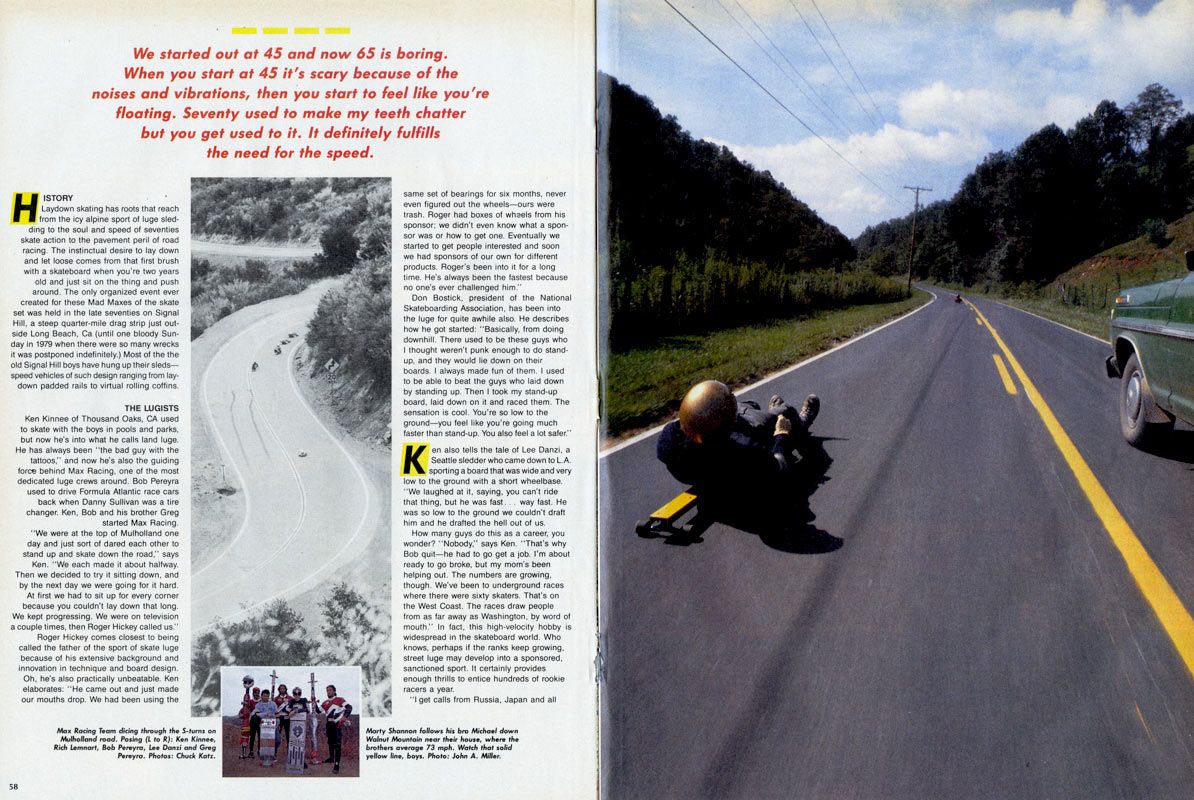
Marty Shannon follows his bro Michael down
Walnut Mountain near their house, where the
brothers average 73 mph. Watch that solid
yellow line, boys. Photo: John A. Miller.