Page Text
            Bad Religion has been cranking out hard-hitting California-style punk rock since 1979. Not
only do their songs have more depth and meaning than the last two books you read, they
also unleash enough pile-driving power to whip any crowd into a frenzy. From their first self-
titled Ep to their latest Lp (No Control) the members of Bad Religion have maintained a standard
of musical and lyrical intensity that is unmatched by their peers. by MCM
ADS
Suffer was considered the best punk
rock record of 1988 by many people and
No Control seems to be getting the
same response. Are you going to sell out
now that you're established again?
Greg-I've heard reports that in Germany
they're saying we already sold out on No
Control. That doesn't make sense. We did
it the same way we did Suffer-we went to
a modest little studio and put it out in about
a month. You have to take other people's
opinions with a grain of salt. I always take
the good with the bad.
Greg H.
Brett
And the ugly.
We're going to sell out, but not yet.
I think that'll be around '97. We're going
to be kind of like the Grateful Dead.
Greg G. The chances of us selling out
are very slim, because there isn't a com-
pany out there in their right mind that would
give us a lot of money. The whole concept
of 'selling out' is pretty absurd if you ask
me. If a band still plays the kind of music
you like, what difference does it make how
well they're doing? People told us we sold
out back in '83 and we had never been
smaller after that record. How is that sell-
ing out? You could argue that selling out
is giving people exactly what they want you
to give them. It's taking an easy road.
Brett-Or you could argue that selling out
is that if you really go against things, you
hold yourself up for a lot of problems.
However, if you flow with things it takes a
little more creativity to be an individual.
Brett I agree with that. But you can be
actively going against something just by
doing nothing. Kids don't have to go out
and bomb their school. I have an apart-
ment and I pay rent-I'm not living in a
squat. I have a job; I'm in the system. Part
of my way of protesting is being in Bad
Religion and spouting out my views at peo-
ple. My reason for doing this, for being anti,
isn't to change the world, it's to change
myself. If you try to make a big fuss, you're
probably not going to change anything.
Greg G. People are too reactionary.
They wouldn't listen to you anyway. The
rule I try to live by is to always be an indi-
vidual. Some say you're vain if you always
bad
religion
would be turning your art over to a cor-
porate conglomerate that's going to take
your money and put it into weapons manu-
facturing. It's a matter of deciding whether
you want to be working for a company
that's involved in things you're against.
Does Bad Religion have a message?
Greg G. Yeah-if you want to be happy,
don't ever go into the music business.
Greg H. Be excellent to each other.
Brett-I think it's good for people to be
skeptical, to question and be anti. If you're
brought up a certain way and your imme-
diate surroundings and environment teach
you a certain thing, you shouldn't just get
swallowed up by it and believe it. You
should question it and even go against it.
Then, in the end, if it turns out that the thing
held up and was worthwhile, you end up
going back to it anyway. Through the pro-
cess of being going against the grain, you
become more alive, more vital, and you'll
learn something in the process.
Greg G.-I agree partly, but the problem
try to measure yourself against other peo
ple, but I think it's the only way to be an
individual and to question things properly.
Do you think that kids in America are en-
couraged to be individuals?
Brett-Are you kidding? I think the entire
world population is turning into a giant
vanilla wafer. People are encouraged to be
homogenous.
Greg G. It's really repulsive. All the
advertising you see is so misleading. It
takes a pretty mature attitude to say, 'I'm
not going to watch TV: Unfortunately, all
the young people in the world are growing
up on TV, which tells you that you can get
the best women if you drive the right car,
you can make the most money if you go
into the right field.
Brett
What makes it worse is that all the
television sitcoms are geared toward the
lowest common denominator so nobody
gets left out and everyone will get the joke.
It waters down the intellect of everybody.
Greg G.-There are a few alternatives of
course. You can't go with what's supplied.
You have to separate everything out.
Brett That's another quiet way to
approach nonconformity. I don't watch
any TV. Well, actually, I watch CNN, but
even when I watch that I think it's bullshit.
I feel like they're telling me half the truth.
Pete Still, the media is a powerful
source. I think that as long as you stay
somewhat skeptical, you can read be-
tween the lines and gain something.
Brett
Radio is another really sad trend.
It's totally prepackaged. The music they
feed us on the airwaves has nothing to
do with what the people want to hear. Take
Metallica for example, they were in the
Billboard top 40 for a long time and they
weren't on any radio stations.
Jay
Bad Religion is another example,
in terms of our popularity. You hear bands
that play on the Sunset Strip on the radio
all the time. We could sell out any club
within a 25-mile radius of this point for five
nights in a row and you'll never hear Bad
Religion on the radio.
Brett Right. And nowadays college.
radio-which used to be a forum for alter-
native music-is almost as formatted as
commercial radio. We can't get Bad
Religion on the college radio charts, even
though our last two records were definitely
in the top fifty most popular underground
records. If it doesn't sound like R.E.M..
kind of industrial like Ministry or Nine Inch
Nails or alternative metal-ish like Sound
Garden or Jane's Addiction, forget it.
Greg G. And what kind of a message
does that send out to everybody? People
who want to be in bands then realize, 'I
The entire world population is turning
into a giant vanilla wafer. People are
encouraged to be homogenous.
better sound like one of these bands if I
want to be popular
Brett-I think eight of the top ten college
radio airplay songs last year were on
either major labels or their subdivisions.
Major labels don't want what happened
in the early eighties to happen again.
Back then all these indie labels sprouted
up because there was a vacuum in the
marketplace. Groups like Black Flag sold
big numbers and the majors weren't in on
it because they were caught with their
pants down. So now they're like, "We'll just
sign up everybody, we'll flood the college
radio stations with promo, and if anyone
gets popular we'll already be in on it."
KRFA
Acuting
Edge
Music
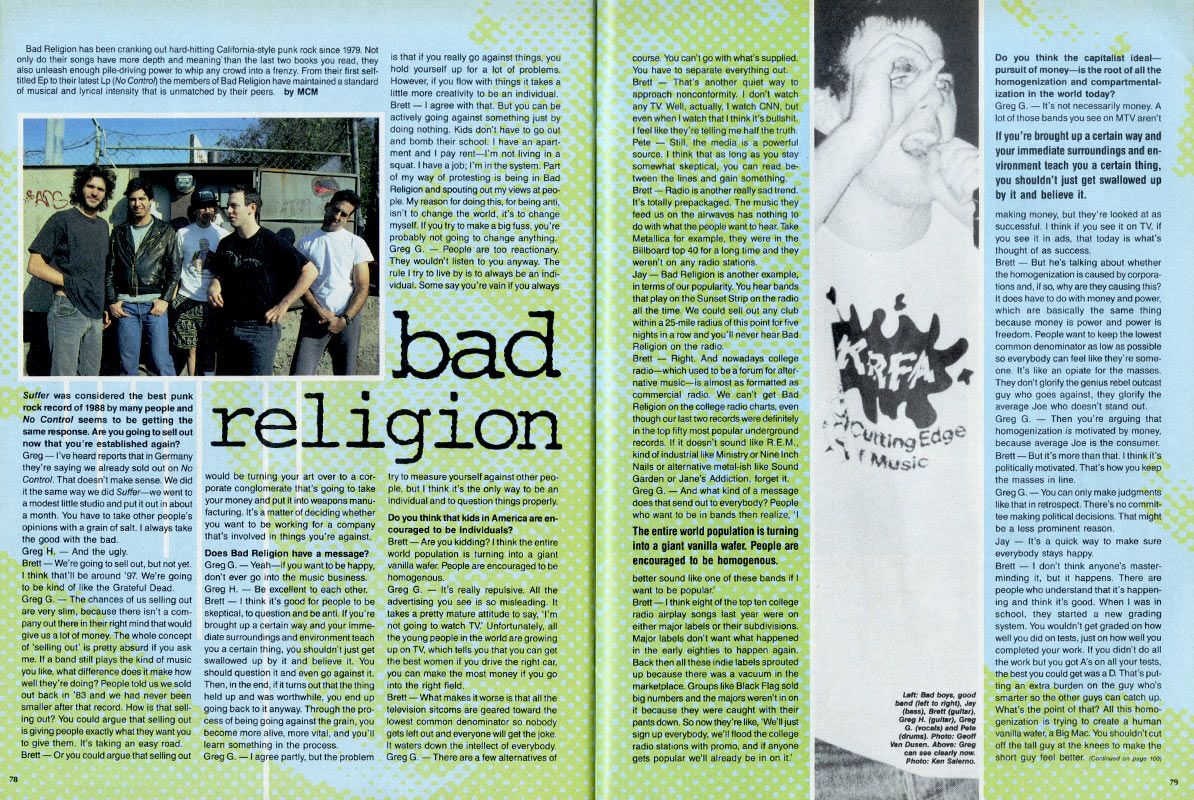
Left: Bad boys, good
band (left to right), Jay
(bass), Brett (guitar).
Greg H. (guitar), Greg
G. (vocals) and Pete
(drums). Photo: Geoff
Van Dusen. Above: Greg
can see clearly now.
Photo: Ken Salerno.
Do you think the capitalist ideal-
pursuit of money-is the root of all the
homogenization and compartmental-
ization in the world today?
Greg G. It's not necessarily money. A
lot of those bands you see on MTV aren't
If you're brought up a certain way and
your immediate surroundings and en-
vironment teach you a certain thing,
you shouldn't just get swallowed up
by it and believe it.
making money, but they're looked at as
successful. I think if you see it on TV, if
you see it in ads, that today is what's
thought of as success.
Brett
But he's talking about whether
the homogenization is caused by corpora-
tions and, if so, why are they causing this?
It does have to do with money and power,
which are basically the same thing.
because money is power and power is
freedom. People want to keep the lowest
common denominator as low as possible
so everybody can feel like they're some-
one. It's like an opiate for the masses.
They don't glorify the genius rebel outcast.
guy who goes against, they glorify thei
average Joe who doesn't stand out.
Greg G. Then you're arguing that
homogenization is motivated by money,
because average Joe is the consumer.
Brett But it's more than that. I think it's
politically motivated. That's how you keep
the masses in line.
Greg G. You can only make judgments
like that in retrospect. There's no commit-
tee making political decisions. That might
be a less prominent reason.
Jay It's a quick way to make sure
everybody stays happy.
Brett I don't think anyone's master-
minding it, but it happens. There are
people who understand that it's happen-
ing and think it's good. When I was in
school, they started a new grading
system. You wouldn't get graded on how
well you did on tests, just on how well you
completed your work. If you didn't do all
the work but you got A's on all your tests,
the best you could get was a D. That's put-
ting an extra burden on the guy who's
smarter so the other guys can catch up.
What's the point of that? All this homo-
genization is trying to create a human.
vanilla wafer, a Big Mac. You shouldn't cut
off the tall guy at the knees to make the
short guy feel better. (Continued on page 100)
78
79