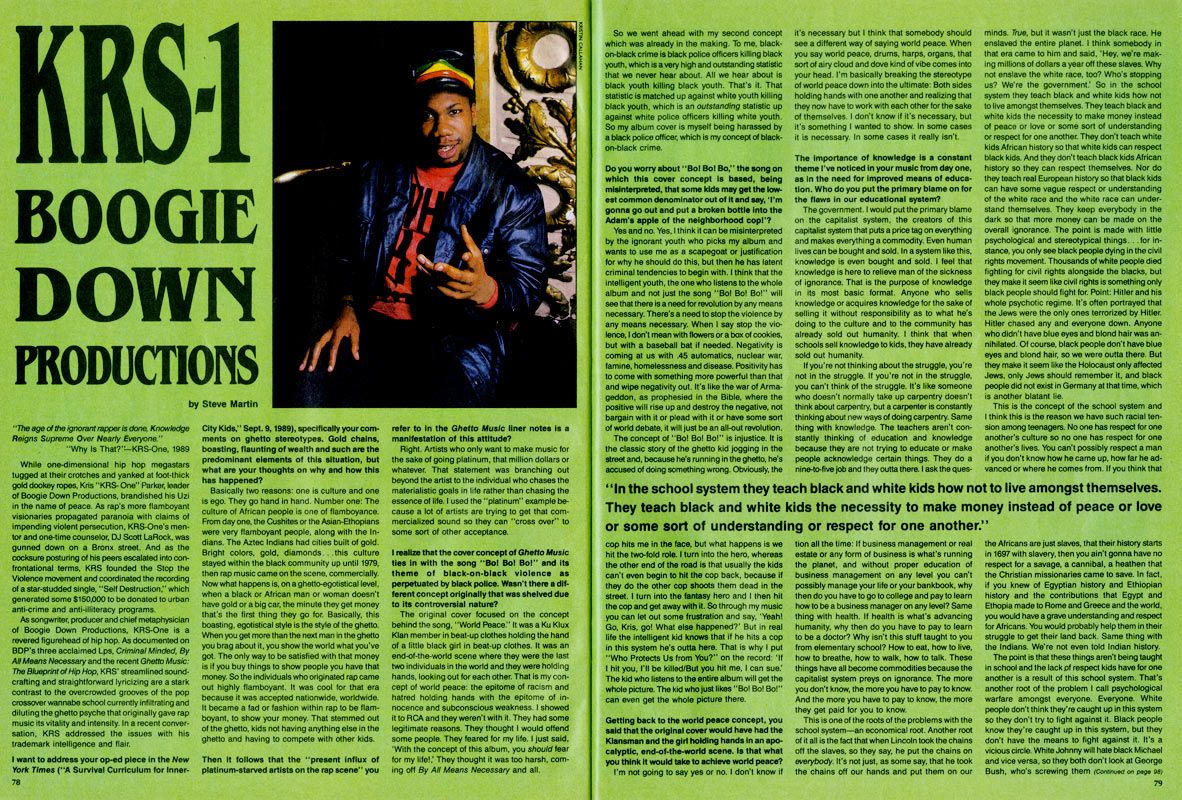
Page Text
            KRS-1
BOOGIE
DOWN
PRODUCTIONS
"The age of the ignorant rapper is done, Knowledge
Reigns Supreme Over Nearly Everyone."
"Why Is That?"-KRS-One, 1989
While one-dimensional hip hop megastars
tugged at their crotches and yanked at foot-thick
gold dookey ropes, Kris "KRS-One" Parker, leader
of Boogie Down Productions, brandished his Uzi
in the name of peace. As rap's more flamboyant
visionaries propagated paranoia with claims of
impending violent persecution, KRS-One's men-
tor and one-time counselor, DJ Scott LaRock, was
gunned down on a Bronx street. And as the
cocksure posturing of his peers escalated into con-
frontational terms, KRS founded the Stop the
Violence movement and coordinated the recording
of a star-studded single, "Self Destruction," which
generated some $150,000 to be donated to urban
anti-crime and anti-illiteracy programs.
As songwriter, producer and chief metaphysician
of Boogie Down Productions, KRS-One is a
revered figurehead of hip hop. As documented on
BDP's three acclaimed Lps, Criminal Minded, By
All Means Necessary and the recent Ghetto Music:
The Blueprint of Hip Hop, KRS' streamlined sound-
crafting and straightforward lyricizing are a stark
contrast to the overcrowded grooves of the pop
crossover wannabe school currently infiltrating and
diluting the ghetto psyche that originally gave rap
music its vitality and intensity. In a recent conver-
sation, KRS addressed the issues with his
trademark intelligence and flair.
I want to address your op-ed plece in the New
York Times ("A Survival Curriculum for Inner-
78
by Steve Martin
City Kids," Sept. 9, 1989), specifically your com-
ments on ghetto stereotypes. Gold chains,
boasting, flaunting of wealth and such are the
predominant elements of this situation, but
what are your thoughts on why and how this
has happened?
Basically two reasons: one is culture and one
is ego. They go hand in hand. Number one: The
culture of African people is one of flamboyance.
From day one, the Cushites or the Asian-Ethopians
were very flamboyant people, along with the In-
dians. The Aztec Indians had cities built of gold.
Bright colors, gold, diamonds...this culture
stayed within the black community up until 1979,
then rap music came on the scene, commercially.
Now what happens is, on a ghetto-egotistical level,
when a black or African man or woman doesn't
have gold or a big car, the minute they get money
that's the first thing they go for. Basically, this
boasting, egotistical style is the style of the ghetto.
When you get more than the next man in the ghetto
you brag about it, you show the world what you've
got. The only way to be satisfied with that money
is if you buy things to show people you have that
money. So the individuals who originated rap came
out highly flamboyant. It was cool for that era
because it was accepted nationwide, worldwide.
It became a fad or fashion within rap to be flam-
boyant, to show your money. That stemmed out
of the ghetto, kids not having anything else in the
ghetto and having to compete with other kids.
Then it follows that the "present influx of
platinum-starved artists on the rap scene" you
refer to in the Ghetto Music liner notes is a
manifestation of this attitude?
Right. Artists who only want to make music for
the sake of going platinum, that million dollars or
whatever. That statement was branching out
beyond the artist to the individual who chases the
materialistic goals in life rather than chasing the
essence of life. I used the "platinum" example be-
cause a lot of artists are trying to get that com-
mercialized sound so they can "cross over" to
some sort of other acceptance.
I realize that the cover concept of Ghetto Music
ties in with the song "Bol Bol Bol" and its
theme of black-on-black violence as
perpetuated by black police. Wasn't there a dif-
ferent concept originally that was shelved due
to its controversial nature?
The original cover focused on the concept
behind the song, "World Peace." It was a Ku Klux
Klan member in beat-up clothes holding the hand
of a little black girl in beat-up clothes. It was an
end-of-the-world scene where they were the last
two individuals in the world and they were holding
hands, looking out for each other. That is my con-
cept of world peace: the epitome of racism and
hatred holding hands with the epitome of in-
nocence and subconscious weakness. I showed
it to RCA and they weren't with it. They had some
legitimate reasons. They thought I would offend
some people. They feared for my life. I just said,
"With the concept of this album, you should fear
for my life!. They thought it was too harsh, com-
ing off By All Means Necessary and all.
So we went ahead with my second concept
which was already in the making. To me, black-
on-black crime is black police officers killing black
youth, which is a very high and outstanding statistic
that we never hear about. All we hear about is
black youth killing black youth. That's it. That
statistic is matched up against white youth killing
black youth, which is an outstanding statistic up
against white police officers killing white youth.
So my album cover is myself being harassed by
a black police officer, which is my concept of black-
on-black crime.
Do you worry about "Bol Bol Bo," the song on
which this cover concept is based, being
misinterpreted, that some kids may get the low-
est common denominator out of it and say, 'I'm
gonna go out and put a broken bottle into the
Adam's apple of the neighborhood cop!"?
Yes and no. Yes, I think it can be misinterpreted
by the ignorant youth who picks my album and
wants to use me as a scapegoat or justification
for why he should do this, but then he has latent
criminal tendencies to begin with. I think that the
intelligent youth, the one who listens to the whole
album and not just the song "Bol Bol Bo!" will
see that there is a need for revolution by any means
necessary. There's a need to stop the violence by
any means necessary. When I say stop the vio-
lence, I don't mean with flowers or a box of cookies,
but with a baseball bat if needed. Negativity is
coming at us with 45 automatics, nuclear war,
famine, homelessness and disease. Positivity has
to come with something more powerful than that
and wipe negativity out. It's like the war of Arma-
geddon, as prophesied in the Bible, where the
positive will rise up and destroy the negative, not
bargain with it or plead with it or have some sort
of world debate, it will just be an all-out revolution.
The concept of "Bol Bol Bo!" is injustice. It is
the classic story of the ghetto kid jogging in the
street and, because he's running in the ghetto, he's
accused of doing something wrong. Obviously, the
it's necessary but I think that somebody should
see a different way of saying world peace. When
you say world peace, drums, harps, organs, that
sort of airy cloud and dove kind of vibe comes into
your head. I'm basically breaking the stereotype
of world peace down into the ultimate: Both sides
holding hands with one another and realizing that
they now have to work with each other for the sake
of themselves. I don't know if it's necessary, but
it's something I wanted to show. In some cases
it is necessary. In some cases it really isn't.
The importance of knowledge is a constant
theme I've noticed in your music from day one,
as in the need for improved means of educa-
tion. Who do you put the primary blame on for
the flaws in our educational system?
The government. I would put the primary blame
on the capitalist system, the creators of this
capitalist system that puts a price tag on everything
and makes everything a commodity. Even human
lives can be bought and sold. In a system like this,
knowledge is even bought and sold. I feel that
knowledge is here to relieve man of the sickness
of ignorance. That is the purpose of knowledge
in its most basic format. Anyone who sells
knowledge or acquires knowledge for the sake of
selling it without responsibility as to what he's
doing to the culture and to the community has
already sold out humanity. I think that when
schools sell knowledge to kids, they have already
sold out humanity.
If you're not thinking about the struggle, you're
not in the struggle. If you're not in the struggle,
you can't think of the struggle. It's like someone
who doesn't normally take up carpentry doesn't
think about carpentry, but a carpenter is constantly
thinking about new ways of doing carpentry. Same
thing with knowledge. The teachers aren't con-
stantly thinking of education and knowledge
because they are not trying to educate or make
people acknowledge certain things. They do a
nine-to-five job and they outta there. I ask the ques-
minds. True, but it wasn't just the black race. He
enslaved the entire planet. I think somebody in
that era came to him and said, "Hey, we're mak-
ing millions of dollars a year off these slaves. Why
not enslave the white race, too? Who's stopping
us? We're the government. So in the school
system they teach black and white kids how not
to live amongst themselves. They teach black and
white kids the necessity to make money instead.
of peace or love or some sort of understanding
or respect for one another. They don't teach white
kids African history so that white kids can respect
black kids. And they don't teach black kids African
history so they can respect themselves. Nor do
they teach real European history so that black kids
can have some vague respect or understanding
of the white race and the white race can under-
stand themselves. They keep everybody in the
dark so that more money can be made on the
overall ignorance. The point is made with little
psychological and stereotypical things...for in-
stance, you only see black people dying in the civil
rights movement. Thousands of white people died
fighting for civil rights alongside the blacks, but
they make it seem like civil rights is something only
black people should fight for. Point: Hitler and his
whole psychotic regime. It's often portrayed that
the Jews were the only ones terrorized by Hitler.
Hitler chased any and everyone down. Anyone
who didn't have blue eyes and blond hair was an-
nihilated. Of course, black people don't have blue
eyes and blond hair, so we were outta there. But
they make it seem like the Holocaust only affected
Jews, only Jews should remember it, and black
people did not exist in Germany at that time, which
is another blatant lie.
This is the concept of the school system and
I think this is the reason we have such racial ten-
sion among teenagers. No one has respect for one
another's culture so no one has respect for one
another's lives. You can't possibly respect a man
if you don't know how he came up, how far he ad-
vanced or where he comes from. If you think that
"In the school system they teach black and white kids how not to live amongst themselves.
They teach black and white kids the necessity to make money instead of peace or love
or some sort of understanding or respect for one another."
cop hits me in the face, but what happens is we
hit the two-fold role. I turn into the hero, whereas
the other end of the road is that usually the kids
can't even begin to hit the cop back, because if
they do the other cop shoots them dead in the
street. I turn into the fantasy hero and I then hit
the cop and get away with it. So through my music
you can let out some frustration and say, 'Yeah!
Go, Kris, go! What else happened?' But in real
life the intelligent kid knows that if he hits a cop
in this system he's outta here. That is why I put
"Who Protects Us from You?" on the record: 'If
I hit you, I'll be killed/But you hit me, I can sue.
The kid who listens to the entire album will get the
whole picture. The kid who just likes "Bol Bol Bol"
can even get the whole picture there.
Getting back to the world peace concept, you
said that the original cover would have had the
Klansman and the girl holding hands in an apo-
calyptic, end-of-the-world scene. Is that what
you think it would take to achieve world peace?
I'm not going to say yes or no. I don't know if
tion all the time: If business management or real
estate or any form of business is what's running
the planet, and without proper education of
business management on any level you can't
possibly manage your life or your bankbook, why
then do you have to go to college and pay to learn
how to be a business manager on any level? Same
thing with health. If health is what's advancing
humanity, why then do you have to pay to learn
to be a doctor? Why isn't this stuff taught to you
from elementary school? How to eat, how to live,
how to breathe, how to walk, how to talk. These
things have all become commodities because the
capitalist system preys on ignorance. The more
you don't know, the more you have to pay to know.
And the more you have to pay to know, the more
they get paid for you to know.
This is one of the roots of the problems with the
school system-an economical root. Another root
of it all is the fact that when Lincoln took the chains
off the slaves, so they say, he put the chains on
everybody. It's not just, as some say, that he took
the chains off our hands and put them on our
the Africans are just slaves, that their history starts
in 1697 with slavery, then you ain't gonna have no
respect for a savage, a cannibal, a heathen that
the Christian missionaries came to save. In fact,
if you knew of Egyptian history and Ethiopian
history and the contributions that Egypt and.
Ethopia made to Rome and Greece and the world,
you would have a grave understanding and respect
for Africans. You would probably help them in their
struggle to get their land back. Same thing with
the Indians. We're not even told Indian history.
The point is that these things aren't being taught
in school and the lack of respect kids have for one
another is a result of this school system. That's
another root of the problem I call psychological
warfare amongst everyone. Everyone. White
people don't think they're caught up in this system
so they don't try to fight against it. Black people
know they're caught up in this system, but they
don't have the means to fight against it. It's a
vicious circle. White Johnny will hate black Michael
and vice versa, so they both don't look at George
Bush, who's screwing them (Continued on page 98)
79