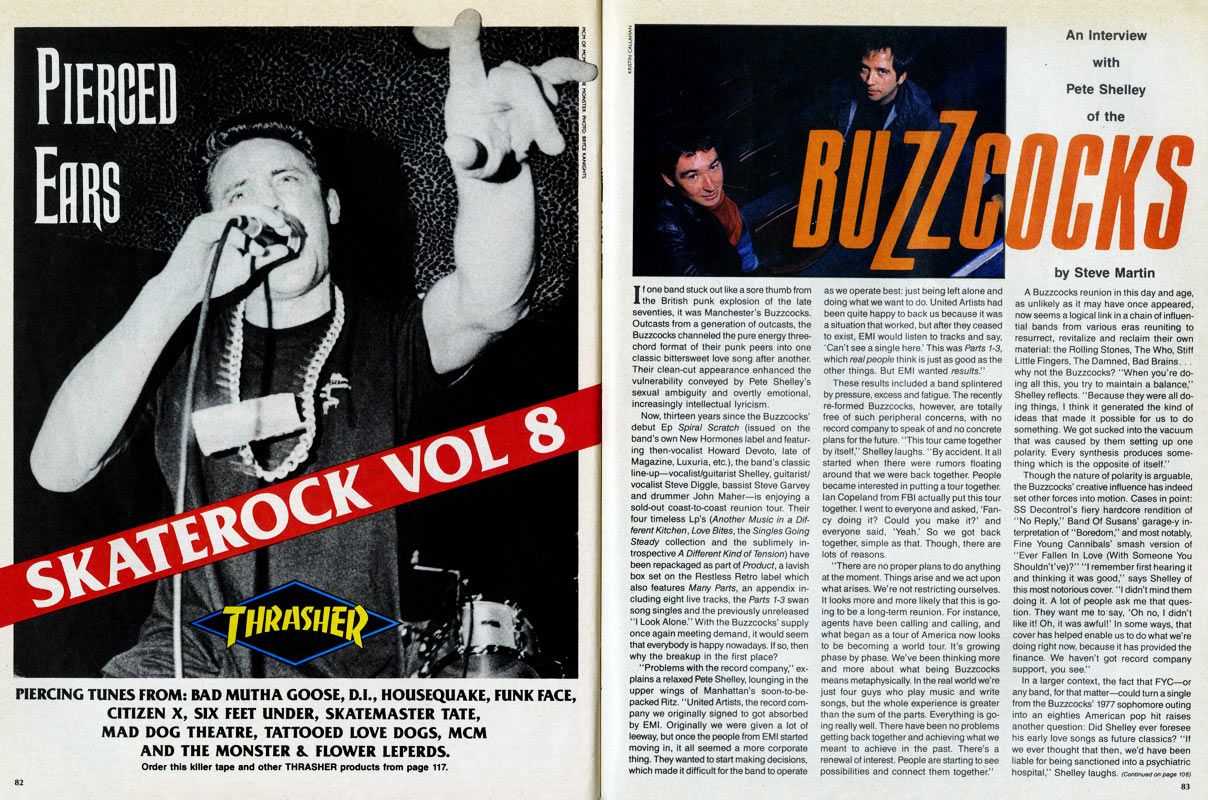
Page Text
            Fors
SKATEROCK VOL 8
THRASHER
PIERCING TUNES FROM: BAD MUTHA GOOSE, D.I., HOUSEQUAKE, FUNK FACE,
CITIZEN X, SIX FEET UNDER, SKATEMASTER TATE,
MAD DOG THEATRE, TATTOOED LOVE DOGS, MCM
AND THE MONSTER & FLOWER LEPERDS.
Order this killer tape and other THRASHER products from page 117.
out thumb
An Interview
with
Pete Shelley
of the
BUZZCOCKS
the British punk explosion of the late doing what we want to do. United Artists had
seventies, it was Manchester's Buzzcocks.
Outcasts from a generation of outcasts, the
Buzzcocks channeled the pure energy three-
chord format of their punk peers into one
classic bittersweet love song after another.
Their clean-cut appearance enhanced the
vulnerability conveyed by Pete Shelley's
sexual ambiguity and overtly emotional,
increasingly intellectual lyricism.
Now, thirteen years since the Buzzcocks'
debut Ep Spiral Scratch (issued on the
band's own New Hormones label and featur
ing then-vocalist Howard Devoto, late of
Magazine, Luxuria, etc.), the band's classic
line-up-vocalist/guitarist Shelley, guitarist/
vocalist Steve Diggle, bassist Steve Garvey
and drummer John Maher-is enjoying a
sold-out coast-to-coast reunion tour. Their
four timeless Lp's (Another Music in a Dif-
ferent Kitchen, Love Bites, the Singles Going
Steady collection and the sublimely in-
trospective A Different Kind of Tension) have
been repackaged as part of Product, a lavish
box set on the Restless Retro label which
also features Many Parts, an appendix in-
cluding eight live tracks, the Parts 1-3 swan
song singles and the previously unreleased
"I Look Alone." With the Buzzcocks' supply
once again meeting demand, it would seem
that everybody is happy nowadays. If so, then
why the breakup in the first place?
"Problems with the record company," ex-
plains a relaxed Pete Shelley, lounging in the
upper wings of Manhattan's soon-to-be-
packed Ritz. "United Artists, the record com-
pany we originally signed to got absorbed
by EMI. Originally we were given a lot of
leeway, but once the people from EMI started
moving in, it all seemed a more corporate
thing. They wanted to start making decisions,
which made it difficult for the band to operate
as we operate best: just being left alone and
been quite happy to back us because it was
a situation that worked, but after they ceased
to exist, EMI would listen to tracks and say,
"Can't see a single here. This was Parts 1-3,
which real people think is just as good as the
other things. But EMI wanted results."
These results included a band splintered
by pressure, excess and fatigue. The recently
re-formed Buzzcocks, however, are totally
free of such peripheral concerns, with no
record company to speak of and no concrete
plans for the future. "This tour came together
by itself," Shelley laughs. "By accident. It all
started when there were rumors floating
around that we were back together. People
became interested in putting a tour together.
lan Copeland from FBI actually put this tour
together. I went to everyone and asked, 'Fan-
cy doing it? Could you make it?' and
everyone said, "Yeah. So we got back
together, simple as that. Though, there are
lots of reasons.
"There are no proper plans to do anything
at the moment. Things arise and we act upon
what arises. We're not restricting ourselves.
It looks more and more likely that this is go-
ing to be a long-term reunion. For instance,
agents have been calling and calling, and
what began as a tour of America now looks
to be becoming a world tour. It's growing
phase by phase. We've been thinking more
and more about what being Buzzcocks
means metaphysically. In the real world we're
just four guys who play music and write
songs, but the whole experience is greater
than the sum of the parts. Everything is go
ing really well. There have been no problems
getting back together and achieving what we
meant to achieve in the past. There's a
renewal of interest. People are starting to see
possibilities and connect them together."
by Steve Martin
as unlikely as it may have once appeared,
A Buzzcocks reunion in this day and age,
now seems a logical link in a chain of influen-
tial bands from various eras reuniting to
resurrect, revitalize and reclaim their own
material: the Rolling Stones, The Who, Stiff
Little Fingers, The Damned, Bad Brains....
why not the Buzzcocks? "When you're do-
ing all this, you try to maintain a balance,"
Shelley reflects. "Because they were all do-
ing things, I think it generated the kind of
ideas that made it possible for us to do
something. We got sucked into the vacuum
that was caused by them setting up one
polarity. Every synthesis produces some-
thing which is the opposite of itself."
Though the nature of polarity is arguable,
the Buzzcocks' creative influence has indeed
set other forces into motion. Cases in point:
SS Decontrol's fiery hardcore rendition of
"No Reply," Band Of Susans' garage-y in-
terpretation of "Boredom," and most notably,
Fine Young Cannibals' smash version of
"Ever Fallen In Love (With Someone You
Shouldn't've)?" "I remember first hearing it
and thinking it was good," says Shelley of
this most notorious cover. "I didn't mind them
doing it. A lot of people ask me that ques-
tion. They want me to say, 'Oh no, I didn't
like it! Oh, it was awful!' In some ways, that
cover has helped enable us to do what we're
doing right now, because it has provided the
finance. We haven't got record company
support, you see."
In a larger context, the fact that FYC-or
any band, for that matter-could turn a single
from the Buzzcocks' 1977 sophomore outing
into an eighties American pop hit raises
another question: Did Shelley ever foresee.
his early love songs as future classics? "If
we ever thought that then, we'd have been
liable for being sanctioned into a psychiatric
hospital," Shelley laughs. (Continued on page 106)
83