Page Text
            ASICS TIGE
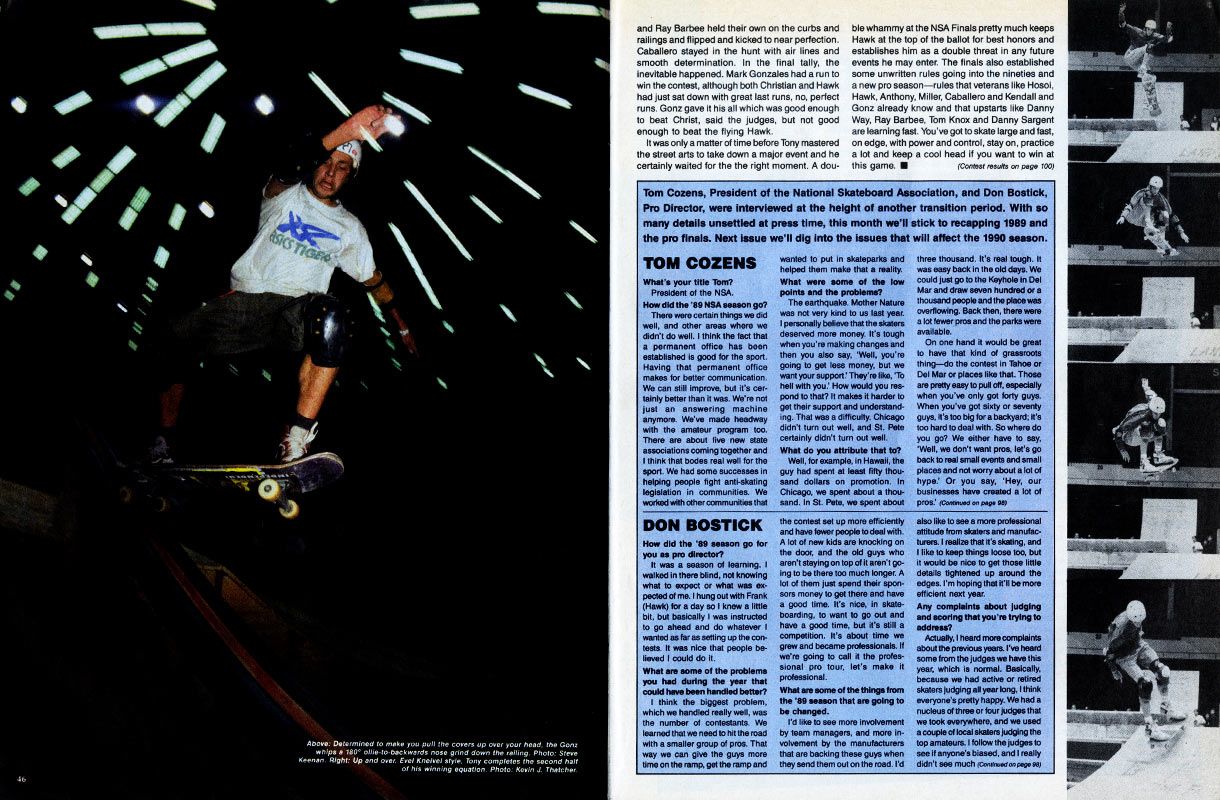
Above: Determined to make you pull the covers up over your head, the Gonz
whips a 180° ollie-to-backwards nose grind down the railing. Photo: Steve
Keenan. Right: Up and over. Evel Kneivel style, Tony completes the second half
of his winning equation. Photo: Kevin J. Thatcher
and Ray Barbee held their own on the curbs and
railings and flipped and kicked to near perfection.
Caballero stayed in the hunt with air lines and
smooth determination. In the final tally, the
inevitable happened. Mark Gonzales had a run to
win the contest, although both Christian and Hawk
had just sat down with great last runs, no, perfect
runs. Gonz gave it his all which was good enough
to beat Christ, said the judges, but not good
enough to beat the flying Hawk.
It was only a matter of time before Tony mastered
the street arts to take down a major event and he
certainly waited for the the right moment. A dou-
ble whammy at the NSA Finals pretty much keeps
Hawk at the top of the ballot for best honors and
establishes him as a double threat in any future
events he may enter. The finals also established
some unwritten rules going into the nineties and
a new pro season-rules that veterans like Hosol,
Hawk, Anthony, Miller, Caballero and Kendall and
Gonz already know and that upstarts like Danny
Way, Ray Barbee, Tom Knox and Danny Sargent
are learning fast. You've got to skate large and fast,
on edge, with power and control, stay on, practice
a lot and keep a cool head if you want to win at
this game.
(Contest results on page 100)
Tom Cozens, President of the National Skateboard Association, and Don Bostick,
Pro Director, were interviewed at the height of another transition period. With so
many details unsettled at press time, this month we'll stick to recapping 1989 and
the pro finals. Next issue we'll dig into the issues that will affect the 1990 season.
TOM COZENS
What's your title Tom?
President of the NSA.
How did the '89 NSA season go?
There were certain things we did
well, and other areas where we
didn't do well. I think the fact that
a permanent office has been
established is good for the sport.
Having that permanent office
makes for better communication.
We can still improve, but it's cer-
tainly better than it was. We're not
just an answering machine
anymore. We've made headway
with the amateur program too.
There are about five new state
associations coming together and
I think that bodes real well for the
sport. We had some successes in
helping people fight anti-skating
legislation in communities. We
worked with other communities that
DON BOSTICK
How did the '89 season go for
you as pro director?
It was a season of learning. I
walked in there blind, not knowing
what to expect or what was ex-
pected of me. I hung out with Frank
(Hawk) for a day so I knew a little
bit, but basically I was instructed
to go ahead and do whatever I
wanted as far as setting up the con-
tests. It was nice that people be-
lieved I could do it.
What are some of the problems
you had during the year that
could have been handled better?
I think the biggest problem,
which we handled really well, was
the number of contestants. We
learned that we need to hit the road
with a smaller group of pros. That
way we can give the guys more
time on the ramp, get the ramp and
wanted to put in skateparks and
helped them make that a reality.
What were some of the low
points and the problems?
The earthquake. Mother Nature
was not very kind to us last year.
I personally believe that the skaters
deserved more money. It's tough
when you're making changes and
then you also say, 'Well, you're
going to get less money, but we
want your support! They're like, "To
hell with you. How would you res-
pond to that? It makes it harder to
get their support and understand-
ing. That was a difficulty. Chicago
didn't turn out well, and St. Pete
certainly didn't turn out well.
What do you attribute that to?
Well, for example, in Hawaii, the
guy had spent at least fifty thou-
sand dollars on promotion. In
Chicago, we spent about a thou-
sand. In St. Pete, we spent about
the contest set up more efficiently
and have fewer people to deal with.
A lot of new kids are knocking on
the door, and the old guys who
aren't staying on top of it aren't go-
ing to be there too much longer. A
lot of them just spend their spon-
sors money to get there and have
a good time. It's nice, in skate-
boarding, to want to go out and
have a good time, but it's still a
competition. It's about time we
grew and became professionals. If
we're going to call it the profes-
sional pro tour, let's make it
professional.
What are some of the things from
the '89 season that are going to
be changed.
I'd like to see more involvement
by team managers, and more in-
volvement by the manufacturers
that are backing these guys when
they send them out on the road. I'd
three thousand. It's real tough. It
was easy back in the old days. We
could just go to the Keyhole in Del
Mar and draw seven hundred or a
thousand people and the place was
overflowing. Back then, there were
a lot fewer pros and the parks were
available.
On one hand it would be great
to have that kind of grassroots
thing-do the contest in Tahoe or
Del Mar or places like that. Those
are pretty easy to pull off, especially
when you've only got forty guys.
When you've got sixty or seventy
guys, it's too big for a backyard; it's
too hard to deal with. So where do
you go? We either have to say,
"Well, we don't want pros, let's go
back to real small events and small
places and not worry about a lot of
hype. Or you say, 'Hey, our
businesses have created a lot of
pros. (Continued on page 98)
also like to see a more professional
attitude from skaters and manufac
turers. I realize that it's skating, and
I like to keep things loose too, but
it would be nice to get those little
details tightened up around the
edges. I'm hoping that it'll be more
efficient next year.
Any complaints about judging
and scoring that you're trying to
address?
Actually, I heard more complaints
about the previous years. I've heard
some from the judges we have this
year, which is normal. Basically,
because we had active or retired
skaters judging all year long, I think
everyone's pretty happy. We had a
nucleus of three or four judges that
we took everywhere, and we used
a couple of local skaters judging the
top amateurs. I follow the judges to
see if anyone's biased, and I really
didn't see much (Continued on pege 98)
LAS