Page Text
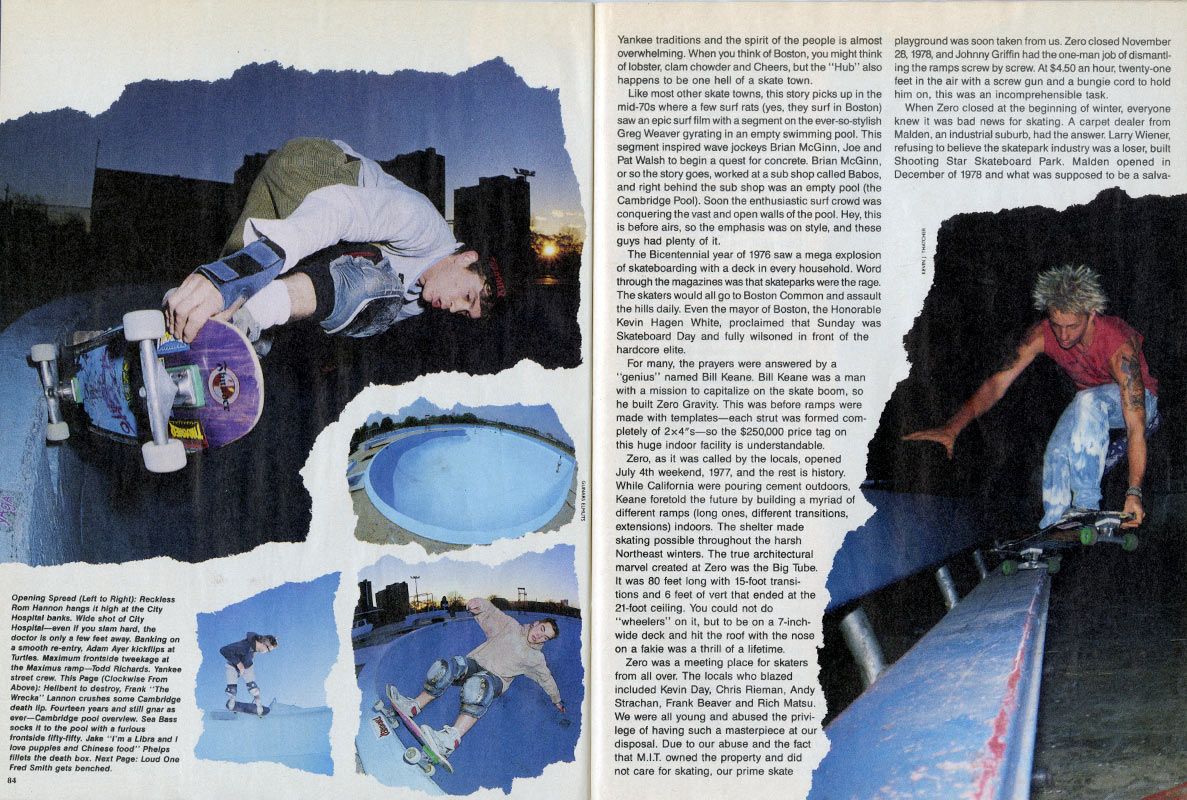
            Opening Spread (Left to Right): Reckless
Rom Hannon hangs it high at the City
Hospital banks. Wide shot of City
Hospital-even if you slam hard, the
doctor is only a few feet away. Banking on
a smooth re-entry, Adam Ayer kickflips at
Turtles. Maximum frontside tweekage at
the Maximus ramp-Todd Richards. Yankee
street crew. This Page (Clockwise From
Above): Hellbent to destroy, Frank "The
Wrecka" Lannon crushes some Cambridge
death lip. Fourteen years and still gnar as
ever-Cambridge pool overview. Sea Bass
socks it to the pool with a furious
frontside fifty-fifty. Jake "I'm a Libra and I
love pupples and Chinese food" Phelps
fillets the death box. Next Page: Loud One
Fred Smith gets benched.
Yankee traditions and the spirit of the people is almost
overwhelming. When you think of Boston, you might think
of lobster, clam chowder and Cheers, but the "Hub" also
happens to be one hell of a skate town.
Like most other skate towns, this story picks up in the
mid-70s where a few surf rats (yes, they surf in Boston)
saw an epic surf film with a segment on the ever-so-stylish
Greg Weaver gyrating in an empty swimming pool. This
segment inspired wave jockeys Brian McGinn, Joe and
Pat Walsh to begin a quest for concrete. Brian McGinn,
or so the story goes, worked at a sub shop called Babos,
and right behind the sub shop was an empty pool (the
Cambridge Pool). Soon the enthusiastic surf crowd was
conquering the vast and open walls of the pool. Hey, this
is before airs, so the emphasis was on style, and these
guys had plenty of it.
The Bicentennial year of 1976 saw a mega explosion
of skateboarding with a deck in every household. Word
through the magazines was that skateparks were the rage.
The skaters would all go to Boston Common and assault
the hills daily. Even the mayor of Boston, the Honorable
Kevin Hagen White, proclaimed that Sunday was
Skateboard Day and fully wilsoned in front of the
hardcore elite.
For many, the prayers were answered by a
"genius" named Bill Keane. Bill Keane was a man
with a mission to capitalize on the skate boom, so
he built Zero Gravity. This was before ramps were
made with templates-each strut was formed com-
pletely of 2x4"s-so the $250,000 price tag on
this huge indoor facility is understandable.
Zero, as it was called by the locals, opened
July 4th weekend, 1977, and the rest is history.
While California were pouring cement outdoors,
Keane foretold the future by building a myriad of
different ramps (long ones, different transitions,
extensions) indoors. The shelter made
skating possible throughout the harsh
Northeast winters. The true architectural
marvel created at Zero was the Big Tube.
It was 80 feet long with 15-foot transi-
tions and 6 feet of vert that ended at the
21-foot ceiling. You could not do
"wheelers" on it, but to be on a 7-inch-
wide deck and hit the roof with the nose
on a fakie was a thrill of a lifetime.
Zero was a meeting place for skaters
from all over. The locals who blazed
included Kevin Day, Chris Rieman, Andy
Strachan, Frank Beaver and Rich Matsu.
We were all young and abused the privi-
lege of having such a masterpiece at our
disposal. Due to our abuse and the fact
that M.I.T. owned the property and did
not care for skating, our prime skate
playground was soon taken from us. Zero closed November
28, 1978, and Johnny Griffin had the one-man job of dismantl
ing the ramps screw by screw. At $4.50 an hour, twenty-one
feet in the air with a screw gun and a bungie cord to hold
him on, this was an incomprehensible task.
When Zero closed at the beginning of winter, everyone
knew it was bad news for skating. A carpet dealer from
Malden, an industrial suburb, had the answer. Larry Wiener,
refusing to believe the skatepark industry was a loser, built
Shooting Star Skateboard Park. Malden opened in
December of 1978 and what was supposed to be a salva-