Page Text
            86
the Skater
from the
Stars
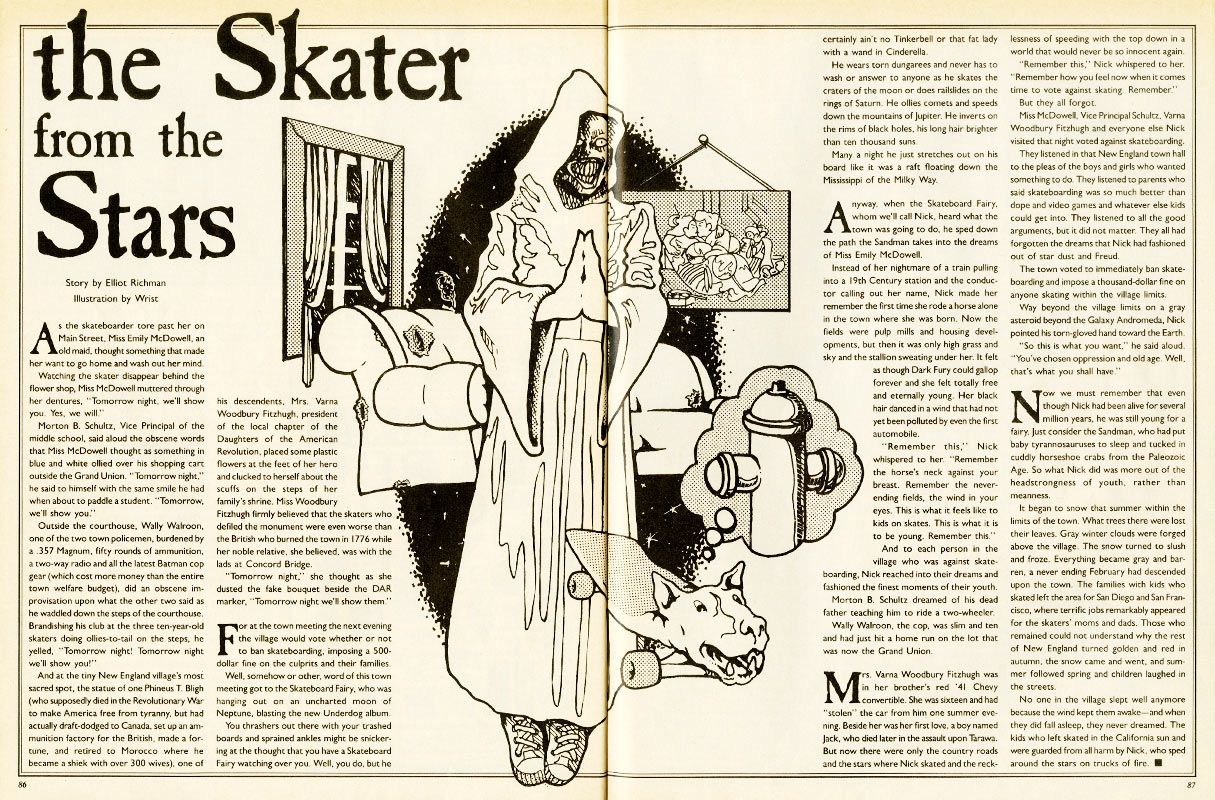
Story by Elliot Richman:
Illustration by Wrist
s the skateboarder tore past her on
Main Street. Miss Emily McDowell, an
old
AM
dmaid, thought something that made
her want to go home and wash out her mind.
Watching the skater disappear behind the
flower shop, Miss McDowell muttered through
her dentures, "Tomorrow night, we'll show
you. Yes, we will."
Morton B. Schultz, Vice Principal of the
middle school, said aloud the obscene words
that Miss McDowell thought as something in
blue and white ollied over his shopping cart
outside the Grand Union. "Tomorrow night,"
he said to himself with the same smile he had
when about to paddle a student. "Tomorrow,
we'll show you."
Outside the courthouse, Wally Walroon,
one of the two town policemen, burdened by
a .357 Magnum, fifty rounds of ammunition,
a two-way radio and all the latest Batman cop
gear (which cost more money than the entire
town welfare budget), did an obscene im-
provisation upon what the other two said as
he waddled down the steps of the courthouse.
Brandishing his club at the three ten-year-old
skaters doing ollies-to-tail on the steps, he
yelled, "Tomorrow night! Tomorrow night
we'll show you!"
And at the tiny New England village's most
sacred spot, the statue of one Phineus T. Bligh
(who supposedly died in the Revolutionary War
to make America free from tyranny, but had
actually draft-dodged to Canada, set up an am-
munition factory for the British, made a for-
tune, and retired to Morocco where he
became a shiek with over 300 wives), one of
his descendents, Mrs. Varna
Woodbury Fitzhugh, president
of the local chapter of the
Daughters of the American
Revolution, placed some plastic
flowers at the feet of her hero
and clucked to herself about the
scuffs on the steps of her
family's shrine. Miss Woodbury
Fitzhugh firmly believed that the skaters who
defiled the monument were even worse than
the British who burned the town in 1776 while
her noble relative, she believed, was with the
lads at Concord Bridge.
"Tomorrow night," she thought as she
dusted the fake bouquet beside the DAR
marker, "Tomorrow night we'll show them."
or at the town meeting the next evening
the village would vote whether or not
dollar fine on the culprits and their families.
Well, somehow or other, word of this town
meeting got to the Skateboard Fairy, who was
hanging out on an uncharted moon of
Neptune, blasting the new Underdog album
You thrashers out there with your trashed
boards and sprained ankles might be snicker-
ing at the thought that you have a Skateboard
Fairy watching over you. Well, you do, but he
certainly ain't no Tinkerbell or that fat lady.
with a wand in Cinderella.
He wears torn dungarees and never has to
wash or answer to anyone as he skates the
craters of the moon or does railslides on the
rings of Saturn. He ollies comets and speeds
down the mountains of Jupiter. He inverts on
the rims of black holes, his long hair brighter
than ten thousand suns.
Many a night he just stretches out on his
board like it was a raft floating down the
Mississippi of the Milky Way.
A
nyway, when the Skateboard Fairy,
whom we'll call Nick, heard what the
town was going to do, he sped down
the path the Sandman takes into the dreams
of Miss Emily McDowell..
Instead of her nightmare of a train pulling
into a 19th Century station and the conduc-
tor calling out her name, Nick made her
remember the first time she rode a horse alone
in the town where she was born. Now the
fields were pulp mills and housing devel-
opments, but then it was only high grass and
sky and the stallion sweating under her. It felt
as though Dark Fury could gallop
forever and she felt totally free.
and eternally young. Her black
hair danced in a wind that had not
yet been polluted by even the first
automobile.
"Remember this," Nick
whispered to her. "Remember
the horse's neck against your
breast. Remember the never-
ending fields, the wind in your
eyes. This is what it feels like to
kids on skates. This is what it is
to be young. Remember this."
And to each person in the
village who was against skate.
boarding, Nick reached into their dreams and
fashioned the finest moments of their youth.
Morton B. Schultz dreamed of his dead
father teaching him to ride a two-wheeler.
Wally Wallroon, the cop, was slim and ten
and had just hit a home run on the lot that
was now the Grand Union.
M
rs. Varna Woodbury Fitzhugh was
in her brother's red 41 Chevy
convertible. She was sixteen and had
"stolen" the car from him one summer eve-
ning. Beside her was her first love, a boy named
Jack, who died later in the assault upon Tarawa.
But now there were only the country roads
and the stars where Nick skated and the reck-
lessness of speeding with the top down in a
world that would never be so innocent again.
"Remember this," Nick whispered to her.
"Remember how you feel now when it comes
time to vote against skating. Remember."
But they all forgot.
Miss McDowell, Vice Principal Schultz. Varna
Woodbury Fitzhugh and everyone else Nick
visited that night voted against skateboarding.
They listened in that New England town hall
to the pleas of the boys and girls who wanted
something to do. They listened to parents who
said skateboarding was so much better than
dope and video games and whatever else kids
could get into. They listened to all the good i
arguments, but it did not matter. They all had
forgotten the dreams that Nick had fashioned
out of star dust and Freud.
The town voted to immediately ban skate-
boarding and impose a thousand-dollar fine on
anyone skating within the village limits.
Way beyond the village limits on a gray
asteroid beyond the Galaxy Andromeda, Nick
pointed his torn-gloved hand toward the Earth.
"So this is what you want." he said aloud.
"You've chosen oppression and old age. Well.
that's what you shall have."
N
Fow we must remember that even
though Nick had been alive for several
million years, he was still young for a
fairy. Just consider the Sandman, who had put
baby tyrannosauruses to sleep and tucked in
cuddly horseshoe crabs from the Paleozoic
Age. So what Nick did was more out of the
headstrongness of youth, rather than
meanness.
It began to snow that summer within the
limits of the town. What trees there were lost
their leaves. Gray winter clouds were forged
above the village. The snow turned to slush
and froze. Everything became gray and bar-
ren, a never ending February had descended
upon the town. The families with kids who
skated left the area for San Diego and San Fran-
cisco, where terrific jobs remarkably appeared
for the skaters' moms and dads. Those who
remained could not understand why the rest
of New England turned golden and red in
autumn, the snow came and went, and sum
mer followed spring and children laughed in
the streets.
No one in the village slept well anymore
because the wind kept them awake-and when
they did fall asleep, they never dreamed. The
kids who left skated in the California sun and
were guarded from all harm by Nick, who sped
around the stars on trucks of fire.
87