Page Text
            "About
twelve of us were
skating a backyard
pool and this gnarly
looking super-
intendent came
toward us with a
machete."
S
uch an intensified city of over-
amped and corrupt energy could
never be a weak spot on the skate
map of America. It's Gotham to
some, hell to the desperate and homeless
and a hot-bed of genius minds and pro-
gressive designs to some. New York City is
Brooklyn, Queens, Manhatten, Staten Island
and the Bronx-a megalopolis of millions of
people. Sure it's dangerous here; just look
at the pictures, Junior, and wonder how a six
could turn out to be a nine.
EARLY HISTORY
When people think of New York, they often
think of the hustle and bustle on the city
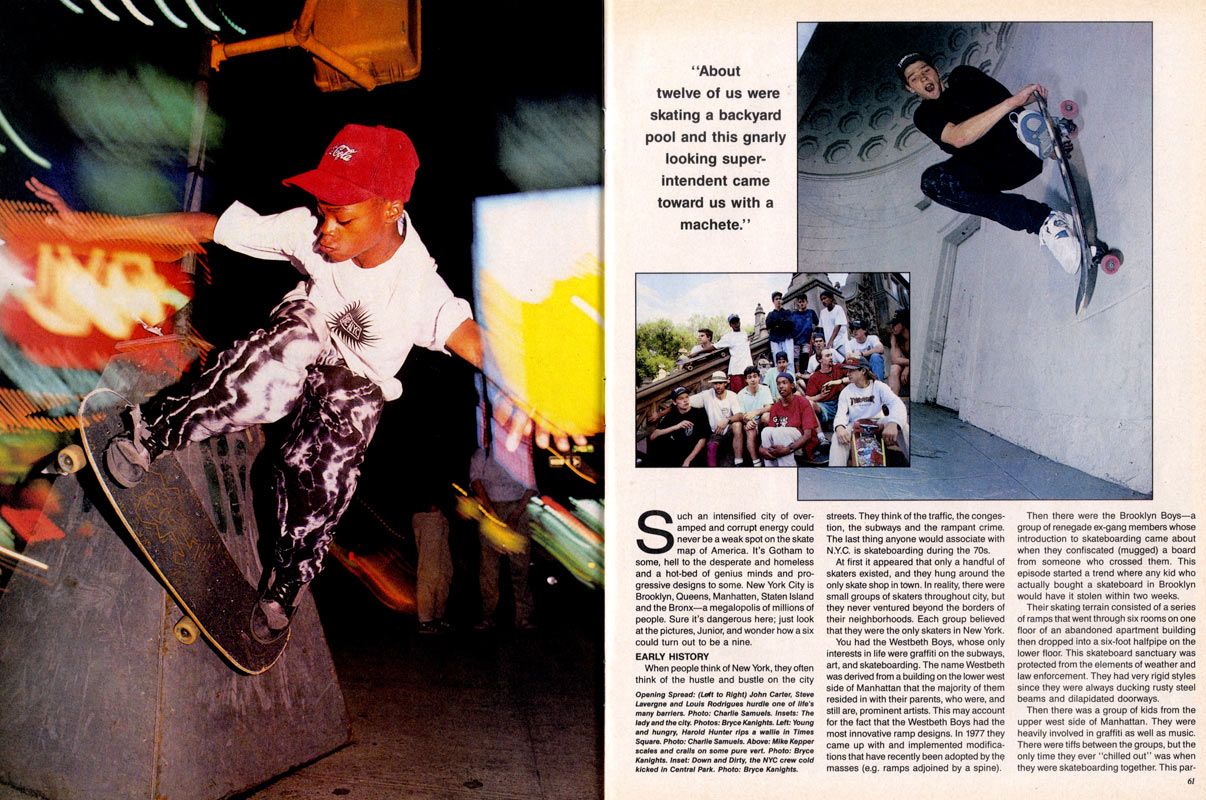
Opening Spread: (Left to Right) John Carter, Steve
Lavergne and Louis Rodrigues hurdle one of life's
many barriers. Photo: Charlie Samuels. Insets: The
lady and the city. Photos: Bryce Kanights. Left: Young
and hungry, Harold Hunter rips a wallie in Times
Square. Photo: Charlie Samuels. Above: Mike Kepper
scales and crails on some pure vert. Photo: Bryce
Kanights. Inset: Down and Dirty, the NYC crew cold
kicked in Central Park. Photo: Bryce Kanights.
streets. They think of the traffic, the conges-
tion, the subways and the rampant crime.
The last thing anyone would associate with
N.Y.C. is skateboarding during the 70s.
At first it appeared that only a handful of
skaters existed, and they hung around the
only skate shop in town. In reality, there were
small groups of skaters throughout city, but
they never ventured beyond the borders of
their neighborhoods. Each group believed
that they were the only skaters in New York.
You had the Westbeth Boys, whose only
interests in life were graffiti on the subways,
art, and skateboarding. The name Westbeth
was derived from a building on the lower west
side of Manhattan that the majority of them
resided in with their parents, who were, and
still are, prominent artists. This may account
for the fact that the Westbeth Boys had the
most innovative ramp designs. In 1977 they
came up with and implemented modifica-
tions that have recently been adopted by the
masses (e.g. ramps adjoined by a spine).
Then there were the Brooklyn Boys-a
group of renegade ex-gang members whose
introduction to skateboarding came about
when they confiscated (mugged) a board
from someone who crossed them. This
episode started a trend where any kid who
actually bought a skateboard in Brooklyn
would have it stolen within two weeks.
Their skating terrain consisted of a series
of ramps that went through six rooms on one
floor of an abandoned apartment building
then dropped into a six-foot halfpipe on the
lower floor. This skateboard sanctuary was
protected from the elements of weather and
law enforcement. They had very rigid styles
since they were always ducking rusty steel
beams and dilapidated doorways.
Then there was a group of kids from the
upper west side of Manhattan. They were
heavily involved in graffiti as well as music.
There were tiffs between the groups, but the
only time they ever "chilled out" was when
they were skateboarding together. This par-
61