Page Text
            RAMPAGE
WTAVIAN
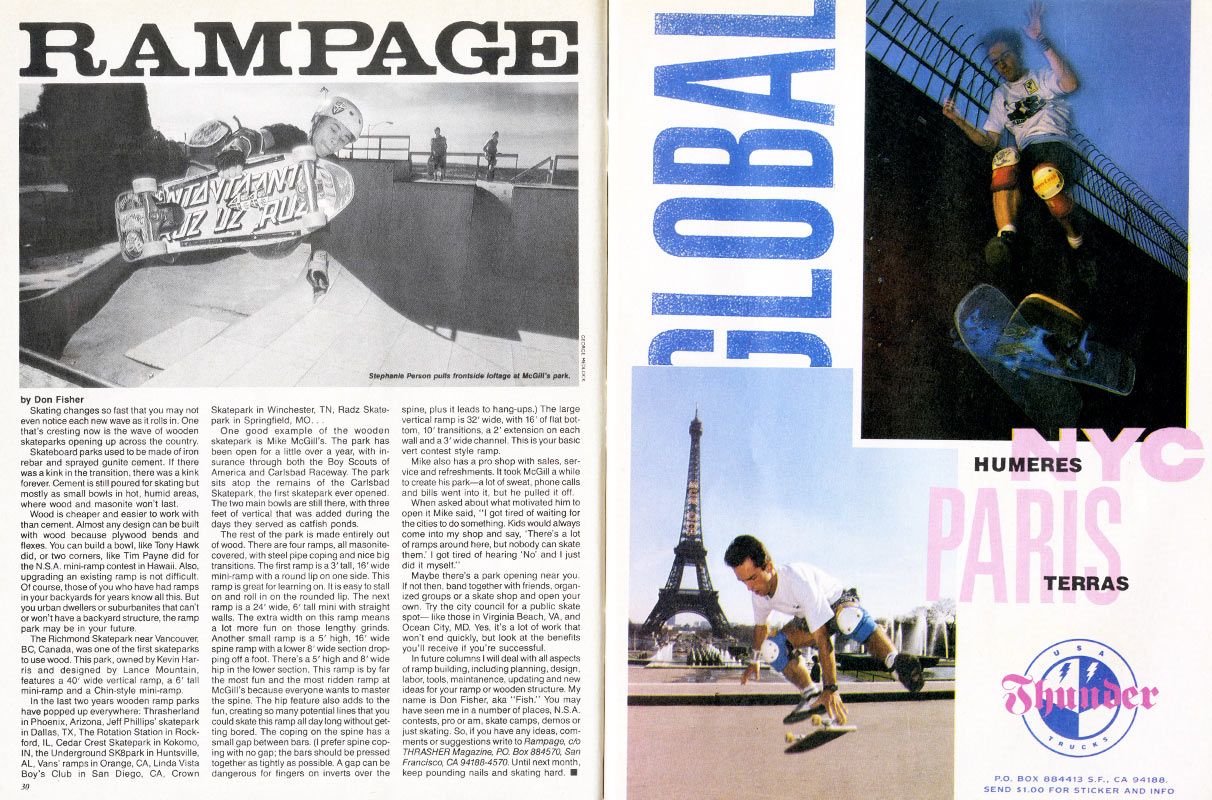
Stephanie Person pulls frontside foltage at McGill's park.
by Don Fisher
Skating changes so fast that you may not
even notice each new wave as it rolls in. One
that's cresting now is the wave of wooden
skateparks opening up across the country.
Skateboard parks used to be made of iron.
rebar and sprayed gunite cement. If there
was a kink in the transition, there was a kink
forever. Cement is still poured for skating but
mostly as small bowls in hot, humid areas,
where wood and masonite won't last.
Wood is cheaper and easier to work with
than cement. Almost any design can be built
with wood because plywood bends and
flexes. You can build a bowl, like Tony Hawk
did, or two corners, like Tim Payne did for
the N.S.A. mini-ramp contest in Hawaii. Also,
upgrading an existing ramp is not difficult.
Of course, those of you who have had ramps
in your backyards for years know all this. But
you urban dwellers or suburbanites that can't
or won't have a backyard structure, the ramp
park may be in your future.
The Richmond Skatepark near Vancouver,
BC, Canada, was one of the first skateparks
to use wood. This park, owned by Kevin Har
ris and designed by Lance Mountain,
features a 40' wide vertical ramp, a 6' tall
mini-ramp and a Chin-style mini-ramp.
In the last two years wooden ramp parks
have popped up everywhere: Thrasherland
in Phoenix, Arizona, Jeff Phillips' skatepark
in Dallas, TX, The Rotation Station in Rock-
ford, IL. Cedar Crest Skatepark in Kokomo,
IN, the Underground SK8park in Huntsville,
AL, Vans' ramps in Orange, CA, Linda Vista
Boy's Club in San Diego, CA, Crown
30
Skatepark in Winchester, TN, Radz Skate- spine, plus it leads to hang-ups.) The large
park in Springfield, MO...
One good example of the wooden
skatepark is Mike McGill's. The park has
been open for a little over a year, with in-
surance through both the Boy Scouts of
America and Carlsbad Raceway. The park
sits atop the remains of the Carlsbad
Skatepark, the first skatepark ever opened.
The two main bowls are still there, with three
feet of vertical that was added during the
days they served as catfish ponds.
The rest of the park is made entirely out
of wood. There are four ramps, all masonite
covered, with steel pipe coping and nice big
transitions. The first ramp is a 3' tall, 16' wide
mini-ramp with a round lip on one side. This
ramp is great for learning on. It is easy to stall
on and roll in on the rounded lip. The next
ramp is a 24' wide, 6' tall mini with straight
walls. The extra width on this ramp means
a lot more fun on those lengthy grinds.
Another small ramp is a 5' high, 16' wide
spine ramp with a lower 8 wide section drop
ping off a foot. There's a 5' high and 8' wide
hip in the lower section. This ramp is by far
the most fun and the most ridden ramp at
McGill's because everyone wants to master
the spine. The hip feature also adds to the
fun, creating so many potential lines that you
could skate this ramp all day long without get
ting bored. The coping on the spine has a
small gap between bars. (I prefer spine cop-
ing with no gap; the bars should be pressed
together as tightly as possible. A gap can be
dangerous for fingers on inverts over the
vertical ramp is 32' wide, with 16' of flat bot-
tom, 10' transitions, a 2' extension on each
wall and a 3' wide channel. This is your basic
vert contest style ramp.
Mike also has a pro shop with sales, ser-
vice and refreshments. It took McGill a while
to create his park-a lot of sweat, phone calls
and bills went into it, but he pulled it off.
When asked about what motivated him to
open it Mike said, "I got tired of waiting for
the cities to do something. Kids would always
come into my shop and say, 'There's a lot
of ramps around here, but nobody can skate
them. I got tired of hearing 'No' and I just
did it myself."
Maybe there's a park opening near you.
If not then, band together with friends, organ-
ized groups or a skate shop and open your
own. Try the city council for a public skate
spot-like those in Virginia Beach, VA, and
Ocean City, MD. Yes, it's a lot of work that
won't end quickly, but look at the benefits
you'll receive if you're successful.
In future columns I will deal with all aspects
of ramp building, including planning, design.
labor, tools, maintanence, updating and new
ideas for your ramp or wooden structure. My
name is Don Fisher, aka "Fish." You may
have seen me in a number of places, N.S.A.
contests, pro or am, skate camps, demos or
just skating. So, if you have any ideas, com-
ments or suggestions write to Rampage, c/o
THRASHER Magazine, PO Box 884570, San
Francisco, CA 94188-4570. Until next month,
keep pounding nails and skating hard.
GLOBAL
HUMERES
SYC
PARIS
TERRAS
you
Thunder
P.O. BOX 884413 S.F., CA 94188.
SEND $1.00 FOR STICKER AND INFO