Page Text
            to wear a mask over your mouth or else you
couldn't breathe. Your hair would come out
pink when you left the place. I went there with
a Logan Earth Ski, Bennetts and Road Rider
4's and completely shackled myself. Milpitas
skatepark was the best skatepark ever built...
All-nighters were great.
"San Francisco has the best places to
skate. It's got hills, hills make driveways, and
driveways make banks. And now, with this
thing called streetskating, there's a hell of an
obstacle course between the construction
that they're always doing and these new high
tech buildings with nice smooth cement.
"Ed Maschal was like a second father. He
was the owner of the skateboard shop I rode
for from '76 or '77 till '80. You'd go to the shop
and hang out and Ed would always be sit-
ting there painting his little pewter goblin
characters or making some musical instru-
ment out of wood. He'd give you good deals
on skateboards. He was always honest. He
was definitely for the skaters.
"Back then Tommy Guerrero was a grubby
buck-toothed little kid with long-ass hair and
a scummy as hell mad rat type hat. Tommy
was always kind of mellower than his older
brother Tony "Skid Plate' Guerrero. They had
the dirtiest room in the world. First time I met
them they wouldn't let me go in it because
you could hardly even open the door. You had
to push against the door to open it. Tony was
always pretty stylish.
"I think skating is bigger now than it ever
has been. I see a lot more kids skating then
I did before. It's funny because they're all
young. It seems different now. If you think
about it, this city was made for street
skating."
JON MALVINO spent his young adult years
as a Marin County resident (north of the
Golden Gate Bridge) and became hooked on
skateboarding through surfing magazines. He
had skated many parts of San Francisco in
the early '70s and documented many Bay
Area sessions with his old 8mm movie
camera. Jon has produced numerous skate
films which include skating in San Francisco
and is currently at work with a new skate
documentary.
"The first time I ever encountered an ac-
complished skater from the L.A. scene was
in 1974. This maniac was coming down a
gentle hill, one-foot tail wheelie-it was Ray
Flores. He had moved up here from Santa
Monica and, basically, he was a Hare
Krishna. He was living in Berkeley at the tem-
ple. He had a bald head and the whole nine
yards. He kind of left the temple for a while
and ended up in Marin county working in a
bicycle shop.
"I'll never forget the day someone came
up to me and said, 'Man, have you been to
the Embarcadero Plaza? There's a half-tube
type thing there and you're not going to
believe it. Within minutes we were there,
68
skating it at night. Within a week we had film-
ed it. Van Crete was on his Bengal GT steel
board with no kick. Bengal gave us all boards
because they liked what we were doing. We
all rode these metal death boards.
"Raymond (Flores) and I used to like the
sidewalks on Geary Street on the way to the
beach. We rode longer boards. I remember
soul skating down Geary forever and ever
and ever. At speed, no powerslides, maybe
an occasional Bert-this was in '75 and '76.
Just driveways and banks. No ollies over
driveways, no ollies to wall, just roots, man.
Semi high speed but in control.
"The Cow Palace contest was the most fun
skate thing you could ever imagine because
the only people there were skaters. Skating
was big, but obviously not big enough to fill
the Cow Palace. They built a gigantic slalom
ramp and painted it with urethane paint. The
thing was huge. If you were a little kid, it must
have looked five-hundred yards long. It was
like they built a hill inside the Cow Palace.
It was such a slippery surface you couldn't
get any bite. You had to have really gummy
wheels. Then they had a freestyle area and
guys like Peralta and Alva were there. The
best thing, of course, was they brought in a
fiberglass pool. It was a really progressive
event. It showed all aspects of skating.
Everybody came; Tony. Ty Page, Ed Nadalin,
John Hutson, Henry Hester. It was great.
Northern Cal had arrived. The promoters lost
a massive amount of money. Being the totally
exploitative jerks that they were, they
immediately turned their back on skating
after that. They thought it was the stupidest
thing they had ever done in their life and they
would never have anything to do with skating
again. We all had a great laugh. It was about
that time that I developed my first mistrust
in big competition.
"Alameda was my favorite park. I liked it
better than Newark, Winchester, all of them.
I think there was a time when I must have.
been living at Alameda. That place serious-
ly upset my life. I loved it. You could soul skate
but you could also charge. It was made for
my style of skating.
"The idea of going to a park and skating
a perfect pool really wasn't the way it was
all supposed to be in my opinion. The strug-
gle and the adventure, the search and
'seizure of the whole process really made
skateboarding something special. When you
can just go pay your five bucks or whatever
to walk in and skate, it gets old after a while.
"When we saw the issue of Skateboarder
with Weaver on the cover skating a pool, we
realized we had a place close by to skate.
The old Paul Daly swim school in Larkspur
near my house had been abandoned since
about 1970. Somehow or another my brother
Kenny and Dan Rubio decided to get all the
water out of the pool. Kenny called up the
Marin County Sanitation Bureau and told
them that we lived next door to Paul Daly
swim school and that it was a hazard
because there were tons of mosquitoes
breeding in it. He said they should exter-
minate the bugs or just drain the whole pool.
Well, within hours Marin Sanitation was down
there draining that pool dry. We were just
laughing the next day, sitting in the bottom
of an empty pool. We had the first pool in
Marin County. Some hella private sessions
went on there. Nick Van Crete, Ray Flores,
myself, Kevin Looney, Keith Looney, Greg
Cespedes, Kim Cespedes, Travis Cespedes,
my brother, Dan Rubio.
"My first street skating experience was at
the PG&E banks. Before we were actively
looking for pools, Raymond came to me and
said, "Jon, we gotta go film and skate this
thing in San Francisco at Second and
Howard." I knew it was there, but I never
thought I could skate it. It was basically one
long wall with all these other wierd forms. We
proceeded to skate and skate and skate. Of
course we had problems with the local
security. This was in '75. We had to be one
of the first in the City to skate that."
JERRY MEISEL began skating in Hawaii and
fine-tuned his abilities on the hills and
driveways of San Francisco's 9th Avenue.
Jerry helped construct many inner-city ramps
and was a local ripper at the Jungle Bowl.
He continues to skate occasionally claiming
that it will remain forever in his soul.
"The Clarendon ramp was started by me
and my buddy Mike. We put a garage door
up against the foundation. Two days later we
added more stuff. Eventually it was 40 yards
long, all wood. It was like a wooden snake
run with a bowl at the bottom. We used to
call that ramp "Ne Mayor" because that's
when Moscone was running for mayor and
the sign on the platform said 'Moscone For
Mayor' but all you could see was Ne Mayor.
That was a lot of fun. That's when I met all
the bros.
"Ninth Avenue held good sessions. If you
had the money to catch the bus you rode the
bus, but I remember just holding on to the
bus and being towed to the top. The big thing
was to see who was the fastest straight down
the hill. Then I started riding driveways, do-
ing kickturns and going up curbs. Everyone
was all, 'I went down the fastest. Big deal.
"The first time I went to Jungle Bowl I went
there with a couple of bros and Dave Cart-
man was sitting in the deep end with his feet
over the side. 'You guys can't ride here.' It
was like, right! We jumped over the fence.
"We're here, you want to fight the five of us?"
Once we rode that place I was set for life.
I also remember Thrasher pool in San Lean-
dro. We used to skate that at night, it had
lights. At first we'd go down, carve, come
back, do a kickturn and out. Then we saw
the Alotaflex team there, gyrating back and
forth and we said, whoah! So we started
gyrating too. Continued on page 100)
SELT EX
PHOTOS B
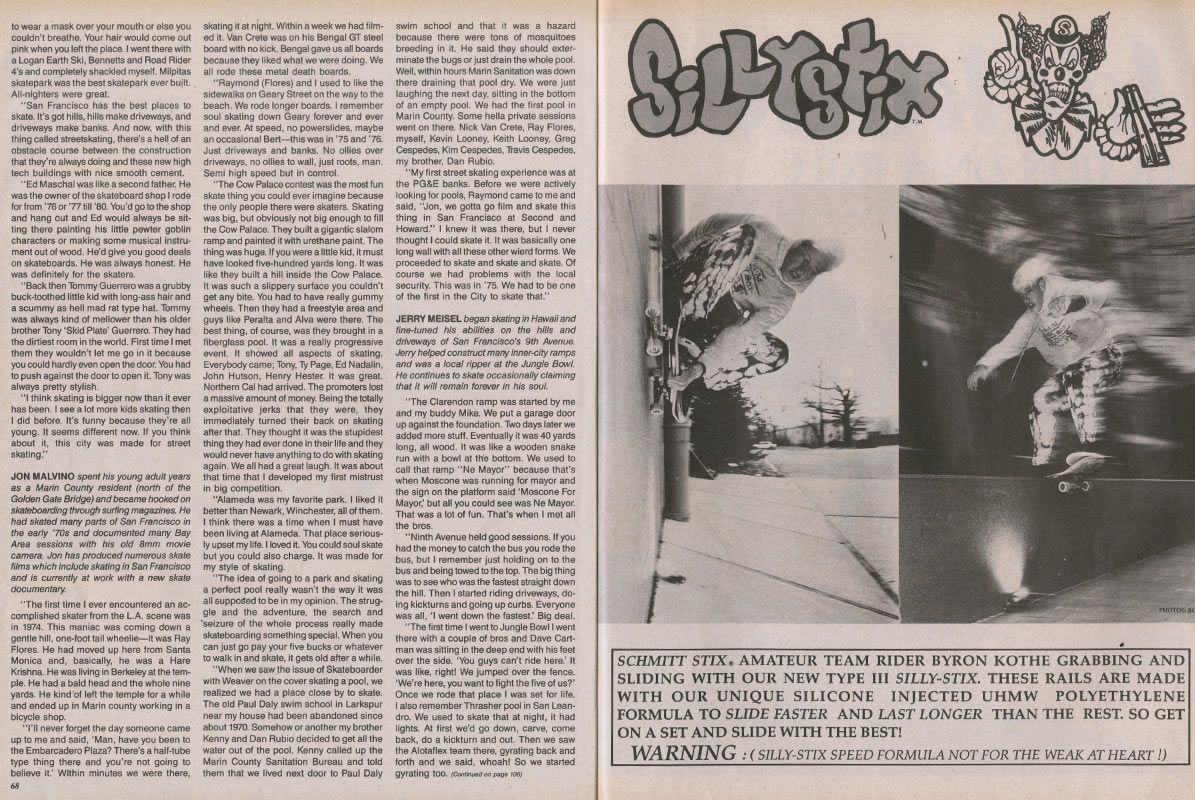
SCHMITT STIX. AMATEUR TEAM RIDER BYRON KOTHE GRABBING AND
SLIDING WITH OUR NEW TYPE III SILLY-STIX. THESE RAILS ARE MADE
WITH OUR UNIQUE SILICONE INJECTED UHMW POLYETHYLENE
FORMULA TO SLIDE FASTER AND LAST LONGER THAN THE REST. SO GET
ON A SET AND SLIDE WITH THE BEST!
WARNING: (SILLY-STIX SPEED FORMULA NOT FOR THE WEAK AT HEART!)