Page Text
            brothers. That was around '75 or '76. Paul
Daly's pool had a lot of vertical. It was like
ten feet deep. It was an L-shaped pool with
a five-foot shallow end and rounded corners.
Guys were really stoked to kickturn in the
corners.
"There was this guy named Crazy John
who had an old ambulance we called the
flea-mobile. It had so many fleas that when
we went to a skate spot everybody would buy
a can of bug killer to spray wherever they sat,
He would take a lot of guys from the City.
Everyone would chip in fifty cents for gas,
we'd make it down to places like the Los Altos
pool and the Orange Bowl and skate. That's
the first time I ever saw Rick Blackhart, Kiwi
and the Buck brothers. Those guys were just
total rippers of Northern California. After I
saw them, I wanted to skate a lot of vertical."
MIKE BROWN housed one of the first
backyard ramps in San Francisco. This struc-
ture eventually developed into a makeshift
bowl. Mike grew up skating the streets near
his home and traveled to all the Bay Area
skateparks. Today Mike skates occasionally
and hosts various underground nightclubs in
the city.
"My ramp first started when Bryce brought
over his little orange ramp in the summer of
'76. It was a little 4x4 ramp that had a slight
incline to it-just an angled piece of wood.
We built my ramps up from that. We would
steal wood from construction sites, bring it
here and just prop it up with whatever we
could. We have photos with chairs under-
neath ramps and these big blocks of cement
that used to be in my backyard. My mom was
kind of into it, she's always been supportive
of whatever I do. It was new to her, but we
weren't getting hurt. Whenever we got wood
we'd just add on, so my backyard basically
became this weird little bowl. As we got bet-
ter it got steeper and steeper. And then there
were the Bassens, my infamous neighbors
who don't like anything I do. To this day we're
still feuding with them over the dogs. They
really objected to the ramps. They called the
cops on us a few times, but I'm still free so
it must be okay.
"Before we could drive we had to take
BART (Bay Area Rapid Transit) everywhere.
The first time we took BART was to go to
Thrasher pool way out in San Leandro. There
would be a crowd of people and we'd all be
carving and getting tile. Then we started
going to Milpitas. You'd have to catch BART
and then catch a bus after that, but we
wouldn't think twice about it. Then we turned
sixteen, got our licenses and started driving.
We'd drive to Campbell, we'd drive to
Winchester and we'd drive to Milpitas.
Alameda was the first skatepark I ever went
to. It was three snake runs at the Alameda
marina and we loved it. We'd go whenever
we got a ride out there. We also built ramps.
My friend Gordon built ramps inside of his
62
garage. We'd just prop at
four-by-eight against the
wall and nail it in. One time
we made a ramp that sloped
up to the wall. You could ride
up onto the wall and grind the
electrical conduit. It was hard-
core. Whatever was available,
we'd do. Nothing was too
extreme.
"The whole scene back then
was much more carefree
because we were all in school
and we didn't have a care in the
world. We lived at home and our
lives revolved around skateboard-
ing. We didn't worry about money or jobs or
anything. We just woke up, went and met
everybody and skated all day in a pack of at
least ten people. Anybody who didn't have
anything to do with skateboarding hated us
because we were terrorizers. We'd ride down
the street, somebody would fall, break a plate
glass window or dent a car fender, get on his
board, laugh, and keep on riding. Stuff like
that used to happen all the time, but we had
a really good time. The best times I had in
my life were skateboarding in the old days.
"I met Bryce Kanights at a little park by
my house. We used to skate on the blacktop
of a basketball court. We met Joe Fong after
a while. Joe was a pretty established skater
in the San Francisco scene, so we all felt cool
to hang out with him. Tony and Tommy
Guerrero. Tony was definitely the cool guy
and Tommy was just his little brother that
hung around with us. He would routinely get
picked on and beat up, but he stayed around.
Monty Smith was another one. Gordon and
Julian Levinson, two kids who lived near me,
were part of our crowd. That was the nucleus.
We stayed together and skated together for
a long time.
"When I see skateboarding now I feel like
a dinosaur. It went through its many eras.
One era was when urethane wheels came
out with sealed bearings, which I caught up
with. Then people started doing airs. When
handplants came in, that started a whole new
thing in skateboarding. A lot of the people
who were trendsetters up to the point of the
handplant definitely were lost after that. It
became much more acrobatic. Then it went
through this phase where it got real robotic.
You'd just do these tricks, without style or
content. No aggression. I do feel like a
dinosaur, but I have no problem picking up
a board and doing my old tricks-the 1-2-3,
frontside grinds, the block hop, rock and
roll-I can do the basics.
"My fondest memory of skateboarding,
when I felt like I was really a part of history.
was the first big skate contest I went to at
Newark when we saw the big pros. I had.
people like Henry Hester and Shogo Kubo
signing my skateboard. In fact I still have that
board. That was the first contest where a
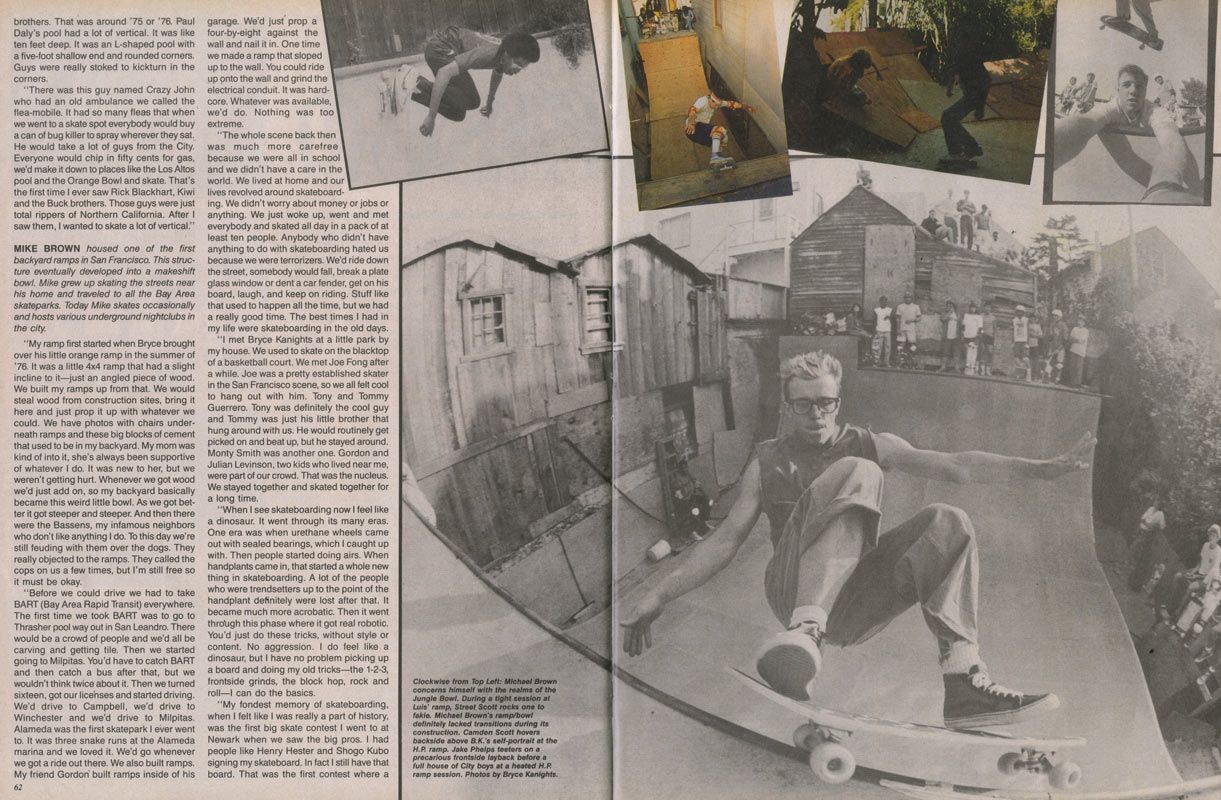
Clockwise from Top Left: Michael Brown
concerns himself with the realms of the
Jungle Bowl. During a tight session at
Luis ramp, Street Scott rocks one to
fakie. Michael Brown's ramp/bowl
definitely lacked transitions during its
construction. Camden Scott hovers
backside above B.K.'s self-portrait at the
H.P. ramp. Jake Phelps teeters on a
precarious frontside layback before a
full house of City boys at a heated H.R
ramp session. Photos by Bryce Kanights.