Page Text
            STRECKER
NAGO
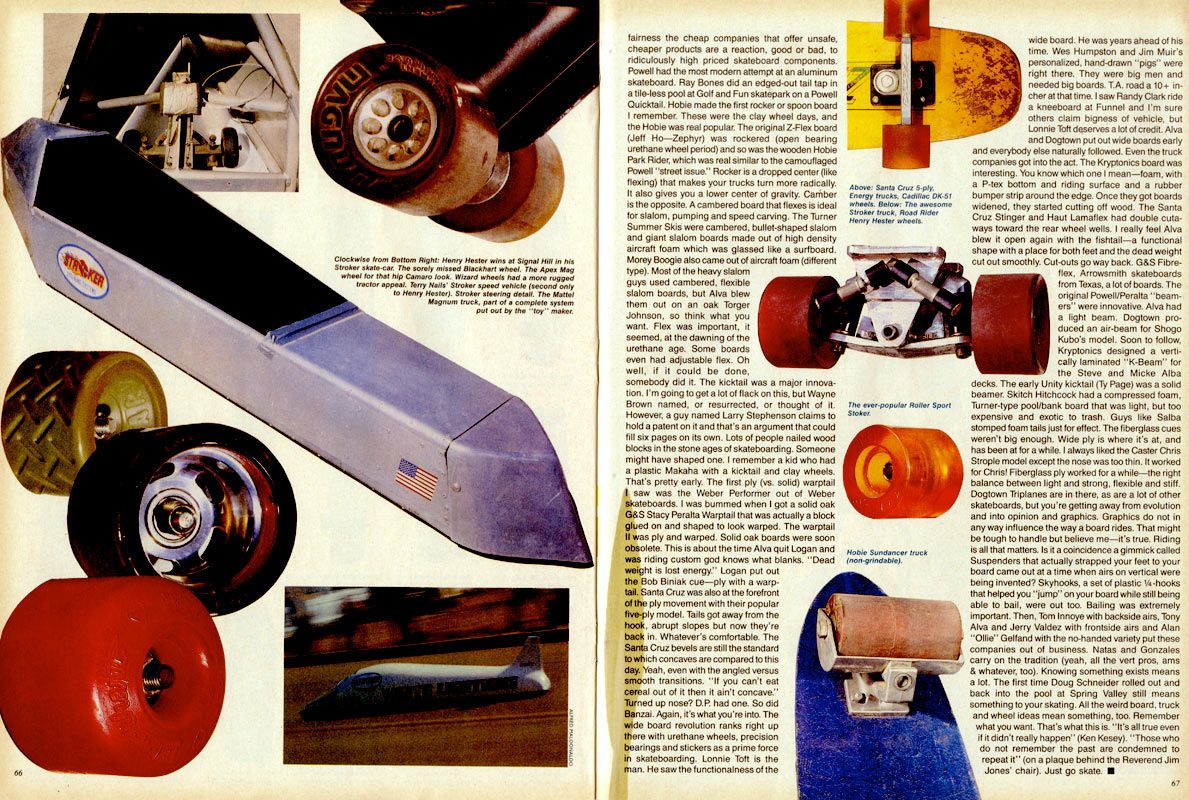
Clockwise from Bottom Right: Henry Hester wins at Signal Hill in his
Stroker skate-car. The sorely missed Blackhart wheel. The Apex Mag
wheel for that hip Camaro look. Wizard wheels had a more rugged
tractor appeal. Terry Nails' Stroker speed vehicle (second only
to Henry Hester). Stroker steering detail. The Mattel
Magnum truck, part of a complete system
put out by the "toy" maker
Above: Santa Cruz 5-ply.
fairness the cheap companies that offer unsafe,
cheaper products are a reaction, good or bad, to
ridiculously high priced skateboard components.
Powell had the most modern attempt at an aluminum
skateboard. Ray Bones did an edged-out tail tap in
a tile-less pool at Golf and Fun skatepark on a Powell
Quicktail. Hobie made the first rocker or spoon board
I remember. These were the clay wheel days, and
the Hobie was real popular. The original Z-Flex board
(Jeff Ho-Zephyr) was rockered (open bearing
urethane wheel period) and so was the wooden Hobie
Park Rider, which was real similar to the camouflaged
Powell "street issue." Rocker is a dropped center (like
flexing) that makes your trucks turn more radically.
It also gives you a lower center of gravity. Camber Energy trucks, Cadillac DK-51
is the opposite. A cambered board that flexes is ideal
for slalom, pumping and speed carving. The Turner
Summer Skis were cambered, bullet-shaped slalom
and giant slalom boards made out of high density
aircraft foam which was glassed like a surfboard.
Morey Boogie also came out of aircraft foam (different
type). Most of the heavy slalom
guys used cambered, flexible
slalom boards, but Alva blew
them out on an oak Torger
Johnson, so think what you
want. Flex was important, it
seemed, at the dawning of the
urethane age. Some boards
even had adjustable flex. Oh
well, if it could be done,
somebody did it. The kicktail was a major innova-
tion. I'm going to get a lot of flack on this, but Wayne
Brown named, or resurrected, or thought of it.
However, a guy named Larry Stephenson claims to
hold a patent on it and that's an argument that could
fill six pages on its own. Lots of people nailed wood
blocks in the stone ages of skateboarding. Someone
might have shaped one. I remember a kid who had
a plastic Makaha with a kicktail and clay wheels.
That's pretty early. The first ply (vs. solid) warptail
I saw was the Weber Performer out of Weber
skateboards. I was bummed when I got a solid oak
G&S Stacy Peralta Warptail that was actually a block
glued on and shaped to look warped. The warptail
Il was ply and warped. Solid oak boards were soon
wheels. Below: The awesome
Stroker truck, Road Rider
Henry Hester wheels.
The ever-popular Roller Sport
Stoker
obsolete. This is about the time Alva quit Logan and Hoble Sundancer truck
was riding custom god knows what blanks. "Dead.
weight is lost energy." Logan put out
the Bob Biniak cue-ply with a warp-
tail. Santa Cruz was also at the forefront
of the ply movement with their popular
five-ply model. Tails got away from the
hook, abrupt slopes but now they're
back in. Whatever's comfortable. The
Santa Cruz bevels are still the standard
to which concaves are compared to this
day. Yeah, even with the angled versus
smooth transitions. "If you can't eat
cereal out of it then it ain't concave."
Turned up nose? D.P. had one. So did
Banzai. Again, it's what you're into. The
wide board revolution ranks right up
there with urethane wheels, precision
bearings and stickers as a prime force
in skateboarding. Lonnie Toft is the
man. He saw the functionalness of the
(non-grindable).
wide board. He was years ahead of his
time. Wes Humpston and Jim Muir's
personalized, hand-drawn "pigs" were
right there. They were big men and
needed big boards. T.A. road a 10+ in-
cher at that time. I saw Randy Clark ride
a kneeboard at Funnel and I'm sure
others claim bigness of vehicle, but
Lonnie Toft deserves a lot of credit. Alva
and Dogtown put out wide boards early
and everybody else naturally followed. Even the truck
companies got into the act. The Kryptonics board was
interesting. You know which one I mean-foam, with
a P-tex bottom and riding surface and a rubber
bumper strip around the edge. Once they got boards
widened, they started cutting off wood. The Santa
Cruz Stinger and Haut Lamaflex had double cuta-
ways toward the rear wheel wells. I really feel Alva
blew it open again with the fishtail-a functional
shape with a place for both feet and the dead weight
cut out smoothly. Cut-outs go way back. G&S Fibre-
flex, Arrowsmith skateboards
from Texas, a lot of boards. The
original Powell/Peralta "beam-
ers" were innovative. Alva had
a light beam. Dogtown pro-
duced an air-beam for Shogo
Kubo's model. Soon to follow,
Kryptonics designed a verti-
cally laminated "K-Beam" for
the Steve and Micke Alba
decks. The early Unity kicktail (Ty Page) was a solid
beamer. Skitch Hitchcock had a compressed foam,
Turner-type pool/bank board that was light, but too
expensive and exotic to trash. Guys like Salba
stomped foam tails just for effect. The fiberglass cues
weren't big enough. Wide ply is where it's at, and
has been at for a while. I always liked the Caster Chris
Strople model except the nose was too thin. It worked
for Chris! Fiberglass ply worked for a while-the right
balance between light and strong, flexible and stiff.
Dogtown Triplanes are in there, as are a lot of other
skateboards, but you're getting away from evolution
and into opinion and graphics. Graphics do not in
any way influence the way a board rides. That might
be tough to handle but believe me-it's true. Riding
is all that matters. Is it a coincidence a gimmick called
Suspenders that actually strapped your feet to your
board came out at a time when airs on vertical were
being invented? Skyhooks, a set of plastic 4-hooks
that helped you "jump" on your board while still being
able to bail, were out too. Bailing was extremely
important. Then, Tom Innoye with backside airs, Tony
Alva and Jerry Valdez with frontside airs and Alan
"Ollie" Gelfand with the no-handed variety put these
companies out of business. Natas and Gonzales
carry on the tradition (yeah, all the vert pros, ams
& whatever, too). Knowing something exists means
a lot. The first time Doug Schneider rolled out and
back into the pool at Spring Valley still means
something to your skating. All the weird board, truck
and wheel ideas mean something, too. Remember
what you want. That's what this is. "It's all true event
if it didn't really happen" (Ken Kesey). "Those who
do not remember the past are condemned to
repeat it" (on a plaque behind the Reverend Jim
Jones' chair). Just go skate.