Page Text
            As Recalled by Don Redondo
W
arning: This article doesn't pretend to be a
definitive encyclopedia of skateboard pro-
ducts. It is an overview of skate history
illustrated by samples from various skate collections.
Even though this is where it
all comes from, riding is all
that matters.
Possibly the most impor-
tant innovation/catalyst for
skateboarding was the in-
vention/adaptation of the
urethane wheel. Who cares
who gets credit for that
(Frank Nasworthy)? It hap-
pened. In this piece we'll ac-
cept the introduction of
urethane as the beginning
5
of modern skateboarding. Before that there was the
steel wheel age with the first mass-produced
board-the little red Roller Derby. The clay wheel age
dawned with some decent decks (Hobie, Super
Surfer, Makaha and later, the Black Knight). The first
urethane wheel came with "open" bearings. Sixteen
loose bearings (eight per side) held together with an
adjustable cone system. Too loose meant lost bear-
ings (BB's won't work), too tight and no workie (wheel
62
H₁
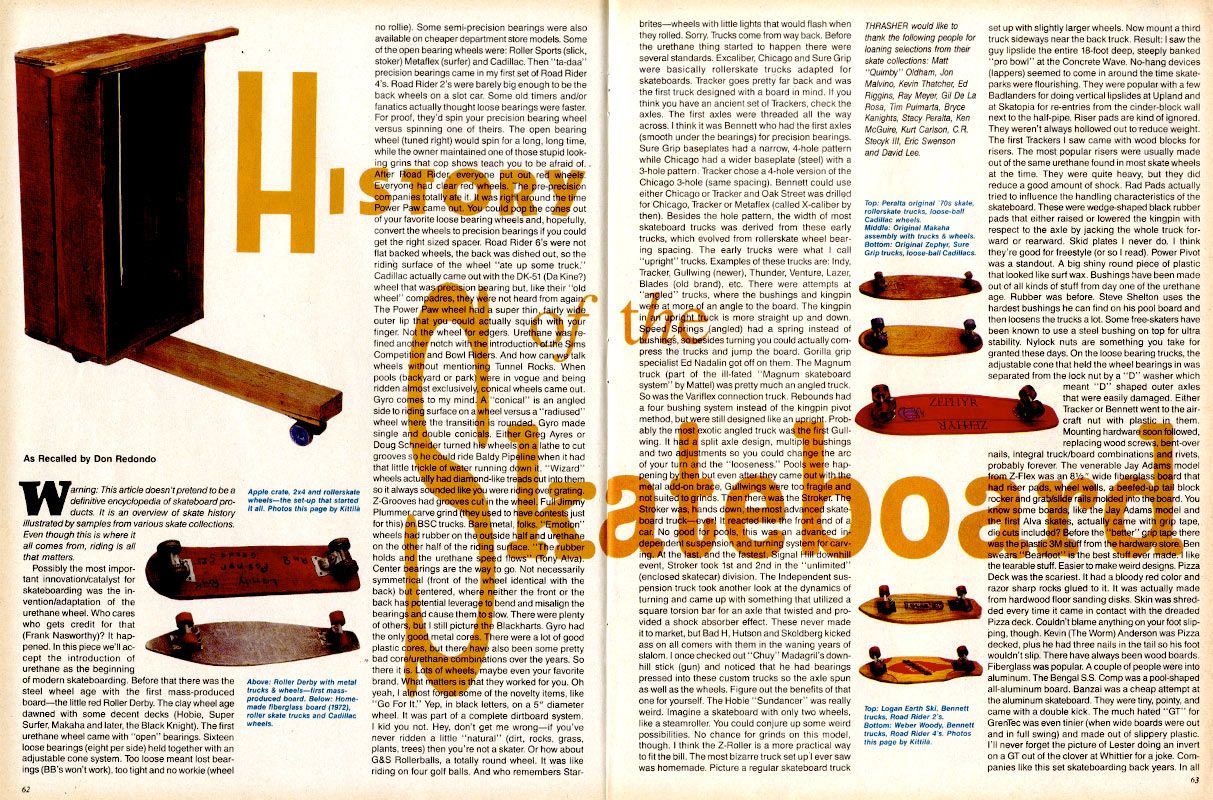
Apple crate, 2x4 and rollerskate
wheels-the set-up that started
it all. Photos this page by Kittilä
Above: Roller Derby with metal
trucks & wheels-first mass-
produced board. Below: Home-
made fiberglass board (1972),
roller skate trucks and Cadillac
wheels.
R
no rollie). Some semi-precision bearings were also
available on cheaper department store models. Some
of the open bearing wheels were: Roller Sports (slick,
stoker) Metaflex (surfer) and Cadillac. Then "ta-daa"
precision bearings came in my first set of Road Rider
4's. Road Rider 2's were barely big enough to be the
back wheels on a slot car. Some old timers and/or
fanatics actually thought loose bearings were faster.
For proof, they'd spin your precision bearing wheel
versus spinning one of theirs. The open bearing
wheel (tuned right) would spin for a long, long time,
while the owner maintained one of those stupid look-
ing grins that cop shows teach you to be afraid of...
After Road Rider, everyone put out red wheels.
Everyone had clear red wheels. The pre-precision
companies totally ate it. It was right around the time
Power Paw came out. You could pop the cones out
of your favorite loose bearing wheels and, hopefully,
convert the wheels to precision bearings if you could
get the right sized spacer. Road Rider 6's were not
flat backed wheels, the back was dished out, so the
riding surface of the wheel "ate up some truck."
Cadillac actually came out with the DK-51 (Da Kine?)
wheel that was precision bearing but, like their "old
wheel" compadres, they were not heard from again
The Power Paw wheel had a super thin, fairly wide
outer lip that you could actually squish with your
finger. Not the wheel for edgers. Urethane was re-
fined another notch with the introduction of the Sims
Competition and Bowl Riders. And how can we talk
wheels without mentioning Tunnel Rocks. When
pools (backyard or park) were in vogue and being
ridden almost exclusively, conical wheels came out.
Gyro comes to my mind. A "conical" is an angled
side to riding surface on a wheel versus a "radiused"
wheel where the transition is rounded. Gyro made
single and double conicals. Either Greg Ayres or
Doug Schneider turned his wheels on a lathe to cut
grooves so he could ride Baldy Pipeline when it had
that little trickle of water running down it. "Wizard"
wheels actually had diamond-like treads cut into them.
so it always sounded like you were riding over grating.
Z-Grooves had grooves cut in the wheel. Full Jimmy
Plummer carve grind (they used to have contests just
tzze
brites-wheels with little lights that would flash when
they rolled. Sorry. Trucks come from way back. Before
the urethane thing started to happen there were
several standards. Excaliber, Chicago and Sure Grip
were basically rollerskate trucks adapted for
skateboards. Tracker goes pretty far back and was
the first truck designed with a board in mind. If you
think you have an ancient set of Trackers, check the
axles. The first axles were threaded all the way
across. I think it was Bennett who had the first axles
(smooth under the bearings) for precision bearings.
Sure Grip baseplates had a narrow, 4-hole pattern
while Chicago had a wider baseplate (steel) with a
3-hole pattern. Tracker chose a 4-hole version of the
Chicago 3-hole (same spacing). Bennett could use
either Chicago or Tracker and Oak Street was drilled
for Chicago, Tracker or Metaflex (called X-caliber by
then). Besides the hole pattern, the width of most
skateboard trucks was derived from these early
trucks, which evolved from rollerskate wheel bear
ing spacing. The early trucks were what I call
"upright" trucks. Examples of these trucks are: Indy,
Tracker, Gullwing (newer), Thunder, Venture, Lazer,
Blades (old brand), etc. There were attempts at
"angled" trucks, where the bushings and kingpin
were at more of an angle to the board. The kingpin
in an upright truck is more straight up and down.
Speed Springs (angled) had a spring instead of
bushings, so besides turning you could actually com-
press the trucks and jump the board. Gorilla grip
specialist Ed Nadalin got off on them. The Magnum
truck (part of the ill-fated "Magnum skateboard
system" by Mattel) was pretty much an angled truck.
So was the Variflex connection truck. Rebounds had
a four bushing system instead of the kingpin pivot
method, but were still designed like an upright. Prob-
ably the most exotic angled truck was the first Gull-
wing. It had a split axle design, multiple bushings
and two adjustments so you could change the arc
of your turn and the "looseness." Pools were hap-
pening by then but even after they came out with the
metal add-on brace, Gullwings were too fragile and
not suited to grinds. Then there was the Stroker. The
Stroker was, hands down, the most advanced skate
board truck-ever! It reacted like the front end of a
car. No good for pools, this was an advanced in-
dependent suspension and turning system for carv-
ing. At the last, and the fastest, Signal Hill downhill
event, Stroker took 1st and 2nd in the "unlimited"
(enclosed skatecar) division. The Independent sus-
pension truck took another look at the dynamics of
turning and came up with something that utilized a
square torsion bar for an axle that twisted and pro-
vided a shock absorber effect. These never made
it to market, but Bad H, Hutson and Skoldberg kicked
ass on all comers with them in the waning years of
slalom. I once checked out "Chuy" Madagril's down-
hill stick (gun) and noticed that he had bearings
pressed into these custom trucks so the axle spun
as well as the wheels. Figure out the benefits of that
one for yourself. The Hobie "Sundancer" was really
weird. Imagine a skateboard with only two wheels,
like a steamroller. You could conjure up some weird
possibilities. No chance for grinds on this model,
though. I think the Z-Roller is a more practical way
to fit the bill. The most bizarre truck set up'l ever saw
was homemade. Picture a regular skateboard truck
THRASHER would like to
thank the following people for
loaning selections from their
skate collections: Matt
"Quimby" Oldham, Jon
Malvino, Kevin Thatcher, Ed
Riggins, Ray Meyer, Gil De La
Rosa, Tim Puimarta, Bryce
Kanights, Stacy Peralta, Ken
McGuire, Kurt Carlson, C.R.
Stecyk II, Eric Swenson
and David Lee.
Top: Peralta original 70s skate,
rollerskate trucks, loose-ball
Cadillac wheels.
Middle: Original Makaha
assembly with trucks & wheels.
Bottom: Original Zephyr, Sure
Grip trucks, loose-ball Cadillacs.
ZEPHYR
set up with slightly larger wheels. Now mount a third
truck sideways near the back truck. Result: I saw the
guy lipslide the entire 18-foot deep, steeply banked
"pro bowl" at the Concrete Wave. No-hang devices
(lappers) seemed to come in around the time skate-
parks were flourishing. They were popular with a few
Badlanders for doing vertical lipslides at Upland and
at Skatopia for re-entries from the cinder-block wall
next to the half-pipe. Riser pads are kind of ignored.
They weren't always hollowed out to reduce weight.
The first Trackers I saw came with wood blocks for
risers. The most popular risers were usually made
out of the same urethane found in most skate wheels
at the time. They were quite heavy, but they did
reduce a good amount of shock. Rad Pads actually
tried to influence the handling characteristics of the
skateboard. These were wedge-shaped black rubber
pads that either raised or lowered the kingpin with
respect to the axle by jacking the whole truck for-
ward or rearward. Skid plates I never do. I think
they're good for freestyle (or so I read). Power Pivot
was a standout. A big shiny round piece of plastic
that looked like surf wax. Bushings have been made
out of all kinds of stuff from day one of the urethane
age. Rubber was before. Steve Shelton uses the
hardest bushings he can find on his pool board and
then loosens the trucks a lot. Some free-skaters have
been known to use a steel bushing on top for ultra
stability. Nylock nuts are something you take for
granted these days. On the loose bearing trucks, the
adjustable cone that held the wheel bearings in was
separated from the lock nut by a "D" washer which
meant "D" shaped outer axles
kateboard
for this) on BSC trucks. Bare metal, folks. "Emotion"
wheels had rubber on the outside half and urethane
on the other half of the riding surface. "The rubber
holds and the urethane speed flows" (Tony Alva).
Center bearings are the way to go. Not necessarily
symmetrical (front of the wheel identical with the
back) but centered, where neither the front or the
back has potential leverage to bend and misalign the
bearings and cause them to slow. There were plenty
of others, but I still picture the Blackharts. Gyro had
the only good metal cores. There were a lot of good
plastic cores, but there have also been some pretty
bad core/urethane combinations over the years. So
there it is. Lots of wheels, maybe even your favorite
brand. What matters is that they worked for you. Oh
yeah, I almost forgot some of the novelty items, like
"Go For It." Yep, in black letters, on a 5" diameter
wheel. It was part of a complete dirtboard system.
I kid you not. Hey, don't get me wrong-if you've
never ridden a little "natural" (dirt, rocks, grass,
plants, trees) then you're not a skater. Or how about
G&S Rollerballs, a totally round wheel. It was like
riding on four golf balls. And who remembers Star-
Top: Logan Earth Ski, Bennett
trucks, Road Rider 2's.
Bottom: Weber Woody, Bennett
trucks, Road Rider 4's. Photos
this page by Kittie
that were easily damaged. Either
Tracker or Bennett went to the air-
craft nut with plastic in them.
Mounting hardware soon followed,
replacing wood screws, bent-over
nails, integral truck/board combinations and rivets,
probably forever. The venerable Jay Adams model
from Z-Flex was an 8% wide fiberglass board that
had riser pads, wheel wells, a beefed-up tail block
rocker and grabíslide rails molded into the board. You
know some boards, like the Jay Adams model and
the first Alva skates, actually came with grip tape,
die cuts included? Before the "better" grip tape there
was the plastic 3M stuff from the hardware store. Ben
swears "Bearfoot" is the best stuff ever made. I like
the tearable stuff. Easier to make weird designs. Pizza
Deck was the scariest. It had a bloody red color and
razor sharp rocks glued to it. It was actually made
from hardwood floor sanding disks. Skin was shred-
ded every time it came in contact with the dreaded
Pizza deck. Couldn't blame anything on your foot slip-
ping, though. Kevin (The Worm) Anderson was Pizza
decked, plus he had three nails in the tail so his foot
wouldn't slip. There have always been wood boards.
Fiberglass was popular. A couple of people were into
aluminum. The Bengal S.S. Comp was a pool-shaped
all-aluminum board. Banzai was a cheap attempt at
the aluminum skateboard. They were tiny, pointy, and
came with a double kick. The much hated "GT" for
GrenTec was even tinier (when wide boards were out
and in full swing) and made out of slippery plastic.
I'll never forget the picture of Lester doing an invert
on a GT out of the clover at Whittier for a joke. Com-
panies like this set skateboarding back years. In all
63