Page Text
            Caballersteve
Interview by M.Fo
ow much did ramp cost? are bad, they're just not the best thing that's How did you feel when you were skating
About 800 dollars it was built. ever lite to learn as a little kids,
About 800 dollars when it was built. ever happened. They're little ramps to learn as a little kid, compared to how you feel
ply, new masonite, putting resin on it to
strengthen it, cutting it down, extending it
higher, it's probably cost over $5,000.
Why'd you build a ramp in your backyard?
Because after Winchester closed there
weren't really any places to skate. We found
backyard pools, and banks and stuff, but we
still wanted to skate vertical, so I got together
with a couple of friends and built a ramp in
my backyard.
I hear you have a new house, where is it?
It's in Campbell, about a mile away from
where Winchester skatepark was.
What were your reasons for moving there?
I wanted a place that had a lot of land in
a nice neighborhood and was close to
everything, the clubs, theaters, eating places.
I didn't like my old neighborhood, it was get-
ting too rough. I wanted a big backyard
because I wanted to build a ramp. But right
now I'm the new guy in town so I want to keep
it cool. I don't want all of the old folks to be
bummed on me.
How have ramps changed since you first
built yours?
I built my ramp pretty much to the same
dimensions as the pool at Winchester. It had
8-foot transitions with a foot of vert. Over the
years the transitions have gotten bigger.
They're not so tight and they're a lot safer
because you have more room to kneeslide
out of them, it's more gradual. People have
experimented with different lengths of flat
bottom and different obstacles, like channels,
extensions, escalators, different kinds of
coping-metal has been proven to be the
best thing for a ramp. It's gone from broom
handles to cement to PVC to metal pipe. The
newest change in ramps is putting two ramps.
back to back, forming a spine. Kids these
days think that mini-ramps are the newest
thing, but actually that's not really new. A
mini-ramp is like something that was at a
park, a little run, a smaller scale half-pipe.
That's where we learned our tricks back in
the park days. I think now all the companies
are going to try and push mini-ramps. For a
while it was the streetstyle thing, but now it's
going to switch to mini-ramps. I hope no one
ever gets a pro mini-ramp model. A lot of guys
do those mini-ramp tricks on vert anyway.
This is a phase, and it's going to come back
around to vertical skating. Vert has always
been there and always will be there, but right
now people are going through stages where
they are promoting certain things leading up
to vertical skating. I'm not saying mini-ramps
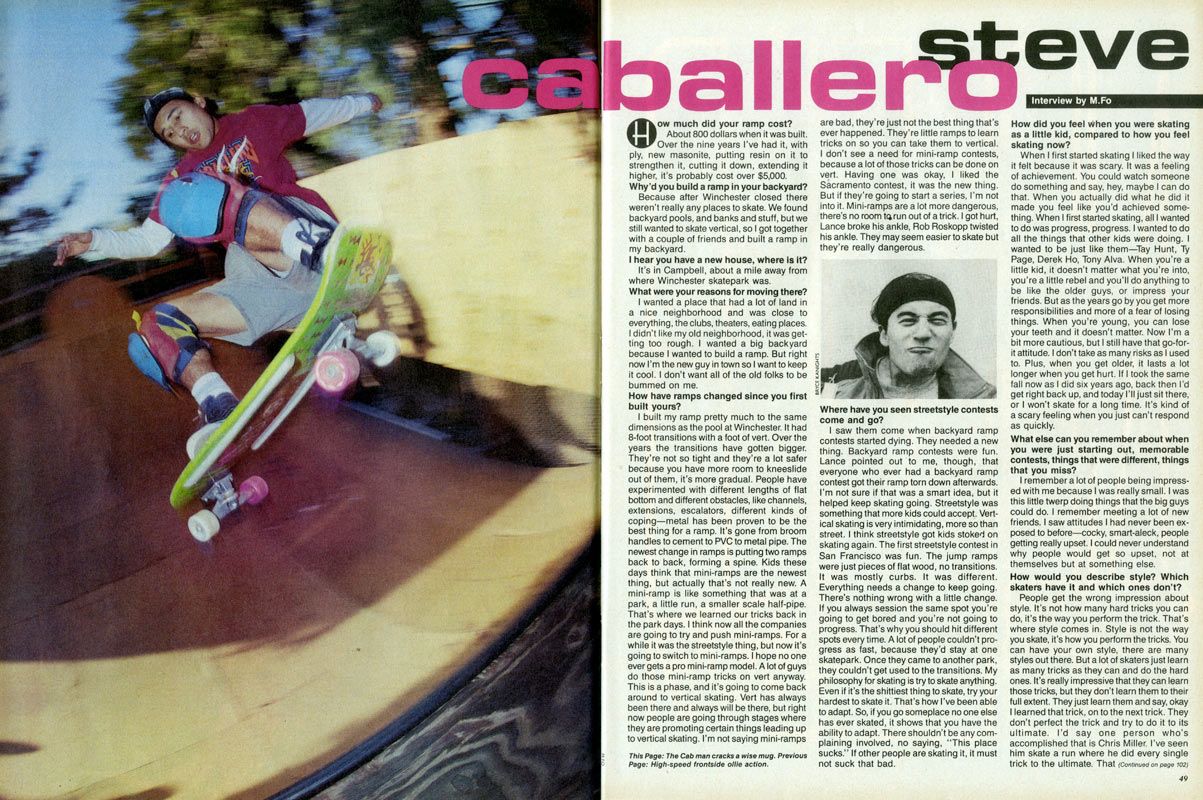
This Page: The Cab man cracks a wise mug. Previous
Page: High-speed frontside olie action.
I don't see a need for mini-ramp contests,
because a lot of those tricks can be done on
vert. Having one was okay, I liked the
Sacramento contest, it was the new thing.
But if they're going to start a series, I'm not
into it. Mini-ramps are a lot more dangerous,
there's no room to run out of a trick. I got hurt,
Lance broke his ankle, Rob Roskopp twisted
his ankle. They may seem easier to skate but
they're really dangerous.
Where have you seen streetstyle contests
come and go?
I saw them come when backyard ramp
contests started dying. They needed a new
thing. Backyard ramp contests were fun.
Lance pointed out to me, though, that
everyone who ever had a backyard ramp
contest got their ramp torn down afterwards.
I'm not sure if that was a smart idea, but it
helped keep skating going. Streetstyle was
something that more kids could accept. Vert-
ical skating is very intimidating, more so than
street. I think streetstyle got kids stoked on
skating again. The first streetstyle contest in
San Francisco was fun. The jump ramps
were just pieces of flat wood, no transitions.
It was mostly curbs. It was different.
Everything needs a change to keep going.
There's nothing wrong with a little change.
If
you always session the same spot you're
going to get bored and you're not going to
progress. That's why you should hit different
spots every time. A lot of people couldn't pro-
gress as fast, because they'd stay at one
skatepark. Once they came to another park,
they couldn't get used to the transitions. My
philosophy for skating is try to skate anything.
Even if it's the shittiest thing to skate, try your
hardest to skate it. That's how I've been able
to
adapt. So, if you go someplace no one else
has ever skated, it shows that you have the
ability to adapt. There shouldn't be any com-
plaining involved, no saying. "This place
sucks." If other people are skating it, it must
not suck that bad.
When I first started skating I liked the way
it felt because it was scary. It was a feeling
of achievement. You could watch someone.
do something and say, hey, maybe I can do
that. When you actually did what he did it
made you feel like you'd achieved some-
thing. When I first started skating, all I wanted
to do was progress, progress. I wanted to do
all the things that other kids were doing. I
wanted to be just like them-Tay Hunt, Ty
Page, Derek Ho, Tony Alva. When you're a
little kid, it doesn't matter what you're into,
you're a little rebel and you'll do anything to
be like the older guys, or impress your
friends. But as the years go by you get more
responsibilities and more of a fear of losing
things. When you're young, you can lose
your teeth and it doesn't matter. Now I'm a
bit more cautious, but I still have that go-for-
it attitude. I don't take as many risks as I used
to. Plus, when you get older, it lasts a lot
longer when you get hurt. If I took the same
fall now as I did six years ago, back then I'd
get right back up, and today I'll just sit there,
or I won't skate for a long time. It's kind of
a scary feeling when you just can't respond
as quickly.
What else can you remember about when
you were just starting out, memorable.
contests, things that were different, things
that you miss?
I remember a lot of people being impress-
ed with me because I was really small. I was
this little twerp doing things that the big guys
could do. I remember meeting a lot of new
friends. I saw attitudes I had never been ex-
posed to before-cocky, smart-aleck, people
getting really upset. I could never understand
why people would get so upset, not at
themselves but at something else.
How would you describe style? Which
skaters have it and which ones don't?
I
People get the wrong impression about
style. It's not how many hard tricks you can
do, it's the way you perform the trick. That's
where style comes in. Style is not the way
you skate, it's how you perform the tricks. You
can have your own style, there are many
styles out there. But a lot of skaters just learn
as many tricks as they can and do the hard.
ones. It's really impressive that they can learn
those tricks, but they don't learn them to their
full extent. They just learn them and say, okay
learned that trick, on to the next trick. They
don't perfect the trick and try to do it to its
ultimate. I'd say one person who's
accomplished that is Chris Miller. I've seen
him skate a run where he did every single
trick to the ultimate. That (Continued on page 102)
49