Page Text
            sugar
one lump or two?
bes
They've charmed America by virtue of the ABBA factor, pro-
pelled themselves to the highest rungs of college/alternative
charts and done an excellent job passing themselves off as
a smiling, slightly off-beat Nordic Islander band. Don't buy it,
Iceland's Sugarcubes are up to something far more sinister.
For instance, take their American debut, Life's Too Good
(Elektra). Bright, happy cover, upbeat songs sung in the "lost
little girl" voice of Bjork Gudmundsdottir and counterpointed
by vocalist/trumpeteer Einar Orn's stoic, nonsensical ramblings.
There's a Machiavellian intelligence at work here tugging the
very strings of sense and perception. Do they want to enter-
tain or exorcise their own most "delicious demons"? Images
of childhood innocence tumble freeform with deeply violent and
erotic undercurrents in "Birthday." Bjork becomes a girl on a
bicycle, eerily drawn to the disaster of "Motorcrash" while Einar
is raped/purified by God in his very own bathtub in "Deus."
To understand their deceptive charm and the wonder of the
Sugarcubes' success, you must understand the context.
Iceland didn't start producing its own native rock 'n' roll until
1981. At that time creativity and inventiveness spread like
wildfire, giving birth to unpronounceable outfits including Theyr,
Purrkur Pillnikk and Vonbrigdi, many of which were precursors
of the Sugarcubes. Spearheading the movement, Orn became
Interview by Mike Gitter
Photos by Kristen Callihan
an Icelandic punk entrepeneur, co-
founding Gramm Records, an importer
and licensee of "alternative" music,
previously unavailable in Iceland.
Owing to a limited media made up of
one single radio and TV station and a
NATO-based Armed Forces radio station
which spewed a steady diet of American
Top 40, combined with a virtual govern-
ment ban of live music, punk's "do-it-
yourself" ethic was a breath of fresh air.
Orn's Purrkur Pillnikk was especially
influential setting up gigs in Iceland for
bands like Crass and the Fall. Affiliations
with these outfits opened doors for Orn,
who eventually disbanded Purrkur
Pillnikk and formed KUKL, an early ver-
sion of the Sugarcubes that included
Orn, Bjork, drummer Siggi Baldursson,
bassist Bragi Olafsson and keys-man
Einar Melax. KUKL released two records
and folded in 1986. Orn then formed the
Sugarcubes. Their lineup included
those mentioned along with guitarist
Thor Eldon, a noted Icelandic poet.
Despite the success of their debut
single "Birthday," the 'Cubes have
stayed true to their independent roots.
They've achieved success and avoided
involvement with major labels. Relations
with the One Little Indian label remain
solid. They are also all full-time em-
ployees of Bad Taste, their self-created
company which handles the band's
Icelandic pressing, production and
management needs.
The Sugarcubes aren't out to become
mega-stars. They're simply having fun.
In fact, they haven't even given up their
everyday occupations in search of fame
and glamour. Orn spends his free time
as an Icelandic circuit lecturer, ponti-
ficating on media communications, Thor
and Bragi are both poets, Bjork is a
songs in English in hopes to go abroad stuff from Rough Trade, but now we are
and make it big.
doing all sorts of stuff and have a good
collection of alternative music for sale.
Thor-It was like America in 1976. Big
rock 'n roll stars playing for huge crowds.
There were a lot of bands doing covers,
making silly dance records and the only
places for people to go were discos.
Einar-They banned all live music in the
colleges and universities, which were a
breeding ground for live bands. They
said that it only brought booze into the
schools. That swept away the foundation
for live music. People became so ac-
customed to disco and recorded music
that they didn't know what a live band
looked or sounded like.
Is Iceland a conservative country?
Einar-It's a manic country. People drive
themselves into a frenzy. People buy
things like car telephones or video
recorders all at the same time. In 1981,
it seemed like everyone started playing
in a band so live music in Iceland started
to grow and prosper.
Thor-That year our generation started
going toward a punk/new wave thing.
We saw English punks on TV and
thought it was interesting and wonder-
fully terrible. That year a friend of mine
went to America and bought some
Stooges albums so I bought a guitar and
learned songs from them. They were
easy to learn and I thought that if they
could do it, so could I.
Einar People thought that punk was
fun. They did it because they were bored
with their present situation.
You (Einar) were involved with bring-
ing alternative music into Iceland.
Einar-Yes, a friend of mine and I had
our own company, Gramm Records. It
seemed like a natural thing to do back
in 1981. It was based on what the in-
dependent record companies were do-
What were you all doing before the
formation of KUKL?
Thor-I was in a surrealistic, avant-
garde electronic band called Fans
Houtens KoKo. It's the name of a Dutch
Our music
is not something a
real musician would
play. It's more of an
extension of what we
are which is why we
sound the way we do.
chocolate company written about in a
poem by a Russian poet named Mayer
Kosky regarding shouting the name
from the gallows because the old
bastard who ran the company actually
hired a man who was going to be hung
to do some advertising for him. We liked
that idea. Einar was in Purrkur Pillnikk.
Bjork was in a pop band, Siggi was in
a gothic band called Theyr. Melax, the
original keyboardist was in a four-piece
experimental band with me and he also
played dancehalls on weekends.
What was the early underground
music scene like in Iceland?
Thor-When things started, a guy called
Bubbi Morthens became very big. He
was more a folk singer like Bob Dylan
and everyone who played with him
became really big. Einar was actually
this guy's manager. Everytime my band
played we drew about seventy people,
Morthens who could draw about four
hundred. Now, we play to about fifteen
hundred in Iceland. We don't care about
being a big arena band. We want to play
clubs where it's hot and sweaty and you
can see people in the front row who
housemother and Siggi an auto mech-
anic. Their sounds and images blend the ing in England and America at the time, except when we played with Bubbi
beautiful with the utterly grotesque.
Having recently completed a successful
U.S. tour, Professor Orn and Company
have brought new meaning to the term
"Do It Yourself." Like they say, "Life's
Too Good!"
What was happening in Icelandic
music before 1981?
Einar-Not really too much. In 1981 a
band called the Outsiders started sing-
ing in Icelandic, which was different from
every other band who composed their
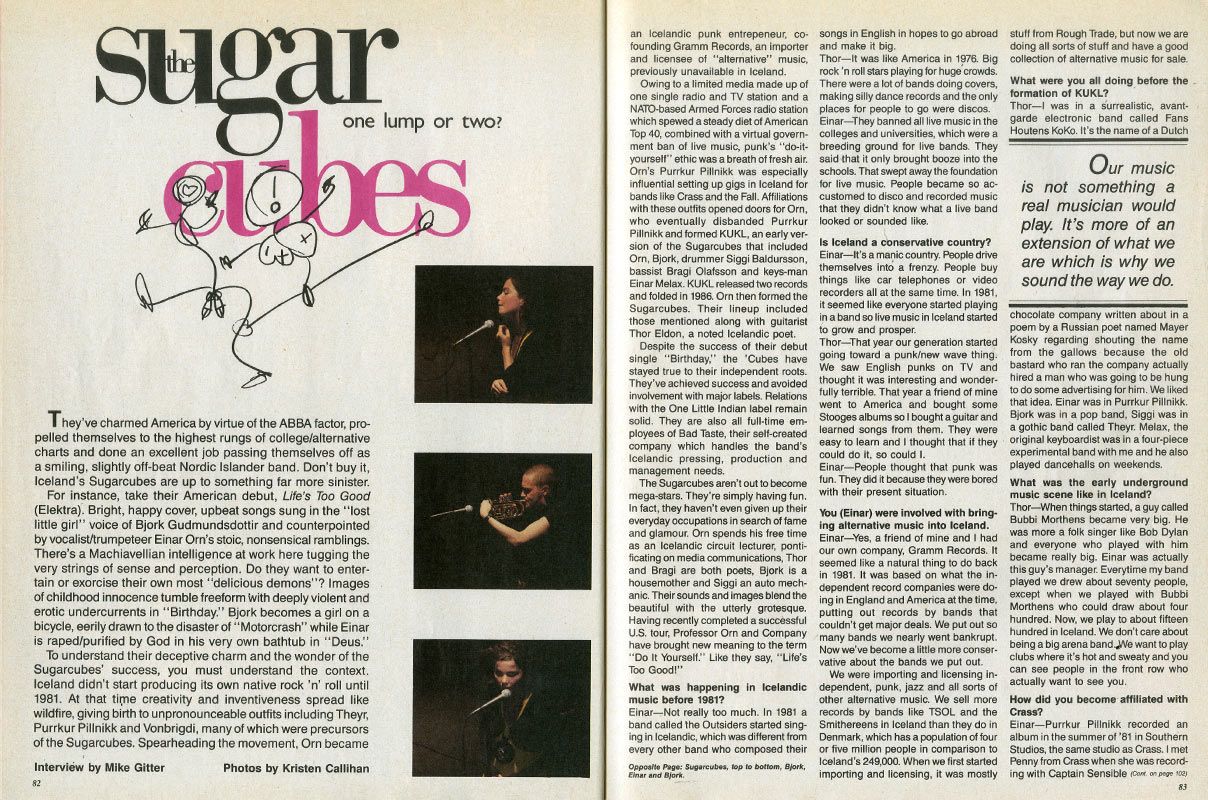
Opposite Page: Sugarcubes, top to bottom, Bjork,
Einar and Bjork.
putting out records by bands that
couldn't get major deals. We put out so
many bands we nearly went bankrupt.
vative about the bands we put out.
Now we've become a little more conser-
We were importing and licensing in-
dependent, punk, jazz and all sorts of
other alternative music. We sell more
records by bands like TSOL and the
Smithereens in Iceland than they do in
Denmark, which has a population of four
or five million people in comparison to
Iceland's 249,000. When we first started
importing and licensing, it was mostly
actually want to see you.
How did you become affiliated with
Crass?
Einar-Purrkur Pillnikk recorded an
album in the summer of '81 in Southern
Studios, the same studio as Crass. I met
Penny from Crass when she was record-
ing with Captain Sensible (Cont. on page 102)
82