Page Text
            KEBALTES
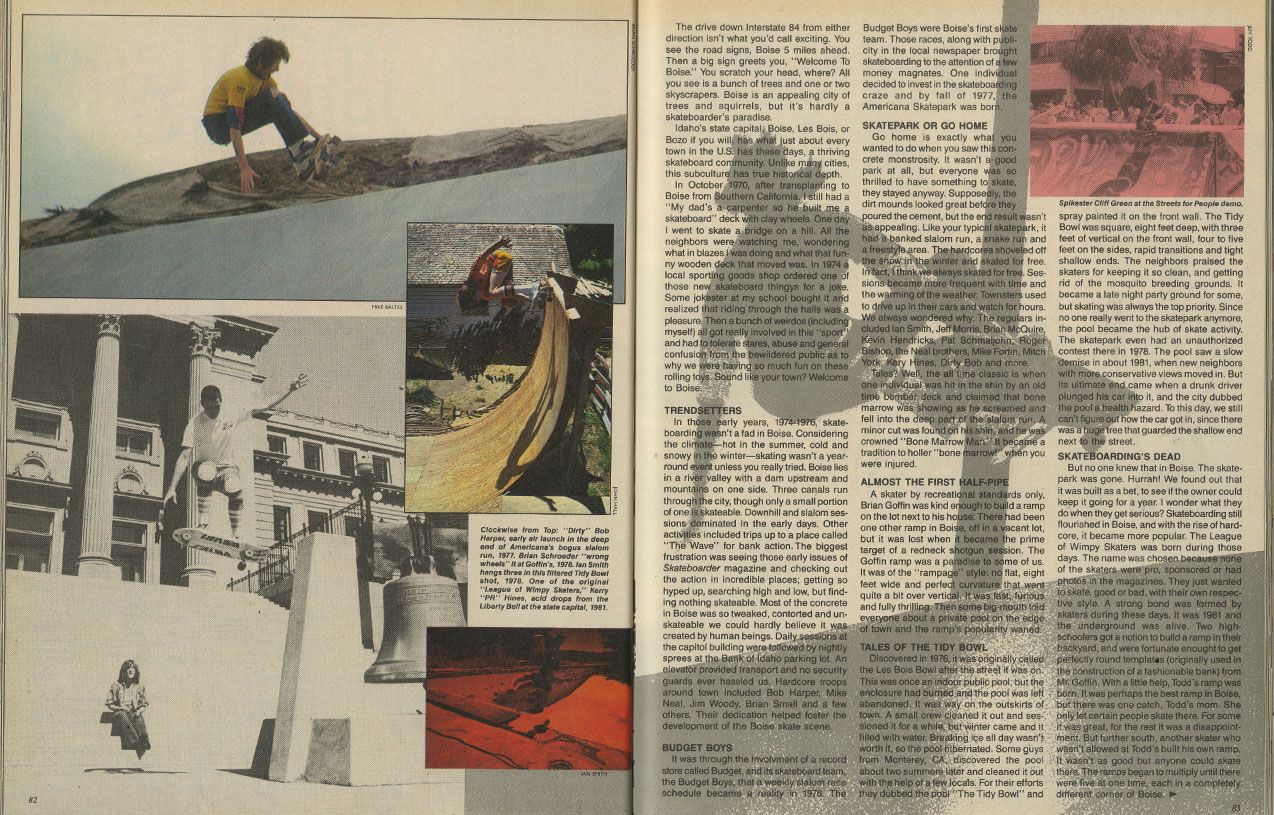
Clockwise from Top: "Dirty" Bob
Harper, early air launch in the deep
end of Americana's bogus slalom
run, 1977. Brian Schroeder "wrong
wheels" it at Goffin's, 1978. Jan Smith
hangs three in this filtered Tidy Bowl
shot, 1978. One of the original
"League of Wimpy Skaters," Kerry
"PR" Hines, acid drops from the
Liberty Bell at the state capital, 1981.
AN SHITH
The drive down Interstate 84 from either
direction isn't what you'd call exciting. You
see the road signs, Boise 5 miles ahead.
Then a big sign greets you, "Welcome To
Boise." You scratch your head, where? All
you see is a bunch of trees and one or two
skyscrapers. Boise is an appealing city of
trees and squirrels, but it's hardly a
skateboarder's paradise.
Idaho's state capital, Boise, Les Bois, or
Bozo if you will has what just about every
town in the U.S. has these days, a thriving
skateboard community. Unlike many cities,
this subculture has true historical depth.
In October 1970, after transplanting to
Boise from Southern California, I still had a
"My dad's a carpenter so he built me a
skateboard" deck with clay wheels. One day
I went to skate a bridge on a hill. All the
neighbors were watching me, wondering
what in blazes I was doing and what that fun-
ny wooden deck that moved was. In 1974 a
local sporting goods shop ordered one of
those new skateboard thingys for a joke.
Some jokester at my school bought it and
realized that riding through the halls was a
pleasure. Then a bunch of weirdos (including
myself) all got really involved in this "sport"
and had to tolerate stares, abuse and general
confusion from the bewildered public as to
why we were having so much fun on these"
rolling toys. Sound like your town? Welcome
to Boise.
TRENDSETTERS
In those early years, 1974-1976, skate-
boarding wasn't a fad in Boise. Considering
the climate-hot in the summer, cold and
snowy in the winter-skating wasn't a year-
round event unless you really tried. Boise lies
in a river valley with a dam upstream and
mountains on one side. Three canals run
through the city, though only a small portion
of one is skateable. Downhill and slalom ses-
sions dominated in the early days. Other
activities included trips up to a place called
"The Wave" for bank action. The biggest
frustration was seeing those early issues of
Skateboarder magazine and checking out
the action in incredible places; getting so
hyped up, searching high and low, but find-
ing nothing skateable. Most of the concrete
in Boise was so tweaked, contorted and un-
skateable we could hardly believe it was
created by human beings. Daily sessions at
the capitol building were followed by nightly
sprees at the Bank of Idaho parking lot. An
elevator provided transport and no security
guards ever hassled us. Hardcore troops
around town included Bob Harper, Mike
Neal, Jim Woody, Brian Small and a few
others. Their dedication helped foster the
development of the Boise skate scene.
BUDGET BOYS
It was through the involvment of a record
store called Budget, and its skateboard team,"
the Budget Boys, that a weekly slalom race
schedule became a reality in 1976. The
Budget Boys were Boise's first skate
team. Those races, along with publi-
city in the local newspaper brought
skateboarding to the attention of a few
money magnates. One individual
decided to invest in the skateboarding
craze and by fall of 1977, the
Americana Skatepark was born.
SKATEPARK OR GO HOME
Go home is exactly what you
wanted to do when you saw this con-
crete monstrosity. It wasn't a-good
park at all, but everyone was so
thrilled to have something to skate,
they stayed anyway. Supposedly, the
dirt mounds looked great before they
poured the cement, but the end result wasn't
as appealing. Like your typical skatepark, it
had a banked slalom run, a snake run and
a freestyle area. The hardcores shoveled off
the snow in the winter and skated for free.
In fact, I think we always skated for free. Ses-
sions became more frequent with time and
the warming of the weather. Townsters used
to drive up in their cars and watch for hours.
We always wondered why. The regulars in-
cluded lan Smith, Jeff Morris, Brian McQuire,
Kevin Hendricks, Pat Schmaljohn, Roger
Spikester Cliff Green at the Streets for People demo.
spray painted it on the front wall. The Tidy
Bowl was square, eight feet deep, with three
feet of vertical on the front wall, four to five
feet on the sides, rapid transitions and tight
shallow ends. The neighbors praised the
skaters for keeping it so clean, and getting
rid of the mosquito breeding grounds. It
became a late night party ground for some,
but skating was always the top priority. Since
no one really went to the skatepark anymore,
the pool became the hub of skate activity.
The skatepark even had an unauthorized
Bishop, the Neal brothers, Mike Fortin, Mitch contest there in 1978. The pool saw a slow
York Kery Hines, Dirty Bob and more.
Tales? Well, the all time classic is when
one individual was hit in the shin by an old
time bomber deck and claimed that bone
marrow was showing as he screamed and
fell into the deep part of the slalom run. A
minor cut was found on his shin, and he was
crowned "Bone Marrow Man. It became a
tradition to holler "bone marrow!" when you
were injured.
ALMOST THE FIRST HALF-PIPE
A skater by recreational standards only,
Brian Goffin was kind enough to build a ramp
on the lot next to his house. There had been
one other ramp in Boise, off in a vacant lot,
but it was lost when it became the prime.
target of a redneck shotgun session. The
Goffin ramp was a paradise to some of us.
It was of the "rampage" style: no flat, eight
feet wide and perfect curvature that went
quite a bit over vertical. It was fast, furious
and fully thrilling. Then some big-mouth told
everyone about a private pool on the edge
of town and the ramp's popularity waned
TALES OF THE TIDY BOWL
Discovered in 1976, it was originally called
the Les Bois Bowl after the street it was on.
This was once an indoor public pool, but the
enclosure had burned and the pool was left
abandoned. It was way on the outskirts of
town. A small crew cleaned it out and ses
sioned it for a while but winter came and it
filled with water. Breaking ice all day wasn't
worth it, so the pool hibernated. Some guys
from Monterey, CA, discovered the pool
about two summers later and cleaned it out
with the help of a few locals. For their efforts
they dubbed the pool "The Tidy Bowl" and
demise in about 1981, when new neighbors
with more conservative views moved in. But
its ultimate end came when a drunk driver
plunged his car into it, and the city dubbed
the pool a health hazard. To this day, we still
can't figure out how the car got in, since there
was a huge tree that guarded the shallow end
next to the street.
SKATEBOARDING'S DEAD
But no one knew that in Boise. The skate-
park was gone. Hurrah! We found out that
it was built as a bet, to see if the owner could.
keep it going for a year. I wonder what they
do when they get serious? Skateboarding still
flourished in Boise, and with the rise of hard-
core, it became more popular. The League
of Wimpy Skaters was born during those
days. The name was chosen because none
of the skaters were pro, sponsored or had.
photos in the magazines. They just wanted
to skate, good or bad, with their own respec-
tive style. A strong bond was formed by
skaters during these days. It was 1981 and
the underground was alive. Two high-
schoolers got a notion to build a ramp in their
backyard, and were fortunate enought to get
perfectly round templates (originally used in
the construction of a fashionable bank) from
Mr. Goffin, With a little help, Todd's ramp was
born. It was perhaps the best ramp in Boise,
but there was one catch, Todd's mom. She
only let certain people skate there. For some
it was great, for the rest it was a disappoint-
ment. But further south, another skater who
wasn't allowed at Todd's built his own ramp.
It wasn't as good but anyone could skate
there. The ramps began to multiply until there
were five at one time, each in a completely
different corner of Boise.