Page Text
            RAMPAGE
JIMMY'Z
眼
R
AMPANT RAMPING AND RAGING
It's time once again for a little refresher
course on the history of wooden ramps in
skateboarding and their uses and abuses
over the years. Just for the hell of it, let's access
the old American Heritage for a definition:
ramp (ramp) n. 1. An inclined passage or roadway
connecting different levels, as of a building or road.
2. Archir. A concave bend of a handrail where a sharp change
in level or direction occurs, as at a stair landing. 3. A mobile
staircase for entering and leaving an airplane.
No mention of skateboarding, but there are some
key words-incline, concave, bend, etc.
Maybe the definition of ramp as a verb is more
descriptive:
ramp² (ramp) intr. v: 1. To assume a threatening stance.
2. To act threatening or violently; rage.
Now that's more like it. There's always a lot of
raucous ramping going on during a radical...er
...ramp skate session.
In these modern skate times, the term ramp has
become a poor description for half-pipes and such.
When you break it down, half-pipe is not a good
name for these well-used skate structures either.
HISTORY NOTE
Both terms, ramp and half-pipe, are leftovers from
different eras in skateboarding. That's where this
brief history lesson begins.
The first skateboard ramp was probably just that:
a crude lean-to design featuring a 4x8' sheet of
plywood (maybe a discarded billboard or road sign
of some sort) leaned up against whatever was
available. Before long a framework was built to keep
the skating surface in place. Then layers began
overlapping, each one steeper than the last, even-
tually forming a skeleton of a transition. It wasn't
long before the obvious presented itself and bent
wood transitions using circular templates and 2x4"
crossbracing became the norm.
In short order the classic U-shape and eight-foot
width became the basic dimensions for the...uh
.half-pipe if you will. Half of a round full pipe,
right? These earliest versions would accomodate
a skater doing kickturns, edgers and light aerials.
Down in Hollywood, Florida, however, guys like
Alan Gelfand and a young Mike McGill were perfect-
ing ollies and airs in skateparks and on a ramp
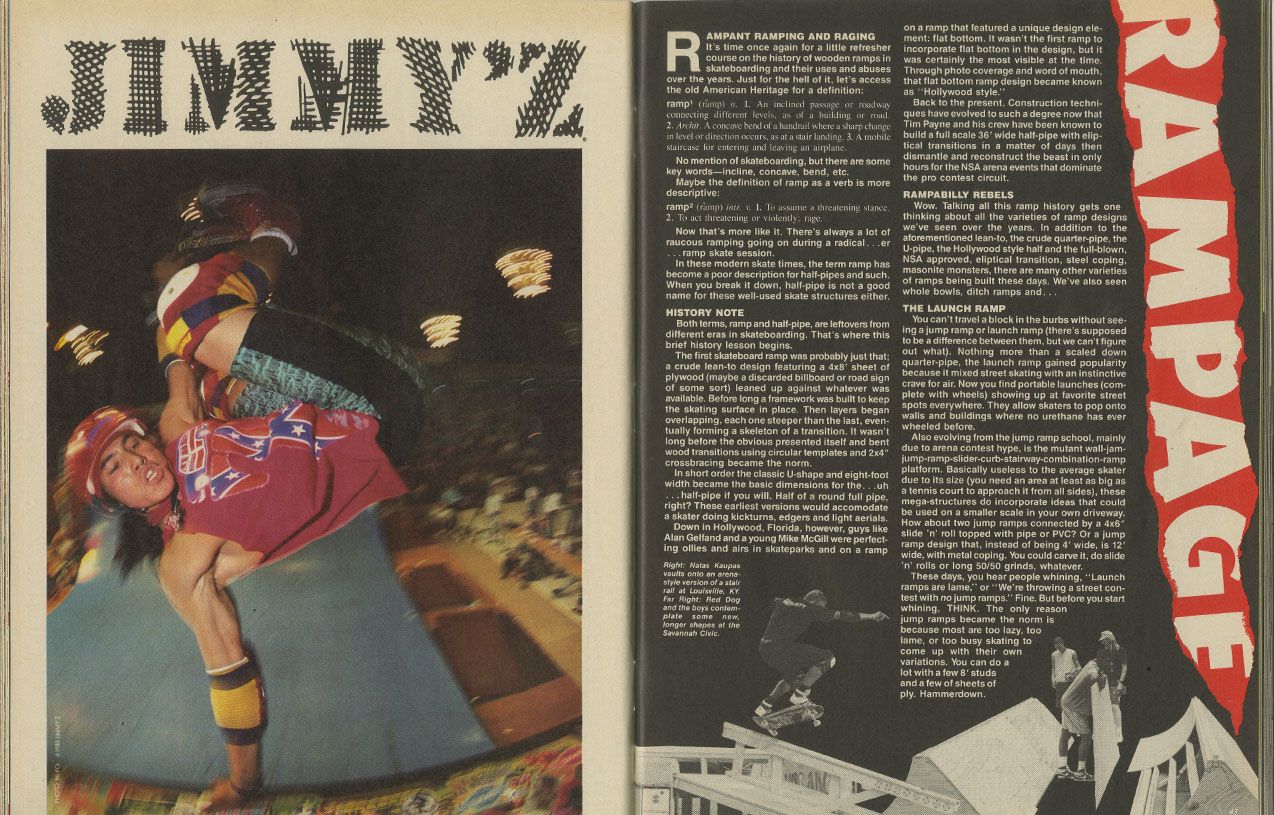
Right: Natas Kaupas
vaults onto an arena-
style version of a stair
ralf at Louisville, KY
Far Right: Red Dog
and the boys contem-
plate some new,
longer shapes at the
Savannah Civic.
on a ramp that featured a unique design ele-
ment: flat bottom. It wasn't the first ramp to
incorporate flat bottom in the design, but it
was certainly the most visible at the time.
Through photo coverage and word of mouth,
that flat bottom ramp design became known
as "Hollywood style."
Back to the present. Construction techni-
ques have evolved to such a degree now that
Tim Payne and his crew have been known to
build a full scale 36' wide half-pipe with elip-
tical transitions in a matter of days then
dismantle and reconstruct the beast in only
hours for the NSA arena events that dominate
the pro contest circuit.
RAMPABILLY REBELS
Wow. Talking all this ramp history gets one
thinking about all the varieties of ramp designs
we've seen over the years. In addition to the
aforementioned lean-to, the crude quarter-pipe, the
U-pipe, the Hollywood style half and the full-blown,
NSA approved, eliptical transition, steel coping,
masonite monsters, there are many other varieties
of ramps being built these days. We've also seen
whole bowls, ditch ramps and...
THE LAUNCH RAMP
You can't travel a block in the burbs without see-
ing a jump ramp or launch ramp (there's supposed
to be a difference between them, but we can't figure
out what). Nothing more than a scaled down
quarter-pipe, the launch ramp gained popularity
because it mixed street skating with an instinctive
crave for air. Now you find portable launches (com-
plete with wheels) showing up at favorite street
spots everywhere. They allow skaters to pop onto
walls and buildings where no urethane has ever
wheeled before.
Also evolving from the jump ramp school, mainly
due to arena contest hype, is the mutant wall-jam-
jump-ramp-slider-curb-stairway-combination-ramp
platform. Basically useless to the average skater
due to its size (you need an area at least as big as
mega-structures do incorporate ideas that could
a tennis court to approach it from all sides), these
be used on a smaller scale in your own driveway.
How about two jump ramps connected by a 4x6"
slide 'n' roll topped with pipe or PVC? Or a jump
ramp design that, instead of being 4' wide, is 12'
wide, with metal coping. You could carve it, do slide
'n' rolls or long 50/50 grinds, whatever.
These days, you hear people whining, "Launch
ramps are lame," or "We're throwing a street con-
test with no jump ramps." Fine. But before you start
whining, THINK. The only reason
jump ramps became the norm is
because most are too lazy, too
lame, or too busy skating to
come up with their own.
variations. You can do a
lot with a few 8' studs
and a few of sheets of
ply. Hammerdown.