Page Text
            groups of skaters in the mainstream: The
Toke Team, a crew of first generation skaters
and the Bethesda Boyz, who cropped up
around 1985 and have been blowing minds
ever since.
Until 1979, Northern VA and Southern MD
were separated by the abundance of local
skateparks, lack of transportation and the
Potomac River. These scenes have infiltra-
ted, cohabited and finally overlapped. Form-
ing the backbone are the skatepark rats of
yesterday and the unspoken rulers of today.
After we got to Cedar Crest, some of those
rats and rulers were reunited to trade stories.
The first four years, 1975-1979, are marked
as a beginning, a breaking-in period. As
Bruce explains, "All of us in VA would make
jokes about the Tokers being afraid to cross
the river to skate our terrain and they would
kick back and say the same thing about us.
But it's not like we were ever rivals or
anything, we just had our separate scenes
back then."
"Back then" there were many parks. The
majority were in MD, but VA had its share.
Crofton, Waldorf, Cascade, Gaithersburg
Freestyle and Gaithersburg Indoor
permeated the depths of Southern Maryland.
Skate World, Mannassas Skatepark, The
Glass Wave and Mall Wall struck the pas-
sions of the young Northern Virginians.
Bruce elaborates: "Skate World opened
around '76 and closed around '80. The park
was basically where all of us Virginians met.
'Micro' (Mike Mapp) and Brady Byrd were
probably into skating the most back then, out
of all of us who are still skating."
"Micro"" interjects, "Yeah, we'd all be slam-
ming into each other in the mogul field.
Bruce's dad out there taking pictures, yell-
ing 'Bruce, do one!" Back then it was basic-
ally me, Brady, Bruce, Wendell, John.
Hargadon, Mike Cresky, Tipedo,
Wildman, Pat and Willy Clarke, and
Miles Ross. Most of them quit when
Skate World died.
"Miles Ross is a hero. So inspira-
tional. He was the first really gutsy
skater at Skate World. Frontside air in
the pipe. Psycho. Mike Cresky was
phenomenal, too."
Bruce: "Yeah, we skated Skate
World bootleg for about a year before
It went under in '81. Manassas
Skatepark came and went. It had a big
pool but it was really kinked. Mall Wall
in Springfield, VA, sprung up in the heat
of the skatepark days. That place was
hell. Lasted a year and was dozed."
"Puker" (Tim Whistler) breaks in,
"Cascade in Kaytonsville, MD, was the
major Toke Team park. We used to
skate there after school in '79 and '80.
It had an indoor keyhole pool. It was
perfect. Ten or eleven feet deep, really
big. Everybody loved it. Outside they
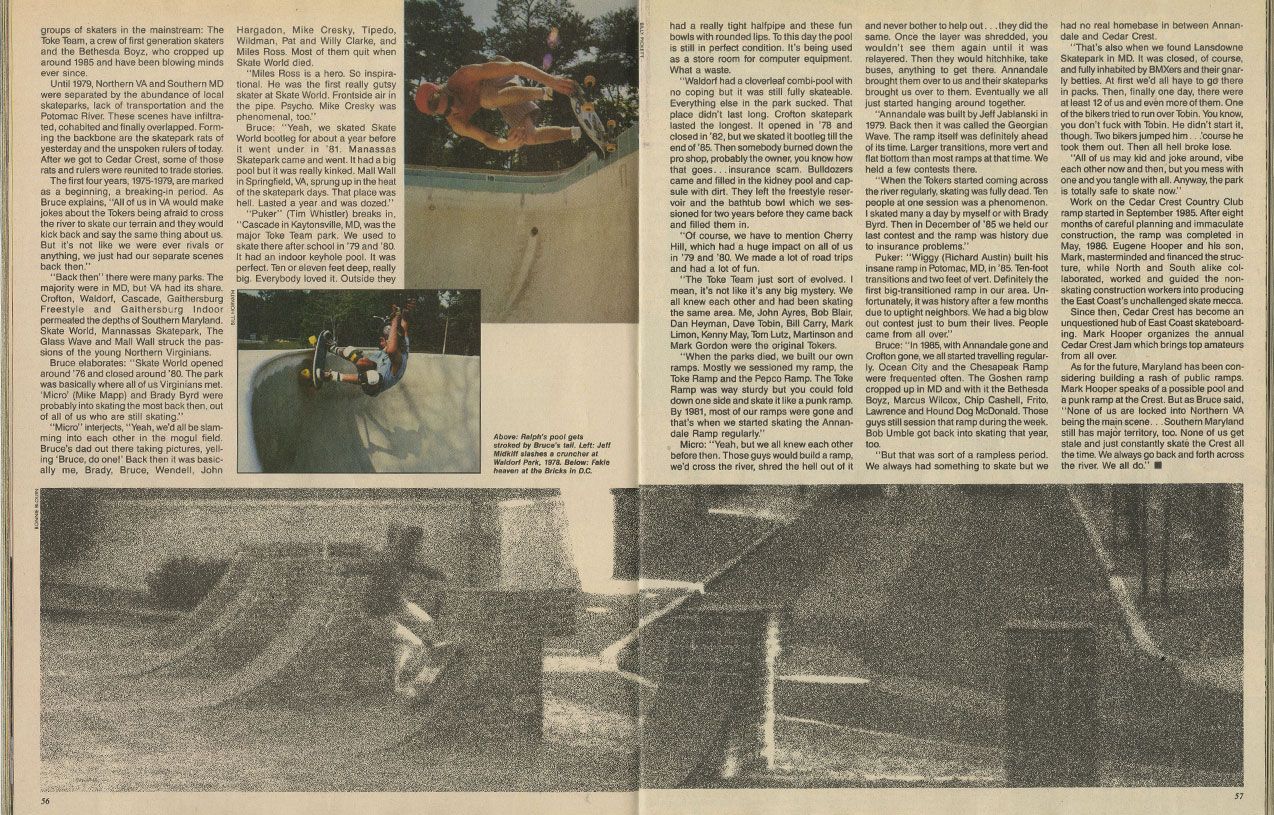
Above: Ralph's pool gets
stroked by Bruce's tail. Left: Jeff
Midkiff slashes a cruncher at
Waldorf Park, 1978. Below: Fakle
heaven at the Bricks in D.C.
had a really tight halfpipe and these fun
bowls with rounded lips. To this day the pool
is still in perfect condition. It's being used
as a store room for computer equipment.
What a waste.
"Waldorf had a cloverleaf combi-pool with
no coping but it was still fully skateable.
Everything else in the park sucked. That
place didn't last long. Crofton skatepark
lasted the longest. It opened in '78 and
closed in '82, but we skated it bootleg till the
end of '85. Then somebody burned down the
pro shop, probably the owner, you know how
that goes...insurance scam. Bulldozers
came and filled in the kidney pool and cap-
sule with dirt. They left the freestyle reser-
voir and the bathtub bowl which we ses-
sioned for two years before they came back
and filled them in.
"Of course, we have to mention Cherry
Hill, which had a huge impact on all of us
in '79 and '80. We made a lot of road trips
and had a lot of fun.
"The Toke Team just sort of evolved. I
mean, it's not like it's any big mystery. We
all knew each other and had been skating
the same area. Me, John Ayres, Bob Blair,
Dan Heyman, Dave Tobin, Bill Carry, Mark
Limon, Kenny May, Tom Lutz, Martinson and
Mark Gordon were the original Tokers.
"When the parks died, we built our own
ramps. Mostly we sessioned my ramp, the
Toke Ramp and the Pepco Ramp. The Toke
Ramp was way sturdy but you could fold
down one side and skate it like a punk ramp.
By 1981, most of our ramps were gone and
that's when we started skating the Annan-
dale Ramp regularly!"
Micro: "Yeah, but we all knew each other
before then. Those guys would build a ramp,
we'd cross the river, shred the hell out of it
and never bother to help out...they did the
same. Once the layer was shredded, you
wouldn't see them again until it was
relayered. Then they would hitchhike, take
buses, anything to get there. Annandale
brought them over to us and their skateparks
brought us over to them. Eventually we all
just started hanging around together.
"Annandale was built by Jeff Jablanski in
1979. Back then it was called the Georgian
Wave. The ramp itself was definitely ahead
of its time. Larger transitions, more vert and
flat bottom than most ramps at that time. We
held a few contests there.
"When the Tokers started coming across
the river regularly, skating was fully dead. Ten
people at one session was a phenomenon.
I skated many a day by myself or with Brady
Byrd. Then in December of '85 we held our
last contest and the ramp was history due
to insurance problems."
Puker: "Wiggy (Richard Austin) built his
insane ramp in Potomac, MD, in '85. Ten-foot
transitions and two feet of vert. Definitely the
first big-transitioned ramp in our area. Un-
fortunately, it was history after a few months
due to uptight neighbors. We had a big blow
out contest just to bum their lives. People
came from all over."
Bruce: "In 1985, with Annandale gone and
Crofton gone, we all started travelling regular-
ly. Ocean City and the Chesapeak Ramp
were frequented often. The Goshen ramp
cropped up in MD and with it the Bethesda
Boyz, Marcus Wilcox, Chip Cashell, Frito,
Lawrence and Hound Dog McDonald. Those
guys still session that ramp during the week.
Bob Umble got back into skating that year,
100.
"But that was sort of a rampless period.
We always had something to skate but we
had no real homebase in between Annan-
dale and Cedar Crest.
"That's also when we found Lansdowne
Skatepark in MD. It was closed, of course,
and fully inhabited by BMXers and their gnar-
ly betties. At first we'd all have to go there
in packs. Then, finally one day, there were
at least 12 of us and even more of them. One
of the bikers tried to run over Tobin. You know,
you don't fuck with Tobin. He didn't start it,
though. Two bikers jumped him...course he
took them out. Then all hell broke lose.
"All of us may kid and joke around, vibe
each other now and then, but you mess with
one and you tangle with all. Anyway, the park
is totally safe to skate now."
Work on the Cedar Crest Country Club
ramp started in September 1985. After eight
months of careful planning and immaculate
construction, the ramp was completed in
May, 1986. Eugene Hooper and his son,
Mark, masterminded and financed the struc-
ture, while North and South alike col-
laborated, worked and guided the non-
skating construction workers into producing
the East Coast's unchallenged skate mecca.
Since then, Cedar Crest has become an
unquestioned hub of East Coast skateboard-
ing. Mark Hooper organizes the annual
Cedar Crest Jam which brings top amateurs
from all over.
As for the future, Maryland has been con-
sidering building a rash of public ramps.
Mark Hooper speaks of a possible pool and
a punk ramp at the Crest. But as Bruce said,
"None of us are locked into Northern VA
being the main scene...Southern Maryland
still has major territory, too. None of us get
stale and just constantly skaté the Crest all
the time. We always go back and forth across
the river. We all do."
57