Page Text
            slant. Yet it shows that even then, Phoeni-
cians knew how to put their best foot forward.
Unfortunately, today no cement skatepark
stands, but there is a light blue fiberglass
remnant of skating's heyday that includes a
snake, a 20' fiberglass full-pipe and two sheet
metal halfpipes. It is named, appropriately
enough, Thrasherland, and a summer
contest series is now underway.
HIGH ROLLER BABY
One of the high points in Phoenix history
was High Roller skatepark. Opened in May
of 1978, the park was loved by all who local-
ized it. Its bowls were dug using the cheap
and precise labor of the skaters themselves.
After hearing a cement guy say, "the bowl
is only as perfect as the dirt is," the skaters
grabbed hoes and finished the holes.
Walter Serafini deserves special mention
here as prime mover of dirt and design at
both High Roller and later, Skate in the
Shade. He was never given due credit, says
Mike Bragone.
"Wally was a maniac who drank tons of
beer and got fired," said Tony Simon. Serafini
never skated either park after they were open
for business.
High Roller had something for everybody,
even your mama. It featured two pools, both
of which sported coping, a small one and a
big one with a snakeway entrance and two
tombstones. Both saw heavy shredding, and
rock and rolls were not uncommon on the
biggun's extensions.
Two pipes also sat at the park. The little
pipe was 16', and had a halfpipe on one side
and a smooth, mellow bowl on the other. The
big pipe was 18' and had vertical flats that
extended nearly to the height of the pipe. To
grind here took steel balls. Nonetheless,
photographic evidence exists of Jimmy Plum-
mer catching air and Doug Schneider wheel-
ing the top of the nine or so feet of vert.
Also of interest were the big and medium
snake. The medium snake was good for
speed and learning tricks while the big one.
was great for speed and blasting tricks.
It was in the medium snake that Todd
Joseph created the extended layback air as
a work of art.
"One day I was feeling real good," says
Todd, "I could not fall. I had a lot of speed
and kind of just flung it over my head, then
tucked it in and landed it. Everybody was
screaming."
Finally, High Roller contained a mellow
reservoir with a vertical extension in one
corner and a roll-in hump that could double
as a cement launch ramp. But the four-foot
deep cloverleaf was the run that everyone
wanted to have in their backyard.
Other High Roller locals included Jon
Haas, Mike "Bam Bam" Sversvold, Dag-
wood Sversvold, Eric Reinfried, John Ousko,
Kip Dent, Eric Vinceagara, Duncan Young,
Gary Sherril, Dave Bidore and Kevin Staab.
Like all good things, High Roller one day
met its end. But not until the park sat sup-
posedly closed for about a month of the most
furious skating of its life. Steve Pingleton rode
there on the last day.
68
"The bulldozers were all around us and
we had bailed all the water out of the big pipe.
It was half destroyed, but they left it for us,"
said Pingleton. Yeah, we had to leave. I
can't even go by there anymore."
WHAT SHADE?
Skate in the Shade is well remembered as
the best pool ever built by mankind. The
park, located in nearby Tempe, never had
anything but the pool, and the pool never had
an ounce of shade.
Mike Gragone recalls the keyhole-shaped
bowl as having a 30-foot diameter, ten feet
of depth and three feet of vert. Its tile was
creamless coffee-colored and its coping was
the biggest many had ever seen.
"All the pools in California had little
coping," said Bragone, "so they made the
coping at Skate in the Shade humongous.
The Val Boys (pros from inland California)
came out and said it was a great bowl but
the coping was bunk, so we felt bad. Then
Peralta, Schneider and some dudes from
Upland came out and said, 'That coping is
perfect, so then we felt good."
Memories jar when attempting to recall the
true depth of Skate in the Shade. Some say
it had to be 13 feet, while Bragone insists it
was ten. But everyone agrees, it was deep
and perfect, with not a kink to be found.
In fact, the drop from shallow to deep was
so quick, pieces of grip tape were pasted
there so that a rider who fell could have some
way of getting himself out.
Only the good die young, and the best die
sooner. Skate in the Shade was plowed
under one sticky Phoenix day. The property
was then abandoned. But the skaters would
not let it rest. Soon, a trench was dug in the
deep end to allow a thin, five-foot strip of
workable area. The pool was sessioned in
a halfpipe manner for almost a month before
the plow sent the walls tumbling down.
In memory, let us consider Tim Hammond
(not the Carl' Jr. commercials' geek) who flew
airs around that pool like no other, Mike Rick,
who pulled 10- to 15-foot slide and rolls way
back then, and especially the burly man,
Steve Shelton, who ripped whatever he
touched.
R.I.P. Hohokam ditch. Photo: M.Fo
AND THEN THERE WAS MORE
Other parks included the Permanent Wave
and the Little Dipper in Mesa. Primitive and
small, these parks did not endure.
Big Surf, "Arizona's Ocean," "Big Flush,"
or whatever the hey you want to call it is an
artificial wave pond that has hosted a few
contests in its time. One was a recent NSA
vert/street extravaganza and one was a
slalom/bank showdown run way back when
trucks were no wider than your little pinkie.
It was during that long ago contest that they
set up a slalom run through the water slide,
and guys like Skitch Hitchcock and Ty Page
fully booked down it.
The wave pond itself features a perfect,
long quarter-pipe with a round lip that has
been snaked before and will be again. In the
summer it is filled with wannabe surfers and
little kids.
FLASH
Occasionally, it does rain in Phoenix, so
man, in his infinite wisdom, built a wide
variety of ditches to control and channel flash
floods. The Proving Grounds were an early
find that stretched for miles. The Hiscos were
loading docks with tri-level banks. Hohokam
was a long standing mellow ditch that
recently saw ruin. The Stupors consist of a
cement quarter-pipe that shoots under a
bridge into a set of banks where one side is
grindable and the other has a rollout.
We could go on listing Phoenix banks for
hours without even pausing to sip a cool
brew, but suffice it to note that there have
been some dang nice banks in the Valley of
the Sun. Eventually, however, some.
homeowner decides they don't like to see
kids having fun, and they attempt to destroy
the skaters' joy. Most times it's not enough.
Way back when, there were some fine
banks called the Alma School Banks. They
were tall and hairy, but they had their lines.
After three years of solid skating, civilization
finally surrounded them with tract homes
where once there was only solitary desert.
Of course, some bitch on the homeowner's
association soon decided they had to go.
In came forty or so tons of huge river rock
and ugly signs that said "No Trespassing.""
Things looked bad. But then the rains came,
and lo and behold, the rocks were washed
away. So the skaters returned for a month
or so before they brought in more rocks, and
again, it was Mother Nature to the rescue.
Finally the bastards wised up and cemented
the rocks in. It is the way of the world that
as one bank dies, another is born to carry on.
TUBULAR BELLS
No article on Phoenix history would be
complete if it left out the pipes. Though
Phoenicians be damned with heat, they be
blessed by an everlasting supply of pools and
a rarer yet more rewarding stash of pipes.
There have been pipes in Phoenix since
before skaters knew how to ride them. Tony
Simon discovered a sea of sections near a
certain canal. The pipe sat 24' high, in un-
countable rows, as Simon sighed.,
He knew that when they were all hooked
together and put in the ground they would
be carvable. At this time, he and his friends
knew nothing of fakies or kickturns, so they
just sat and stared, sensing there was
something they could do with them, only not
knowing what.
Around this time, Skateboarder Mag sent
a crew to cover the desert Goliaths. Among
them were the top pros who demonstrated
the fine arts of kickturns and fakies. Never
again would such sections go unridden.
A pair of renegade riders known as the
Loco Locals proved they were well named.
Jimmy Howard and Morgan McCarthy skated
barefoot and padless in the pipes,
and drew lines as high as Tony Alva.
The pipes were often located next to
bodies of water such as lakes or canals,
and the skaters took full advantage of the
chance to cool down. Some, like Steve and
John Pingleton would ride all day and then
go swimming. Others, like Tony Cholewa.
would grab their surfboards and have a truck
pull them from the dirt road along the canal,
while they churned big carves and long
sprays.
Although some busts occurred, there were
also friendly authority figures.
"We were out there skating all day and the
coolest security guard I ever met came on,"
says Steve Pingleton. "He said, "Yeah, the
sheriff might come by. If he does, tell him
you're my cousin and you're from California
and you're going to be spending the night."
We skated until it was dark, then this guy
said, 'Come on down to my trailer. I'll give
you some beers and we'll talk awhile."
One day the workers arrived to find a hearty
and able crew drawing over-vertical lines.
"Man, we were wondering how those
damn wheel marks got way up there on the
ceiling," they said.
Of course, the locations of the many pipe
sites remain to this day closely guarded
secrets. Mike Cornelius, bassist for JFA,
would not even tell members of his own band
where a certain pipeline lay.
"You guys got to understand the sworn to
secrecy thing," was his plea.
Evan Jones says that he was sworn to tell
only one person and that person was sworn
to tell only one.
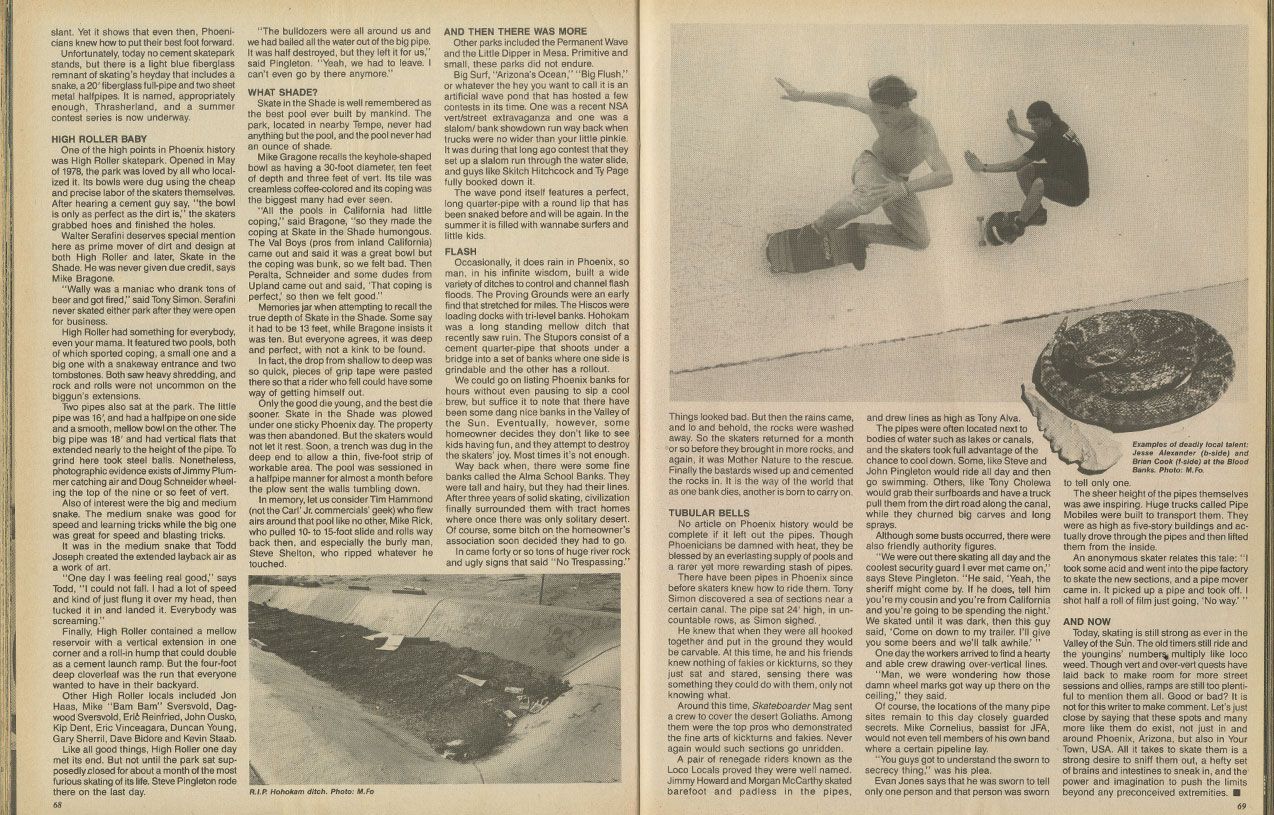
Examples of deadly local talent:
Jesse Alexander (b-side) and
Brian Cook (f-side) at the Blood
Banks. Photo: M. Fo
The sheer height of the pipes themselves
was awe inspiring. Huge trucks called Pipe
Mobiles were built to transport them. They
were as high as five-story buildings and ac-
tually drove through the pipes and then lifted
them from the inside..
An anonymous skater relates this tale: "I
took some acid and went into the pipe factory
to skate the new sections, and a pipe mover
came in. It picked up a pipe and took off. I
shot half a roll of film just going, 'No way."
AND NOW
Today, skating is still strong as ever in the
Valley of the Sun. The old timers still ride and
the youngins' numbers, multiply like loco
weed. Though vert and over-vert quests have
laid back to make room for more street
sessions and ollies, ramps are still too plenti-
ful to mention them all. Good or bad? It is
not for this writer to make comment. Let's just
close by saying that these spots and many
more like them do exist, not just in and
around Phoenix, Arizona, but also in Your
Town, USA. All it takes to skate them is a
strong desire to sniff them out, a hefty set
of brains and intestines to sneak in, and the
power and imagination to push the limits.
beyond any preconceived extremities.
69