Page Text
            ex
LUGE MASTER
DUNCAN KENNEDY
An interview with the skating, sliding Olympian
Interview by Kurt Carlson.
Imagine yourself being dragged down the freeway on a
skateboard behind your friend's Barracuda, doing 85 mph.
Replace the tires with thin metal blades, throw in a steep incline,
a solid ice surface, banked hairpin turns, and you're luging (or
sliding, as the racers call it). Luge racing, if you're not familiar
with it, is like minimalist bobsledding. The rider slips into his
Hefty bag-thin body suit, straps on a helmet, lies back on the
pod of his aerodynamically correct sled and launches down the
track with one overpowering desire: to GO FAST!
Duncan Kennedy has been fulfilling this desire for almost a
decade. Duncan is currently top American luge-dog and one of
the best fifteen sliders on the whole planet. He's also been a
hardcore skater for the last three years. Maybe you saw him on
T.V. blazing in the '88 Winter Olympics. If you watched the closing
ceremonies, you might have noticed Duncan's arm in a sling-
he had separated his shoulder at a local half-pipe earlier that
day. If you thought your last downhill speed run was rad, try go-
ing more than twice as fast. That is luging, and that is gnarly!
Read on and learn more about this high velocity sport from the
nation's best...
What was it like riding for the U.S. Olympic team?
It was cool, but it wasn't that different from other races. Since the
Olympics are so media-oriented, a lot of people kind of forget that
the athletes compete on the World Cup circuit all year. The at-
mosphere of the Olympics is a big deal because we're with other
sports, but as far as the actual competition, it's just another race.
Were you satisfied with your Olympic experience?
I'm not one to blame things on equipment, I'll blame myself first
if something goes wrong, but there was a big problem during the
Games. My first two runs were virtually flawless-the best raced runs
in my life-and they were very, very slow. All I can think is that there
was something wrong with the sled. I'm not going to pin the rap
on anyone for fooling around with my sled or changing something.
but I know something was done. I've placed consistently in the top
ten at other, more difficult tracks and I've placed top six in Calgary
against the same people, but
there I was driving perfect
runs and not even breaking
top fifteen. I saw eight years
of training snatched out from
under me basically. It would
be like a kingpin breaking in
the middle of Hawk's most im-
portant competition. Naturally
I was disappointed.
What was that caused by?
It could be a number of
things. It gets so technical.
You've got two steel blades
touching the ice and the
edges on the blades are so
finely tuned that when you get
into a high caliber race like
the Olympics, the slightest
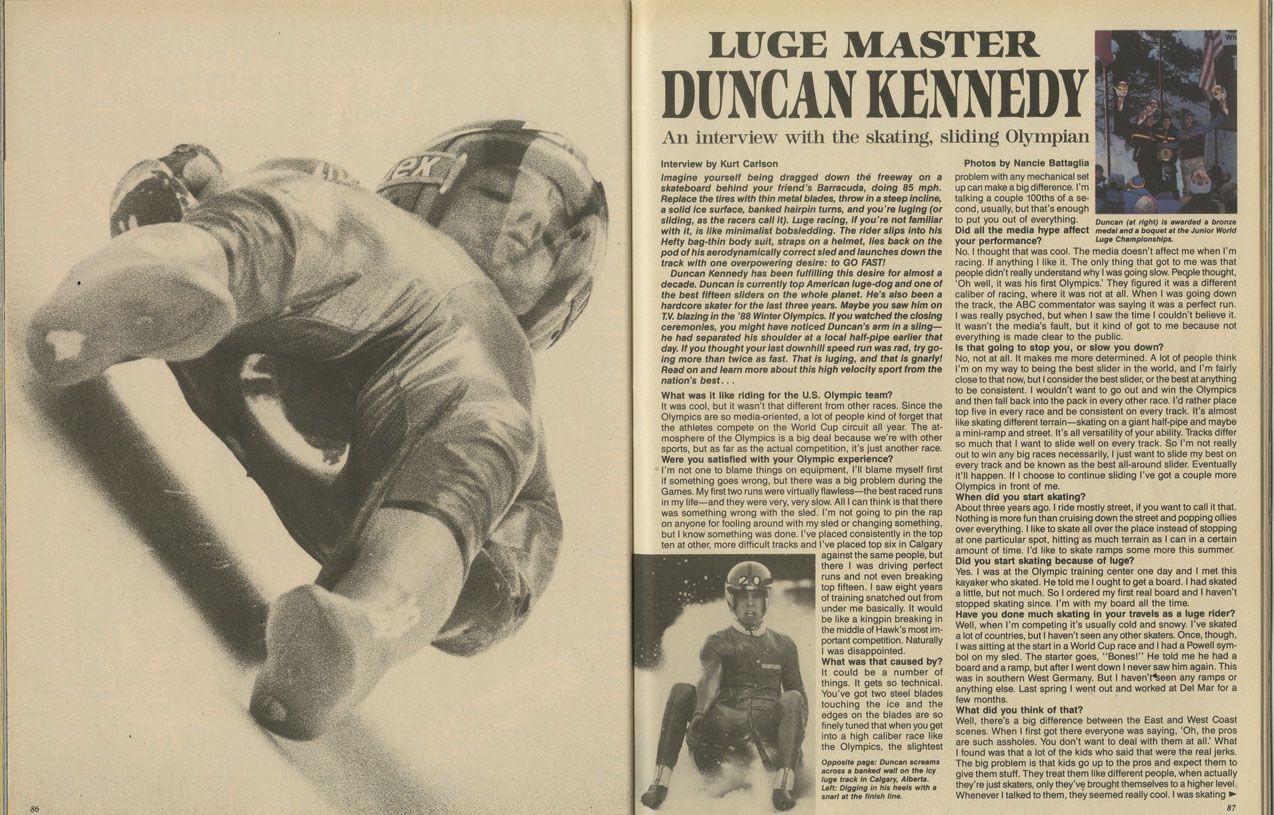
Opposite page: Duncan screams
across a banked wall on the icy
luge track in Calgary, Alberta.
Left: Digging in his heels with a
snarl at the finish line.
Photos by Nancie Battaglia
problem with any mechanical set
up can make a big difference. I'm
talking a couple 100ths of a se-
cond, usually, but that's enough
to put you out of everything.
Did all the media hype affect
your performance?
No. I thought that was cool. The media doesn't affect me when I'm
racing. If anything I like it. The only thing that got to me was that
people didn't really understand why I was going slow. People thought,
'Oh well, it was his first Olympics." They figured it was a different
caliber of racing, where it was not at all. When I was going down
the track, the ABC commentator was saying it was a perfect run.
I was really psyched, but when I saw the time I couldn't believe it.
It wasn't the media's fault, but it kind of got to me because not
everything is made clear to the public.
Duncan (at right) is awarded a bronze
medal and a boquet at the Junior World
Luge Championships.
Is that going to stop you, or slow you down?
No, not at all. It makes me more determined. A lot of people think
I'm on my way to being the best slider in the world, and I'm fairly
close to that now, but I consider the best slider, or the best at anything
to be consistent. I wouldn't want to go out and win the Olympics
and then fall back into the pack in every other race. I'd rather place
top five in every race and be consistent on every track. It's almost
like skating different terrain-skating on a giant half-pipe and maybe
a mini-ramp and street. It's all versatility of your ability. Tracks differ
so much that I want to slide well on every track. So I'm not really
out to win any big races necessarily, I just want to slide my best on
every track and be known as the best all-around slider. Eventually
it'll happen. If I choose to continue sliding I've got a couple more
Olympics in front of me.
When did you start skating?
About three years ago. I ride mostly street, if you want to call it that.
Nothing is more fun than cruising down the street and popping ollies
over everything. I like to skate all over the place instead of stopping
at one particular spot, hitting as much terrain as I can in a certain
amount of time. I'd like to skate ramps some more this summer.
Did you start skating because of luge?
Yes. I was at the Olympic training center one day and I met this
kayaker who skated. He told me I ought to get a board. I had skated
a little, but not much. So I ordered my first real board and I haven't
stopped skating since. I'm with my board all the time.
Have you done much skating in your travels as a luge rider?
Well, when I'm competing it's usually cold and snowy. I've skated
a lot of countries, but I haven't seen any other skaters. Once, though,
I was sitting at the start in a World Cup race and I had a Powell sym-
bol on my sled. The starter goes, "Bones!" He told me he had a
board and a ramp, but after I went down I never saw him again. This
I was in southern West Germany. But I haven't seen any ramps or
anything else. Last spring I went out and worked at Del Mar for a
few months.
What did you think of that?
Well, there's a big difference between the East and West Coast
scenes. When I first got there everyone was saying, 'Oh, the pros
are such assholes. You don't want to deal with them at all." What
I found was that a lot of the kids who said that were the real jerks.
The big problem is that kids go up to the pros and expect them to
give them stuff. They treat them like different people, when actually
they're just skaters, only they've brought themselves to a higher level.
Whenever I talked to them, they seemed really cool. I was skating