Page Text
            KNIGHTS of KRYPTONICUS
Sir Dave Crabb
Sir Gary Sanderson
Sir Peanut Brown
KRYPTONICUS WHEELIS
est. 1976
1908
ARMORY
KRYPTONICS
5660 Central Avenue, Boulder Colorado 80301 Telly 303-442-9173
Send Dollar for Info & Stickers
Micros
Reaktor Core
Gammas
strutting in front of them. I learned if I walked
with a certain humility in my steps I would be
left alone. But if I dragged my heels, I had
a chance of having a fight going."
Tell us about Ed "Big Daddy" Roth.
"I could talk about that all day. I went to
Los Angeles City College and got married
and had to give up school. I went to
Chounaird (sp?) for awhile, and got my first
art job as the director for Black Belt
magazine. They hired me to do the paste-up
and I ended up doing too much illustration,
so they canned me. I took this job, through a
certain amount of dirty politics, as a container
designer for Weyerhaeuser Corporation. I
was smoking grass and taking LSD, just a kid,
20- or 21-years-old, having to get up early
in the morning and put on a tie and wingtip
shoes. It was such a clash, it didn't take them
long to realize that I was just not executive
stock. They canned me. I bummed around
awhile and went to an unemployemnt agency.
They said, 'For an artist we don't have much
other than this one job. Nobody we send there
will take it, it's too grimy. Well, there's a guy
down in Maywood, Ed Roth, looking for an
art director. I said, 'Baby, it was made for
me; give me that phone." I called up Roth and
bullshitted with him. He said come on down,
had me draw some cars and I got the job. It
paid three times more than the Weyerhaeuser
job. I could come and go when I wanted. I
didn't have to wear a tie. I was issued a cer-
tain amount of work to do per month and then
my time was my own.
Shit like that makes you believe in God.
Every day was an adventure down there.
Celebrities coming in, the FBI, bikers, prosti-
tutes, a menagerie, a carnival coming through
the door. It was like an extreme think tank.
Roth was interested in ideas no matter how
wild they were. The more far out the better.
Boy, I supplied his needs. He thought of me-
he was very mistaken-as the guy that had
his hand on the pulse of the youth. I had to
explain to him, 'No, I'm this bohemian over
here on the fringes.' He knew I was smoking
grass and thought I was the front of the
legions. What Ed really wanted was the
average American kid, and I was this pseudo
intellectual artist pretender. Ed was in his hey-
day when I started work there. God, I couldn't
belive the money coming in. In that period of
time, back before the Vietnam war, it was just
incredible. The entire world was right wing,
but I was in this bohemian heaven with other
pals of my own ilk. Hot rodder buddies with
imagination.
Ed is out there. He's a compulsive worker
who'll tackle anything. He always has to be
on the cutting edge of technology. Right now
he's working on car bodies made out of
graphite, like that Challen-
ger that went around the
world. He's right at the
forefront of solar power.
He's got a good enough
reputation so he can get in
with anybody to find out
the latest information. But
he's kind of fucked up and
funky; he doesn't wear
socks. He's naturally at-
tracted to scroungy bohe-
mian people. He's like the
Buffalo Bill of our times.
Once he got in a fight with
some bikers and had like
a three-day shoot out. He
held them off and prac-
tically kicked their ass. This
shoot out finally termi-
nated in hundreds of
bikers coming to town to
get him and he held hist
own on his roof with guns
and a couple of buddies.
I mean that's more than Buffalo Bill ever did."
What do you think about skateboarding?
"I'm real surprised at how far skateboard-
ing has come. I would have never dreamed
it would have gotten to where it has today.
I remember when it first came out in the early
60s. It hit pretty hard and it was red-blooded
and American. It started taking on an Ed Roth
Rat Fink feeling. A lot of other things had done
that, too-the surfers and the hot rodders and
the motorcycle guys, but it just seemed to fit.
Then it died out about 1967-68. It just kinda
took a big shit. Im sure there were continual
skateboard sales, but it wasn't a big thing like
it started out. The fact that it picked back up
again is really miraculous. I had no idea it
would become such a big goddamn thing,
with national competitions and kids
skateboarding all over the world.
Things that happen now in the world aren't
regional like they used to be ten or fifteen
years ago. The graphics coming out on
skateboards are a whole new powerful thing.
They've got their own energy force. I didn't
think one thing or another about skateboards
until all of a sudden I noticed these really fan-
tastic graphics. They went through a metamor-
phosis that it seems like everything involved
in commercial graphics goes through. When
it starts out and isn't restricted, it gets wilder
and wilder until it starts feeling its audience
out. Then the restrictions of mom and dad start
moving in. This is already happening. Now's
the time to put a stop to this and keep that
frontier open. The way to do that is by sup-
porting the raunchier graphics. Buy the
raunchier ones." I
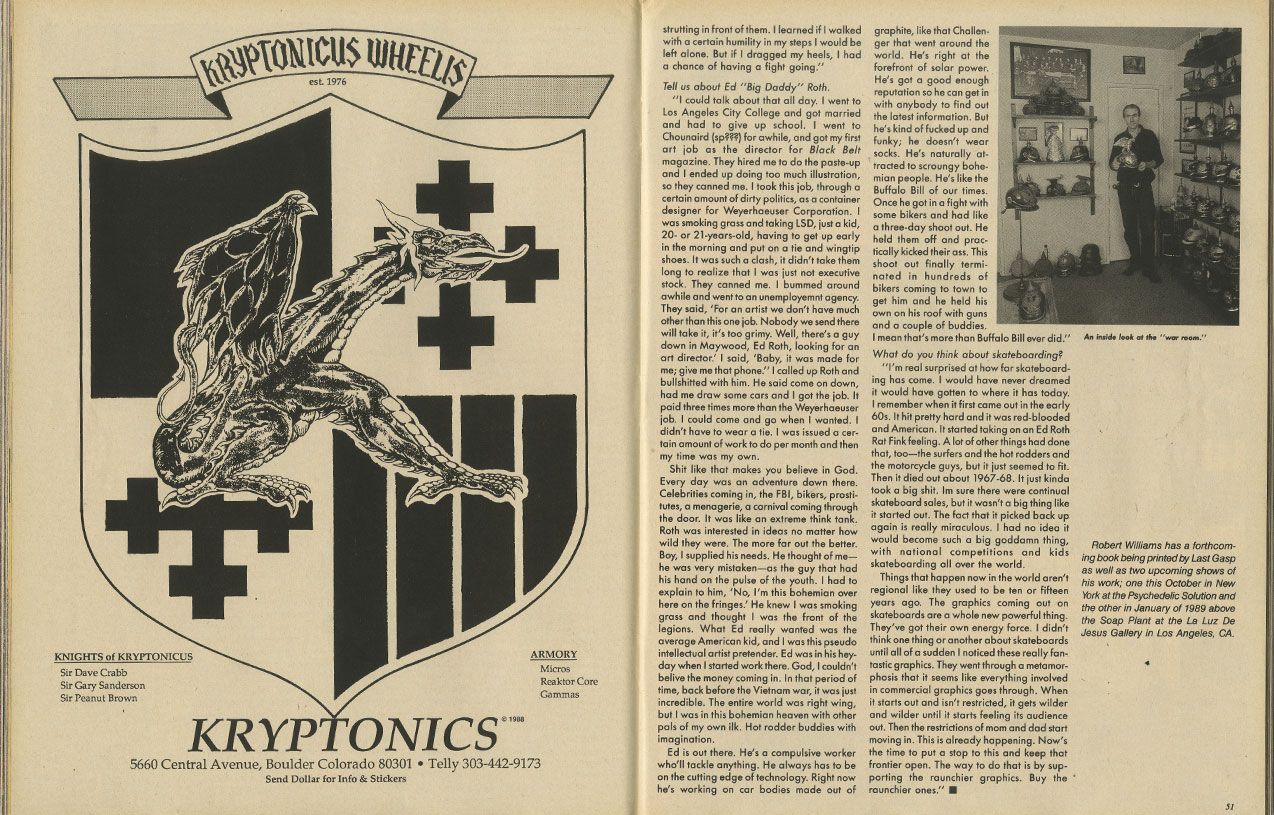
An inside look at the "war room."
Robert Williams has a forthcom-
ing book being printed by Last Gasp
as well as two upcoming shows of
his work; one this October in New
York at the Psychedelic Solution and
the other in January of 1989 above
the Soap Plant at the La Luz De
Jesus Gallery in Los Angeles, CA.
51