Page Text
            by Mike Gitter
And goofthe
The wasteland. Leather clad,
spikey tressed warriors struggle,
anthemize, bludgeon with ideology
and otherwise combat each other
for possession of the sand-blasted
warzone. Violence crazed com-
batants await the deciding blow
known as Final Conflict. Final Con-
flict: apocalyptic struggle or a
death-harbinging fade to black?
Four horsemen or four fun-loving
Los Angelinos with a deadly
musical barrage screaming protest
against a world gone mad?
"We're the last of the guitar-
wielding mohawk warriors," laughs
Final Conflict vocalist Ron Mar-
tinez. "Seriously, we question vir-
tually everything around us and, in
terms of any sort of punk ethic,
that's more effective than spray
painting the walls or circling A's."
Although the punk aesthetic has
virtually disappeared from the U.S.
NEURUSE
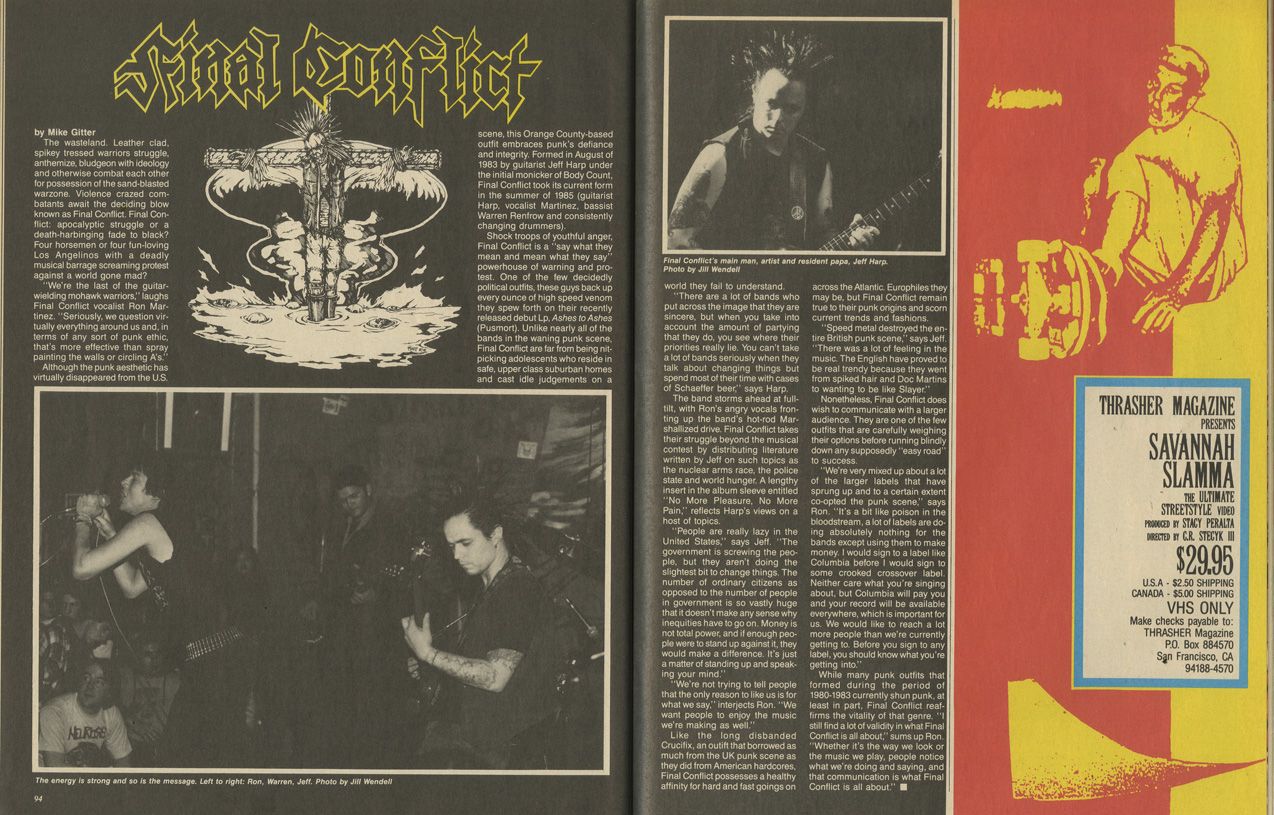
The energy is strong and so is the message. Left to right: Ron, Warren, Jeff. Photo by Jill Wendell
94
scene, this Orange County-based
outfit embraces punk's defiance
and integrity. Formed in August of
1983 by guitarist Jeff Harp under
the initial monicker of Body Count,
Final Conflict took its current form
in the summer of 1985 (guitarist
Harp, vocalist Martinez, bassist
Warren Renfrow and consistently
changing drummers).
Shock troops of youthful anger,
Final Conflict is a "say what they
mean and mean what they say"
powerhouse of warning and pro-
test. One of the few decidedly
political outfits, these guys back up
every ounce of high speed venom
they spew forth on their recently
released debut Lp, Ashes to Ashes
(Pusmort). Unlike nearly all of the
bands in the waning punk scene,
Final Conflict are far from being nit-
picking adolescents who reside in
safe, upper class suburban homes
and cast idle judgements on a
Final Conflict's main man, artist and resident papa, Jeff Harp.
Photo by Jill Wendell
world they fail to understand.
"There are a lot of bands who
put across the image that they are
sincere, but when you take into
account the amount of partying
that they do, you see where their
priorities really lie. You can't take
a lot of bands seriously when they
talk about changing things but
spend most of their time with cases
of Schaeffer beer," says Harp.
The band storms ahead at full-
tilt, with Ron's angry vocals fron-
ting up the band's hot-rod Mar-
shallized drive. Final Conflict takes
their struggle beyond the musical
contest by distributing literature
written by Jeff on such topics as
the nuclear arms race, the police
state and world hunger. A lengthy
insert in the album sleeve entitled
"No More Pleasure, No More
Pain," reflects Harp's views on a
host of topics.
"People are really lazy in the
United States," says Jeff. "The
government is screwing the peo-
ple, but they aren't doing the
slightest bit to change things. The
number of ordinary citizens as
opposed to the number of people
in government is so vastly huge
that it doesn't make any sense why
inequities have to go on. Money is
not total power, and if enough peo-
ple were to stand up against it, they
would make a difference. It's just
a matter of standing up and speak-
ing your mind."
"We're not trying to tell people
that the only reason to like us is for
what we say," interjects Ron. "We
want people to enjoy the music
we're making as well."
Like the long disbanded
Crucifix, an outift that borrowed as
much from the UK punk scene as
they did from American hardcores,
Final Conflict possesses a healthy
affinity for hard and fast goings on
across the Atlantic. Europhiles they
may be, but Final Conflict remain
true to their punk origins and scorn
current trends and fashions.
"Speed metal destroyed the en-
tire British punk scene," says Jeff.
"There was a lot of feeling in the
music. The English have proved to
be real trendy because they went
from spiked hair and Doc Martins
to wanting to be like Slayer.""
Nonetheless, Final Conflict does
wish to communicate with a larger
audience. They are one of the few
outfits that are carefully weighing
their options before running blindly
down any supposedly "easy road'
to success.
"We're very mixed up about a lot
of the larger labels that have
sprung up and to a certain extent
co-opted the punk scene," says
Ron. "It's a bit like poison in the
bloodstream, a lot of labels are do-
ing absolutely nothing for the
bands except using them to make
money. I would sign to a label like
Columbia before I would sign to
some crooked crossover label.
Neither care what you're singing
about, but Columbia will pay you
and your record will be available
everywhere, which is important for
us. We would like to reach a lot
more people than we're currently
getting to. Before you sign to any
label, you should know what you're
getting into."
While many punk outfits that
formed during the period of
1980-1983 currently shun punk, at
least in part, Final Conflict reaf-
firms the vitality of that genre. "I
still find a lot of validity in what Final
Conflict is all about," sums up Ron.
"Whether it's the way we look or
the music we play, people notice
what we're doing and saying, and
that communication is what Final
Conflict is all about."
THRASHER MAGAZINE
PRESENTS
SAVANNAH
SLAMMA
THE ULTIMATE
STREETSTYLE VIDEO
PRODUCED BY STACY PERALTA
DIRECTED BY C.R. STECYK III
$29.95
U.S.A $2.50 SHIPPING
CANADA $5.00 SHIPPING
VHS ONLY
Make checks payable to:
THRASHER Magazine
P.O. Box 884570
San Francisco, CA
94188-4570