Page Text
            louder than this. But it's appropriate to the
atmosphere. If you bring the donkey into the city,
you're going to have neighbors complaining that
the sound disturbs them. The ramp sound itself,
from my perspective, is rhythmic. Non-rhythmic
sounds have more impact and are more disturb-
ing. This is rhythmic and I would call it melo-
dious. Most people in Bolinas, and there's all types
in Bolinas, are pro-ramp. It's the two neighbors
closest to the ramp that unfortunately feel agriev-
ed. But others will go and do their zen in front
of it, they will meditate in front of it. They will
say, to the effect, that it is harmonious with the
environment, that the sound isn't something that
ruffles the atmosphere. It's actually a sound that's
conducive to the harmony of the atmosphere.
And they're not skating late at night or
anything?
No. It's fully regulated. They skate three after-
noons a week and Saturday afternoons. Nine
hours a week is all they're skating.
Do you have insurance to cover the ramp?
No, I do it by an express waiver of liability' that
is signed and notarized both by the skater and
their adult parents.
Is the case you're involved in a city or county
case?
County.
What's the difference, and where does it go
from here?
Well, there may well be cities in California and
other states that seek to regulate structures,
buildings, ramps, noise, congregation of people,
et cetera. And such a city could seek in some way
to abridge or abate the skateboard performance.
This isn't that kind of case. Bolinas is not a city,
but a township, and it has no ordinance, it has
nothing that covers a skateboard. And so the
county, through their building code, has sought
jurisdiction over the skateboard. This city,
Bolinas, doesn't have a building code.
So it is not the city council that you are fighting?
Absolutely not. It's the county planning commis-
sion. It's the persons who ultimately are respon-
sible for the enforcement of the county building
code. They are our adversaries. And yet, candidly,
they recognize that it's a case of first impression.
Their code doesn't say skateboard. Therefore there
is something meaningful to litigate. And if they
want to make it cover skateboard then let them
go back and re-enact the provision. And they
haven't done it. We want notice. Our due process
is, if you're going to outlaw ramps because they're
building accessories and require building permits
and in that fashion seek to regulate, then tell us
in advance. But your code doesn't say it, nor is
there any analogy in your code by which we can
infer that your code would cover it.
If they did ammend their code now, could they
force you to tear your ramp down?
No, because that would be like ex post facto? We
would be saved by the grandfather clause: they
can't make something invalid that is valid before
the enactment.
Is the current case still in litigation?
Yes, it is. You see, what occurs is first a building
inspector comes out. And he posts a notice. "Hey,
this doesn't conform to the building code." And
they actually give you a stop notice, like you're
supposed to stop building. Well, at the point he
posted it, the ramp had been in operation for a
month, so it was willfully late. So I just wrote
86
a note. I said, "There's nothing to stop here, it's
been going on for a month." Then they signed
a citation that says we either have to conform it
to the building code or apply for what they call
a use permit. A use permit means even though
it doesn't conform to the building code, you,
through discretion of the planning commission,
can be issued a permit to use it. That's their way
of balancing equity sometimes. Even though
something may not have followed the building
code provisions, you can still use it. I retorted
to that letter, "Oh, no. The building code doesn't
apply to this edifice and we won't, therefore, apply
for your use permit." That started the litigation.
So then the building code people said, "All right.
Send us your rationale for why it doesn't apply."
I said, "First, it's not fifteen feet high, second,
it's not an accessory structure, third, your code
doesn't specify ramps, but lastly," and this is what
caught the eye of the media, "the activity is art
activity, which is protected by the first
amendment Now most of the media says, "Oh,
Serra the lawyer says that the ramp is art. Well,
we don't see it as art. It doesn't look like sculpture
to us. It looks like a ramp." That's not what I said.
Like ice skating is a sport but also an art form,
like ballet is an art form but also a sport, like the
sports that were present in classical time, star-
ting with athletics, that is bodily perfection,
whatever you want to call it, it ends in art. And
so the ramp supports activity like a theater, like
a stage supports ballet. It's not connected to the
house, it's connected to art activity. Art activity.
can't be proscribed by a building code. We're say-
ing it has first ammendment rights because the
ramp supports art activity. Skateboarding is an
art activity. I mean to define art activity by the
activity itself and all that surrounds it. What
surrounds this is an art form, all the garb and
insignias, all of that is connected to skating. So
it's not just skating, it's like a movement, it's like
a movement that moves on different dimensions.
It moves on a social dimension, on a sport
dimension, on an athletic dimension, on an art
dimension, all at the same time. And you can't
take the art out of it because the first ammend-
ment allows us to preserve the art in it.
So is this courtroom battle going to stay at the
county level?
For a longish time. After the planning commis-
sion, in essence, agrees with the building inspec-1
tor and says, "It pertains but, (give a wink,) we'll
give you a use permit, but just apply for a use
permit. Make your peace with the neighbors and
apply for a use permit," then the next step for
me is to bring my appeal to a board of supervisors
in Marin County. That's now pending. And they
take a larger look, hopefully a more transcendental
view of it, and see maybe larger ramifications."
They can reverse it, then we've won. They can
say, "Listen, we don't think the code pertains.
If you want it to pertain, then put it in the code."
They can do anything they want, and they prob-
ably will be more objective than the planning
commission, because the planning commission
is really just the enforcer for the building code
inspectors. They're interwoven in terms of their
jurisdiction. Marin County is the alleged hot tub
capital of the world. There are more French
restaurants and Porche's and BMW's in Marin
than any other county. But they don't have a
skateboard ramp. The board of supervisors will
be sensitive to that, so we can win there. If we
don't win there, then we go into the local court
system. If we don't win there, we can go into the
federal court system because there is a first am-
mendment issue. With the federal court system
can go all the way to the U.S. Supreme Court.
I don't think I will have to do that. I think already
they are trying to compromise. But I'm willing
to do it because I'm a lawyer and that's what I
do. It's easy for me.
I
Say a skateboarder wants to get city hall to put
up a ramp, or wants to convince his parents
to let him build one in his front yard. What
kind of presentation do you think a skater
should make to these kind of people?
I think it's simple. You have to get a large enough
piece of private property where you're not going
to have complaints. Secondly, you build in accord-
ance with the codes. If you don't want complaint-
ants, just build it pertinent to the code and you've
got it.
If action is taken against a ramp owner, like
your sons, is it okay to keep riding it?
The way law works in this country is that you're
innocent until proven guilty. (Though this isn't
criminal, the analogy holds.) You're not guilty
until proven innocent. So if you engage in an
appeal process and then in a litigation process,
by all means you are legally allowed to use the
ramp. So we're using it, of course, during this
process. This process can take two or three years.
How much power do security guards and rent-
a-cops have when it comes to regulating a
skateboarder? Can they confiscate your
property?
No. A thousand percent no, they can't confiscate
your property. We're not talking about drug
forfeiture. You're talking about private police
officers? They've got no power of confiscation.
They're not peace officers, they have no powers
of arrest. They have only powers that an ordinary
citizen would have. Period.
So then they are committing an illegal act by
taking a skateboard or a launch ramp?
If they confiscate it, they are guilty of what they
call civil tresspass or civil conversion and also
theft. It's a criminal theft. They can't do that. If
someone goes out into private property and a non-
peace officer takes their equipment then that
would be a crime and a potential lawsuit, but you
probabaly won't find the local police making it
a crime. But technically it's a crime; they can't
do it.
So a skater's rights are to say, "Keep your hands
off my property"?
Yes, "It's my property. You have no right to
convert it or seize it. It's not the implement of
a crime." You see, if I go, "I'm going to shoot
you, I'm going to knife you" and I'm arrested.
they take the knife as evidence.
Even if there's a sign that says "No Skateboard-
ing" and there's a non-peace officer there?
No. If you go in on skateboards you might have
committed a trespass. And a trespass can be a
civil or criminal act. And if you are arrested for
a trespass, then evidence of the trespass could be
preserved, that is seized. A (Continued on page 115)
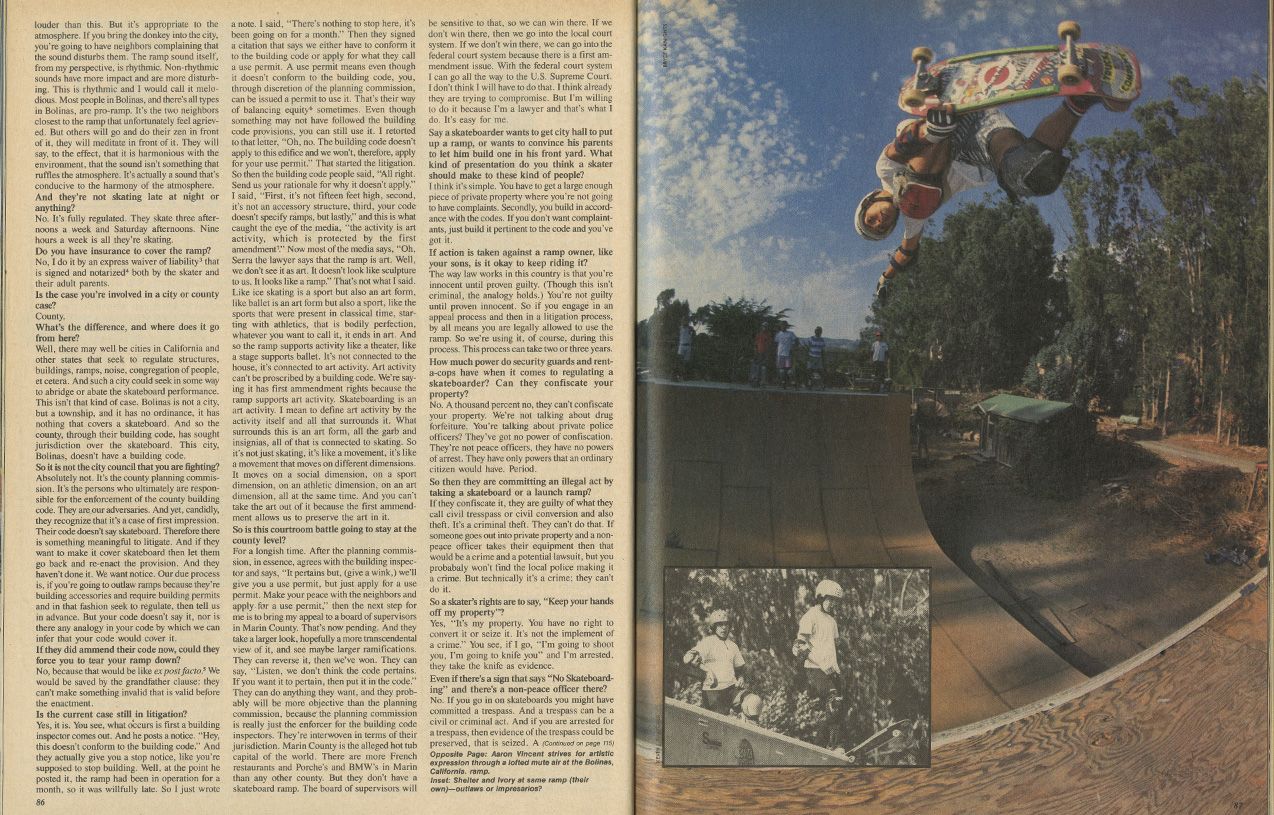
Opposite Page: Aaron Vincent strives for artistic
expression through a lofted mute air at the Bolines,
California. ramp.
Inset: Shelter and Ivory at same ramp (their
own)-outlaws or impresarios?