Page Text
            161
DRY RODEN IMBECILES
by Mike Gitter
Explosive, unrelenting, bombastic high speed
torrents of adrenaline-ravaged insanity. Grinding
heaviness plunges head-on in a tumult self-
described as "crossover" When it comes to ultra-
fast paced delivery, DRI (Dirty Rotten Imbeciles)
reigns supreme as kings of speed.
Since they formed in Houston in early 1982, the
Imbeciles have gained a steadily growing follow-
ing among both hardcores and metal-heads. From
their 1982 7" debut, simply titled "22 song EP"
to the recently released "Crossover" (Metal
Blade/Death), DRI has honed their assault from
a speedy riot to a virtual brick wall of force and
power Vocalist Kurt Brecht howls away as axeman
Spike Cassidy grinds with unbridled force. The
wrecking ball rhythm section of drummer Felix
Griffin and bassist Josh Pappe thunders in a fast
ferver. Hard and fast rules, dude.
Gitter-Background time. What was the feel-
ing when you guys formed?
Kurt-It was a blast for me. It was the first time
that we had all been in a band.
Spike-It had something to do with boredom, there
being nothing to do in Houston, Texas, at the time.
I was into playing guitar and listening to a lot of
84
heavy, guitar music, so I was dying to get into a
band. It was when hardcore first started, with Black
Flag, the Circle Jerks, TSOL and a lot of the real
fresh bands from '81 and '82.
What was the initial Houston scene like?
K-There were two good clubs, the Omni and the
Island, and they'd have touring bands every couple
of weeks and a local show every week.
S-We all knew each other.
K-
and not too many suburban kids, mainly
the downtown punks.
S-We played almost every weekend. Every time
there was a show we wound up playing. There
weren't a lot of local bands-just us and Dooms-
day Massacre- we would switch off opening for
whoever came through and eventually they started
letting us headline.
Why did you move to San Francisco?
K-Verbal Abuse was also a Houston band and
they had moved there. Nicki, their singer, came
back and we gave him a tape, which he gave to
Tim Yohannan at Maximum Rock 'n' Roll. Tim
called us up and told us that we were right for San
Francisco and he invited us to play a Texas show
that Verbal Abuse, MDC and the Dicks were go-
ing to play. We did the show and ended up
staying around for awhile.
S-We wanted to get out of town. We were work
ing hard in Houston but going nowhere, so we
jumped at the chance to move to San Francisco.
which was one of the punk capitals at the time..
Wasn't DRI part of the SF "Vat Scene?"
S-Toward the very end. After we moved to SF, we
were there for about six months to a year. We really
weren't there when everyone was squatting
heavily. It was gloomy.
Josh-I kind of liked it!
K-You could hear all the other bands, Con-
demned to Death, MDC and the Dicks practicing.
We all influenced each other insofar as coming
up with songs that sounded like something you
might have heard the night before and not realized
it. The vat was an abandoned Hamms beer
brewery, that's now been leveled and is currently
a parking lot.
Tell me about the Rock Against Reagan tour.
S-It was okay since it was our first tour. We played
a string of free shows and got food plus money
for gas
K-The first couple of shows we did on the way
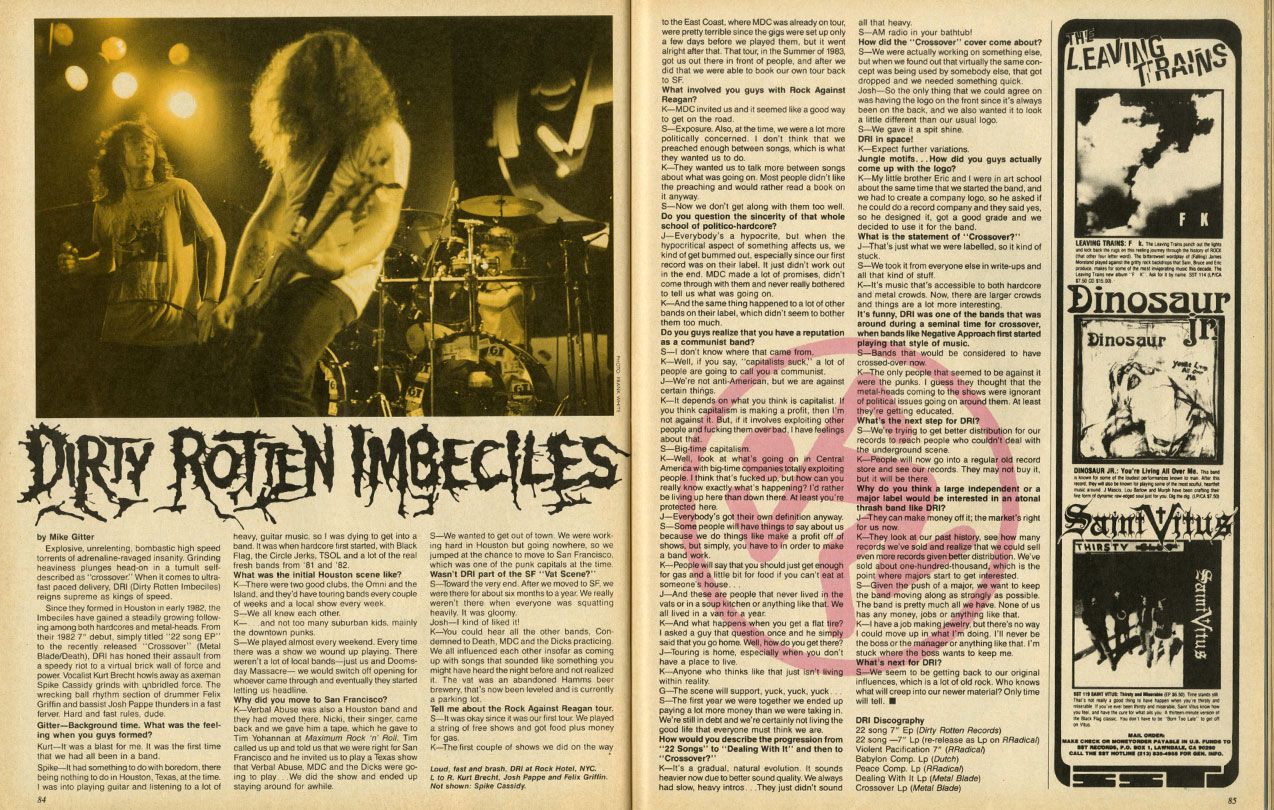
Loud, fast and brash, DRI at Rock Hotel, NYC.
L to R. Kurt Brecht, Josh Pappe and Felix Griffin.
Not shown: Spike Cassidy
to the East Coast, where MDC was already on tour,
were pretty terrible since the gigs were set up only
a few days before we played them, but it went
alright after that. That tour, in the Summer of 1983,
got us out there in front of people, and after we
did that we were able to book our own tour back
to SF
What involved you guys with Rock Against
Reagan?
K-MDC invited us and it seemed like a good way
to get on the road.
S-Exposure. Also, at the time, we were a lot more
politically concerned. I don't think that we
preached enough between songs, which is what
they wanted us to do.
K-They wanted us to talk more between songs
about what was going on. Most people didn't like
the preaching and would rather read a book on
it anyway.
S-Now we don't get along with them too well..
Do you question the sincerity of that whole
school of politico-hardcore?
J-Everybody's a hypocrite, but when the
hypocritical aspect of something affects us, we
kind of get bummed out, especially since our first
record was on their label. It just didn't work out
in the end. MDC made a lot of promises, didn't
come through with them and never really bothered
to tell us what was going on.
K-And the same thing happened to a lot of other
bands on their label, which didn't seem to bother
them too much.
Do you guys realize that you have a reputation
as a communist band?
S-I don't know where that came from..
K-Well, if you say, "capitalists suck," a lot of
people are going to call you a communist.
J-We're not anti-American, but we are against
certain things.
K-It depends on what you think is capitalist. If
you think capitalism is making a profit, then I'm
not against it. But, if it involves exploiting other
people and fucking them over bad, I have feelings
about that.
S-Big-time capitalism.
K-Well, look at what's going on in Central
America with big-time companies totally exploiting
people. I think that's fucked up, but how can you
really know exactly what's happening? I'd rather
be living up here than down there. At least you're
protected here.
J-Everybody's got their own definition anyway.
S-Some people will have things to say about us
because we do things like make a profit off of
shows, but simply, you have to in order to make
a band work.
K-People will say that you should just get enough
for gas and a little bit for food if you can't eat at
someone's house....
J-And these are people that never lived in the
vats or in a soup kitchen or anything like that. We
all lived in a van for a year.
K-And what happens when you get a flat tire?
I asked a guy that question once and he simply
said that you go home. Well, how do you get there?
J-Touring is home, especially when you don't
have a place to live.
K-Anyone who thinks like that just isn't living
within reality.
G-The scene will support, yuck, yuck, yuck.
S-The first year we were together we ended up
paying a lot more money than we were taking in.
We're still in debt and we're certainly not living the
good life that everyone must think we are."
How would you describe the progression from
"22 Songs" to "Dealing With It" and then to
"Crossover?"
K-It's a gradual, natural evolution. It sounds
heavier now due to better sound quality. We always
had slow, heavy intros...They just didn't sound
all that heavy.
S-AM radio in your bathtub!
How did the "Crossover" cover come about?
S-We were actually working on something else,
but when we found out that virtually the same con-
cept was being used by somebody else, that got
dropped and we needed something quick.
Josh-So the only thing that we could agree on
was having the logo on the front since it's always
been on the back, and we also wanted it to look
a little different than our usual logo.
S We gave it a spit shine.
DRI in space!
K-Expect further variations.
Jungle motifs... How did you guys actually
come up with the logo?
K-My little brother Eric and I were in art school
about the same time that we started the band, and
we had to create a company logo, so he asked if
he could do a record company and they said yes,
so he designed it, got a good grade and we
decided to use it for the band.
What is the statement of "Crossover?"
J-That's just what we were labelled, so it kind of
stuck.
S-We took it from everyone else in write-ups and
all that kind of stuff.
K-It's music that's accessible to both hardcore
and metal crowds. Now, there are larger crowds
and things are a lot more interesting.
It's funny, DRI was one of the bands that was
around during a seminal time for crossover,
when bands like Negative Approach first started
playing that style of music.
S-Bands that would be considered to have
crossed-over now.
K-The only people that seemed to be against it
were the punks. I guess they thought that the
metal-heads coming to the shows were ignorant
of political issues going on around them. At least
they're getting educated.
What's the next step for DRI?
S-We're trying to get better distribution for our
records to reach people who couldn't deal with
the underground scene.
K-People will now go into a regular old record
store and see our records. They may not buy it,
but it will be there.
Why do you think a large independent or a
major label would be interested in an atonal
thrash band like DRI?
J-They can make money off it; the market's right
for us now
K-They look at our past history, see how many
records we've sold and realize that we could sell
even more records given better distribution. We've
sold about one-hundred-thousand, which is the
point where majors start to get interested.
S-Given the push of a major, we want to keep
the band moving along as strongly as possible.
The band is pretty much all we have. None of us
has any money, jobs or anything like that.
K-I have a job making jewelry, but there's no way
I could move up in what I'm doing. I'll never be
the boss or the manager or anything like that. I'm
stuck where the boss wants to keep me.
What's next for DRI?
S-We seem to be getting back to our original
influences, which is a lot of old rock. Who knows
what will creep into our newer material? Only time
will tell.
DRI Discography
22 song 7 Ep (Dirty Rotten Records)
22 song-7" Lp (re-release as Lp on RRadical)
Violent Pacification 7" (RRadical)
Babylon Comp. Lp (Dutch)
Peace Comp. Lp (RRadical)
Dealing With It Lp (Metal Blade).
Crossover Lp (Metal Blade)
THE
LEAVING
LEAVING TRAINS: F
TRAINS
FK
Dinosaur
Dinosaur
DINOSAUR JR.: You're Living All Over Me. The band
SamniVitus
THIRSTY
SamiVitus
MAKE CHECK OR MONEYORDER PAYABLE IN US. FUNDS TO
SET RECORDS, P.G. BOX 1, LAWNDALE, CA 902
CALL THE SET HOTLINE (213) 835-4955 FOR GEN. INFO.
85