Page Text
            SLALOM
RETURNS TO EARTH
Story by Bob Denike Photos by Steve Keenan
I was eleven, it was my first board, and I was
clueless. I couldn't do anything on it except turn,
so it was only natural to lay something on the
ground and skate around it. A simple idea that was
a lot of fun.
There was this old lady on the block, a real
skater's nightmare. She used to throw gravel on
the strip in front of her house and watch me slam
from the safety of her bedroom window. I scared
her. She didn't like to meet me face-to-face.
Somehow she kept the gravel flowing.
We had a standard routine every day after
school. We set up a course, using walnuts as
markers, down the driveway, over the death crack,
onto the sidewalk, through the gravel and up onto
her driveway. The steel wheels on my board would
clack down the street, leaving nice, clean, white
scratches around each walnut. You knew you had
made it when you hit the ice-smooth pavement
of the old lady's driveway, laying down a nice, long,
white scratch. She really hated my guts.
The courses varied, but one thing was for
sure-we made them hard to skate. We always laid
down the killer walnut, one that was impossible
to make, just past the death crack so we could see
some good wipes. Lots of skin was laid down on
that turn.
The timing system was as simple as the skating
itself. The faucet in my yard had a drip, really even,
with a good pace. The runs would start with a yell
from the timer and end with a loud "clack" at the
old lady's driveway. Just count the drips from the
faucet and round up.
The pureness and simplicity of the whole thing
is what I remember most. Even when I was grow-
ing up and skating vertical, I used to race once
in a while to keep in touch. It really helped me with
board control, balance and reaction time in bad
situations. But the best part about it was that
racing was black and white. No judging, no crowds.
no hype, and no b.s. Make it through the cones
as fast as possible without missing a gate. It was
as simple as that, but it was like no other type of
skating.
We weren't interested in pleasing a crowd with
flashy moves. We really just wanted to do one
thing: go as fast and as clean as possible. Just
the course, you, and your board. No one and
nothing else.
We also took chances. Try weaving through
some cones, speeding toward the finish, sliding.
pumping and pushing it all at sometimes uncom-
fortable speeds. You quickly gain respect for
speed, especially after your body slides to a grin-
ding halt and you check for damage. Going fast,
laying it on the line and pulling it off gives you a
feeling like no other.
This particular weekend, July 11 & 12, 1987, was
nothing if not complete purity. It started with a
strange flyer in the mail, stating that "slalom had
returned to earth. Next thing I knew I was in
an overcast parking lot on the central coast of
California, waiting for the rest of the crew. The
skaters came from all over, old-timers and new.
Everyone was glad to see each other and still
in disbelief that it could actually fall together and
we would race. The theme of the event was
simplicity. Have a short meeting, agree to the
"guidelines" (the first rule was to have no rules)
and then get down to some racing in the streets.
The courses were set up by slowly moving down
the hill, cone by cone. Put down a cone, move it
over, move it down, try it out, agree to it, and lay
down a chalk mark with a rock. After a little trial
and error and a unanimous vote, the cones were
locked in.
The timing system was salvaged from a past
event and set up with pressure strips to start and
stop the clock. The battery was fresh and the whole
thing actually worked without a single hitch.
The scoring was easy, some said a little too sim-
ple, but Guideline #2 was if you complain, you split.
The fastest time out of five runs each on the tight
and giant slalom were combined to figure the plac-
ings. Each skater coughed up $25 cash to be divid-
ed later among the top six places.
With all the formalities out of the way, we finally
got down to some racing. The tight slalom was set
up halfway down the hill, staggered at the top and
funneling in to some tight wigglers at the bottom.
Individual styles in the tight slalom weren't as
varied as in the giant, but each skater did have
his own creative approach. There was one "killer
walnut" on the course, right before the wigglers.
that added a little spice to everyone's run. Overall,
the tight slalom was a breeze for some and a
frustrating challenge for others.
The giant slalom sort of turned the tables on
the whole event: those who ripped on the wigglies
really struggled on this course. It started at the very
top of the hill. It was really wide and all over the
street. Everyone was sliding, leaning, breaking and
sweating down the course, only to be rewarded
with some fast but open "downhill slalom" type
gates. Some made it clean and some just made
it. Everyone was on edge for this one, but as the
race wore on, the times improved and so did
everyone's spirits. The only real competition
seemed to be yourself; if you could just pull it all
together in your mind and put in a good, clean run.
It was kind of over just as we started to get
going, but that was a good reason to plan another
race on another day. The scores were totalled, the
cash was split, and the course was packed up.
The winner, Rob Roskopp, who really had no for-
mal slalom experience at all, really took everyone
by surprise. Just proves that it was only street
skating, with a twist. Slalom has really returned
to earth.
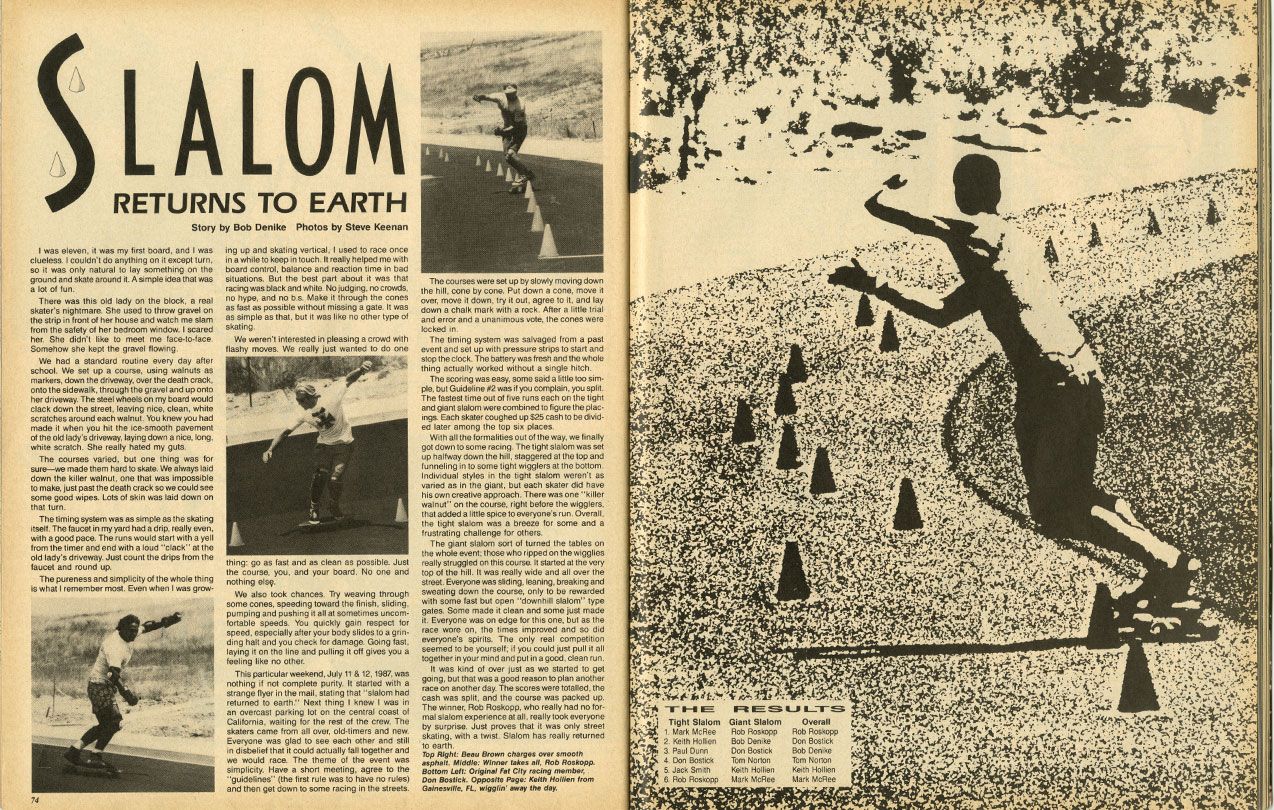
Top Right: Beau Brown charges over smooth
asphalt. Middle: Winner takes all, Rob Roskopp.
Bottom Left: Original Fat City racing member,
Don Bostick. Opposite Page: Keith Hollien from
Gainesville, FL, wigglin' away the day.
THE
Tight Slalom
1. Mark McRee
2. Keith Hollen
3. Paul Dunn
RESULTS
Giant Slalom.
Rob Roskopp
Bob Denike
Don Bostick
Overall
Rob Roskopp
Don Bostick
Bob Denike
4. Don Bostick
5. Jack Smith
Tom Norton
Tom Norton
Keith Hollien
Keith Hollien
Mark McRee
Mark McRee
6 Rob Roskopp