Page Text
            the double yellow. Most of the early ma-
jor contests had downhill competitions.
The Catalina classic and the Ventura
Skate Championships ran them in the
streets. (The latter had an airbag for
stopping skaters. Guy Grundy missed it
on purpose and, failing to negotiate the.
next turn, went off a dirt cliff.) Magic
Mountain hosted a downhill on pave-
ment, but at indoor contests, like the
Freeformer Pro, skaters raced down a
large wooden ramp that was neither ex-
citing nor fast. An oil-soaked mound of
dirt near Long Beach called Signal Hill
would change that.
The first race was won by Guy Grun-
dy, a surfer from Huntington Beach. He
beat Gary Hitchcock, who was riding a
custom downhill skateboard built by his
brother Skitch. Gary experienced speed
wobbles at the bottom of the hill and
slid it out in motorcycle-type leathers at
a little over 50 mph. Guy, also in full
leathers, won on a long spear-shaped
skateboard with standard trucks and
wheels. Gary's board, however, featured
a fixed fairing in front and custom 4-inch
wheels. The next year Grundy lost to
Sam Pucco, a longshoreman from San
Pedro, California. Pucco brought a luge-
type laydown skateboard to take the "hill
street drop" on his back, beating
everyone in the ever expanding field.
Because of protests, future events were
divided between a standup division and
an "open" division. It was the first use
of a luge and the beginning of the
"anything goes" mentality that allowed
the fully-enclosed laydown skatecars.
Around this time, the magazine
published the second and last interview/
article on Dennis Shufeldt. Shufeldt ex-
pressed no interest in Signal Hill, but had
developed a new "head-forward, arms-
back" tuck borrowed from downhill and
speed skiers. Until then, downhillers had
been using the arms-forward squat. Guy
Grundy appeared in a "Who's Hot" arti-
cle and publicly stated that he would like
to race Shufeldt. But it never happened.
Despite the activity on Signal Hill,
Skateboarder published a centerfold
showing Shufeldt negotiating a turn in
the old arms-forward tuck with a caption
that read: "A fleeting glimpse of the
fastest man in the west." His new tuck
would later be referred to as the "Hut"
tuck (after John Hutson, the winningest
downhiller of all time). Dennis was never
really heard from again..
Years before people figured out that
fixed fairings were the way to go at
Signal Hill, there was Nathan Pratt.
Pratt, who also had no intèrest in Signal
Hill, was truly a man ahead of his time.
An original Z-Boy, he would race down
hills with the likes of Alva and Adams on
pool boards (the Z-Boys rode them in
pools then, even though there was no
such thing as a pool board). Pratt then
developed a traingle-shaped, hand-held.
76
see-through fairing that increased his
speed. The boyz were now drafting on
him. No one really saw or heard from
him much until an interview with him
was published at the height of the
Signal Hill years. By the time this inter-
view came out, Pratt had developed a
number of fairings, including a cigar-
shaped laydown skatecar, a football-
shaped standup fairing, and a very ex-
otic stand-up fairing that can only be
described as half of a jet engine intake
nozzle. The two standup fairings were
adjustable through turns and were wind-
tunnel tested with help from aerospace
engineers. Pratt said he thought the
laydown fairings were boring and called
for more challenging courses than
Signal Hill with turns that would require
tuck and fairing adjustments. This type
of race would not be realized until years
later. Pratt also faded from the scene,
but his name did come up in Henry
Hester's interview when Signal Hill was
only a memory. It seems Hester went to
Pratt for advice about the design of his
"White Lightning"-the skate car that
tied for first at the last race ever held on
Signal Hill.
Besides consulting Nathan Pratt,
Henry Hester also consulted the people
who made Strokers, a revolutionary turn-
ing system for skateboards, not a stan-
dard "truck." Both Henry Hester, who
tied for first, and Terry Nails, who got se-
cond, ran Stroker trucks on the front
end and an axle in the back. Bob
"Chuy" Madrigal was running custom
trucks with bearings in the hanger that
allowed the axle, as well as the wheels,
to spin. All the skatecars in the open
division were required to have braking
systems. Kirby Flair took the drop on his
back and used a parachute for a brake.
Unfortunately it opened unevenly, throw
ing him into a spin. Terry Nails' breaking
system worked unevenly too, causing
him to crash after he passed through
the time traps.
Not all of the downhill boards were so
hi-tech. At the last couple of Signal Hill
races the guys from up north invaded.
They rode in the standup division on
wooden longboards with standard trucks
and wheels. Mike Goldman won the
standup division using the head-forward,
arms-back fairing on stock OJ wheels.
The final two years belonged to John
Hutson. However, he did utilize a
lightweight honeycomb deck and larger
diameter wheels.
The last Signal Hill race can only be
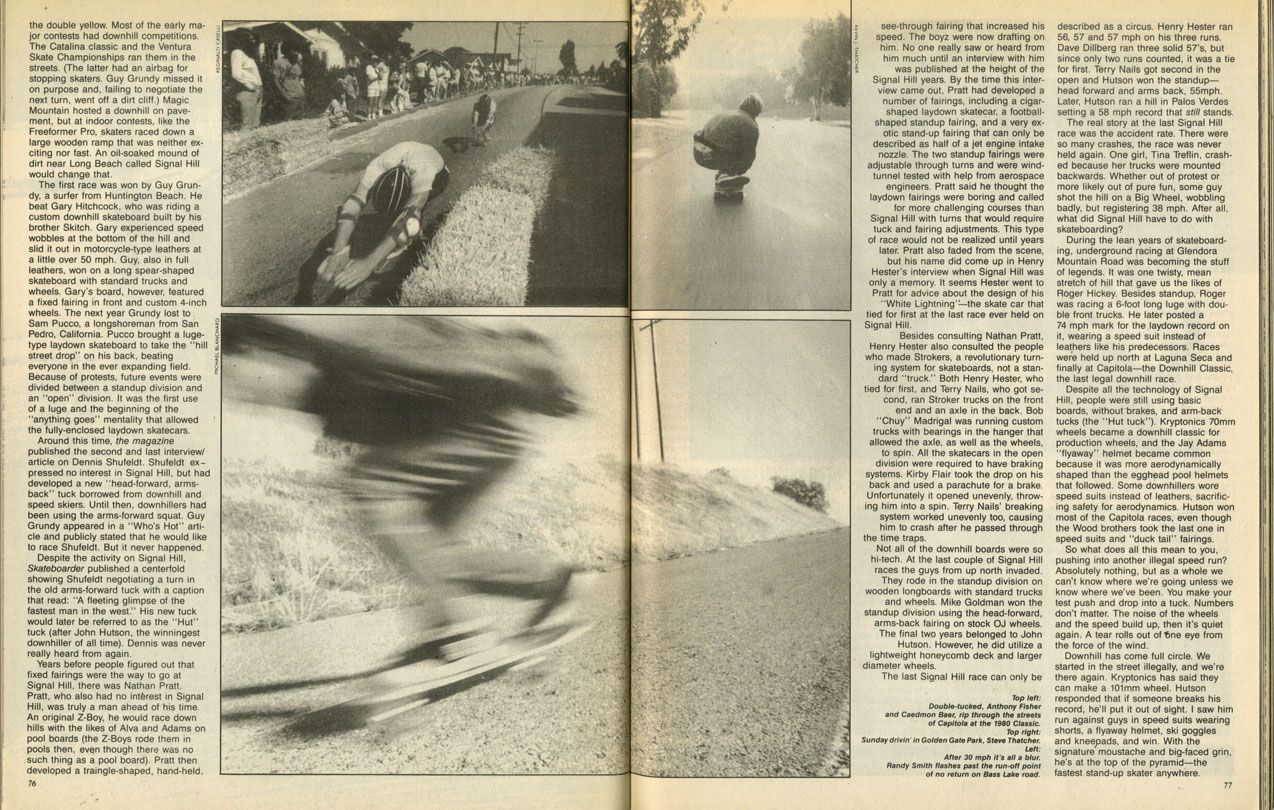
Top left:
Double-tucked, Anthony Fisher
and Caedmon Baer, rip through the streets
of Capitola at the 1980 Classic.
Top right:
Sunday drivin' in Golden Gate Park, Steve Thatcher.
Left:
After 30 mph it's all a blur
Randy Smith flashes past the run-off point
of no return on Bass Lake road.
described as a circus. Henry Hester ran
56, 57 and 57 mph on his three runs.
Dave Dillberg ran three solid 57's, but
since only two runs counted, it was a tie
for first. Terry Nails got second in the
open and Hutson won the standup-
head forward and arms back, 55mph.
Later, Hutson ran a hill in Palos Verdes
setting a 58 mph record that still stands.
The real story at the last Signal Hill
race was the accident rate. There were
so many crashes, the race was never
held again. One girl, Tina Treflin, crash-
ed because her trucks were mounted
backwards. Whether out of protest or
more likely out of pure fun, some guy
shot the hill on a Big Wheel, wobbling
badly, but registering 38 mph. After all,
what did Signal Hill have to do with
skateboarding?
During the lean years of skateboard-
ing, underground racing at Glendora
Mountain Road was becoming the stuff
of legends. It was one twisty, mean
stretch of hill that gave us the likes of
Roger Hickey. Besides standup, Roger
was racing a 6-foot long luge with dou-
ble front trucks. He later posted a
74 mph mark for the laydown record on
it, wearing a speed suit instead of
leathers like his predecessors. Races
were held up north at Laguna Seca and
finally at Capitola-the Downhill Classic,
the last legal downhill race.
Despite all the technology of Signal
Hill, people were still using basic
boards, without brakes, and arm-back
tucks (the "Hut tuck"). Kryptonics 70mm
wheels became a downhill classic for
production wheels, and the Jay Adams
"flyaway" helmet became common
because it was more aerodynamically
shaped than the egghead pool helmets
that followed. Some downhillers wore
speed suits instead of leathers, sacrific-
ing safety for aerodynamics. Hutson won
most of the Capitola races, even though
the Wood brothers took the last one in
speed suits and "duck tail" fairings.
So what does all this mean to you,
pushing into another illegal speed run?
Absolutely nothing, but as a whole we
can't know where we're going unless we
know where we've been. You make your
test push and drop into a tuck. Numbers
don't matter. The noise of the wheels
and the speed build up, then it's quiet
again. A tear rolls out of one eye from
the force of the wind.
Downhill has come full circle. We
started in the street illegally, and we're
there again. Kryptonics has said they
can make a 101mm wheel. Hutson
responded that if someone breaks his
record, he'll put it out of sight. I saw him
run against guys in speed suits wearing
shorts, a flyaway helmet, ski goggles
and kneepads, and win. With the
signature moustache and big-faced grin.
he's at the top of the pyramid-the
fastest stand-up skater anywhere.
77