Page Text
            720
THE GAME
PHOTOS BY KEVIN J. THATCHER
くる
BEHIND THE SCREENS LOOK AT ATARI'S NEWEST VIDEO GAME.
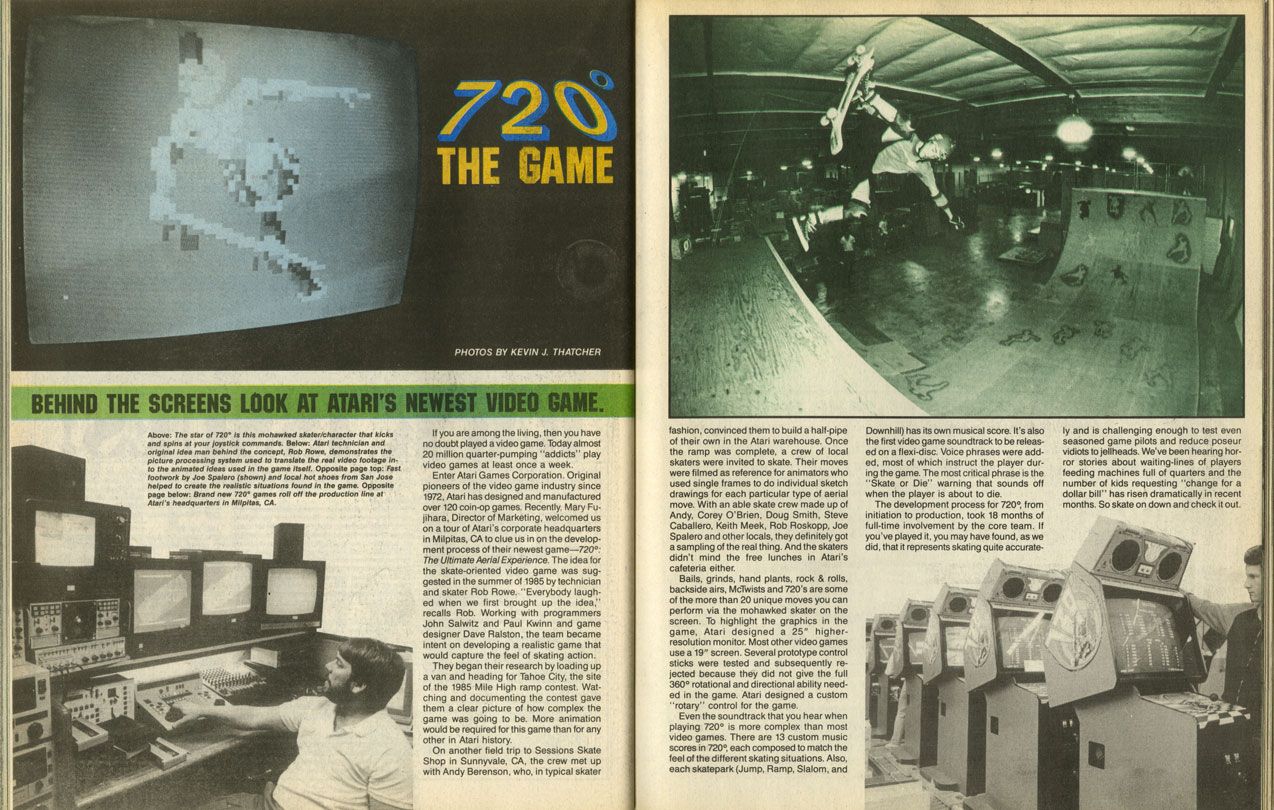
Above: The star of 720" is this mohawked skater/character that kicks
and spins at your joystick commands. Below: Atari technician and
original idea man behind the concept, Rob Rowe, demonstrates the
picture processing system used to translate the real video footage in-
to the animated ideas used in the game itself. Opposite page top: Fast
footwork by Joe Spalero (shown) and local hot shoes from San Jose
helped to create the realistic situations found in the game. Opposite
page below: Brand new 720° games roll off the production line at
Atari's headquarters in Milpitas, CA.
If you are among the living, then you have.
no doubt played a video game. Today almost
20 million quarter-pumping "addicts" play
video games at least once a week.
Enter Atari Games Corporation. Original
pioneers of the video game industry since
1972, Atari has designed and manufactured
over 120 coin-op games. Recently, Mary Fu-
jihara, Director of Marketing, welcomed us
on a tour of Atari's corporate headquarters
in Milpitas, CA to clue us in on the develop-
ment process of their newest game-720°
The Ultimate Aerial Experience. The idea for
the skate-oriented video game was sug-
gested in the summer of 1985 by technician
and skater Rob Rowe. "Everybody laugh-
ed when we first brought up the idea,"
recalls Rob. Working with programmers
John Salwitz and Paul Kwinn and game
designer Dave Ralston, the team became
intent on developing a realistic game that
would capture the feel of skating action.
They began their research by loading up
a van and heading for Tahoe City, the site
of the 1985 Mile High ramp contest. Wat-
ching and documenting the contest gave
them a clear picture of how complex the
game was going to be. More animation
would be required for this game than for any
other in Atari history.
On another field trip to Sessions Skate
Shop in Sunnyvale, CA, the crew met up
with Andy Berenson, who, in typical skater
fashion, convinced them to build a half-pipe
of their own in the Atari warehouse. Once
the ramp was complete, a crew of local
skaters were invited to skate. Their moves
were filmed as reference for animators who
used single frames to do individual sketch
drawings for each particular type of aerial
move. With an able skate crew made up of
Andy, Corey O'Brien, Doug Smith, Steve
Caballero, Keith Meek, Rob Roskopp, Joe
Spalero and other locals, they definitely got
a sampling of the real thing. And the skaters
didn't mind the free lunches in Atari's
cafeteria either.
Bails, grinds, hand plants, rock & rolls,
backside airs, McTwists and 720's are some
of the more than 20 unique moves you can
perform via the mohawked skater on the
screen. To highlight the graphics in the
game, Atari designed a 25" higher-
resolution monitor. Most other video games
use a 19" screen. Several prototype control
sticks were tested and subsequently re-
jected because they did not give the full
360° rotational and directional ability need-
ed in the game. Atari designed a custom
"rotary" control for the game.
Even the soundtrack that you hear when
playing 720° is more complex than most
video games. There are 13 custom music
scores in 720°, each composed to match the
feel of the different skating situations. Also,
each skatepark (Jump, Ramp, Slalom, and
Downhill) has its own musical score. It's also
the first video game soundtrack to be releas-
ed on a flexi-disc. Voice phrases were add-
ed, most of which instruct the player dur-
ing the game. The most critical phrase is the
"Skate or Die" warning that sounds off
when the player is about to die.
The development process for 720°, from
initiation to production, took 18 months of
full-time involvement by the core team. If
you've played it, you may have found, as we
did, that it represents skating quite accurate-
ly and is challenging enough to test even
seasoned game pilots and reduce poseur
vidiots to jellheads. We've been hearing hor-
ror stories about waiting-lines of players
feeding machines full of quarters and the
number of kids requesting "change for a
dollar bill" has risen dramatically in recent
months. So skate on down and check it out.
B