Page Text
            THE STORY OF THIS RAMP
At the outset, the ramp sucked. It cost
about $35,000 and was worth about $100.
The plywood was laid down the wrong way,
there were large gaps in the seams where
you could really FEEL each seam; there
were pipes that stuck out in places, about
two inches enough to take out chunks of
armsand there was no vertical (which was
fine with me). After we all decided that the
ramp sucked, it was relayered with cheap
plywood, which splintered up with the effec
tiveness of punji stick antipersonnel booby
traps. Jeff Phillips took a large splinter that
went through his foot and came out his toe,
requiring over four hours of surgery to
remove.
I liked the ramp this way. The ramp wasn't
as big anymore, and there was still no ver-
tical, so there were a lot of lip tricks you
could do. But everyone else had to cry.
Everyone had to have more vertical.
Everyone had to have the same contest.
Everyone had to do bio-airs. It was to be the
same contest all over again. So, on to stage
three of the $35,000 ramp. We all had to add
vertical. We all had to put masonite on it,
and we all had to make it happy.
Since there was a different ramp every
day, no one got to practice much on any one
ramp. For example, I got to practice for a
half-hour on the second ramp, and for only
3 hours (from four a.m. until seven a.m. the
day of the contest), on the third ramp, which
was the raddest session ever. It was Joe
Johnson,, Lester Kasai, Sean Goff, Kevin
Staab and myself. At six a.m. Kevin Staab
made a McTwist. It was the raddest thing.
The sun was coming up, there were birds
chirping, absolutely no one but us there on
the closed Expo grounds, and he just
blasted up and broke one out. Nobody even
knew we were in there.
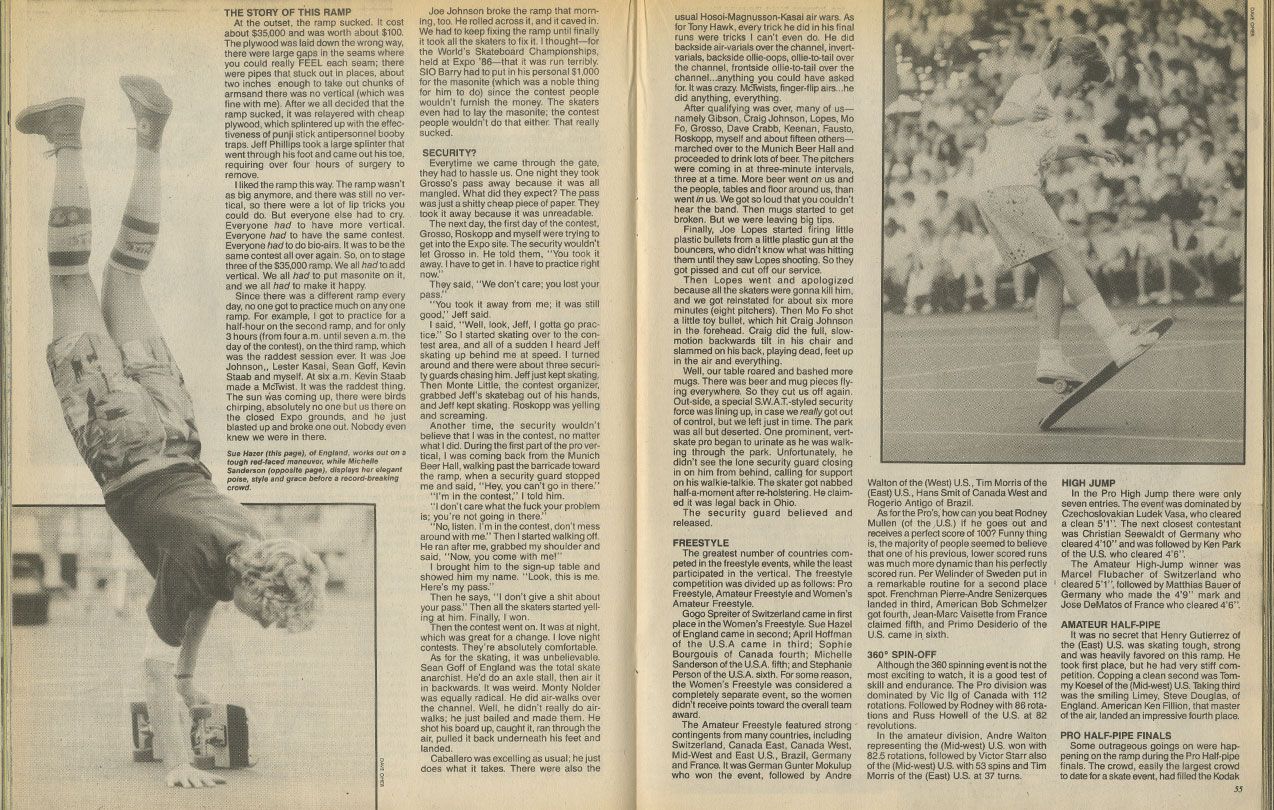
Sue Hazer (this page), of England, works out on a
tough red-faced maneuvor, while Michelle
Sanderson (opposite page), displays her elegant
poise, style and grace before a record-breaking
crowd.
Joe Johnson broke the ramp that mom-
ing, too. He rolled across it, and it caved in.
We had to keep fixing the ramp until finally
it took all the skaters to fix it. I thought-for
the World's Skateboard Championships,
held at Expo '86-that it was run terribly.
SIO Barry had to put in his personal $1,000
for the masonite (which was a noble thing
for him to do) since the contest people
wouldn't furnish the money. The skaters
even had to lay the masonite; the contest
people wouldn't do that either. That really
sucked.
SECURITY?
Everytime we came through the gate,
they had to hassle us. One night they took
Grosso's pass away because it was all
mangled. What did they expect? The pass
was just a shitty cheap piece of paper. They
took it away because it was unreadable.
The next day, the first day of the contest,
Grosso, Roskopp and myself were trying to
get into the Expo site. The security wouldn't
let Grosso in. He told them, "You took it
away. I have to get in. I have to practice right
now."
They said, "We don't care; you lost your
pass.
"You took it away from me; it was still
good, Jeff said.
I said, "Well, look, Jeff, I gotta go prac-
tice." So I started skating over to the con-
test area, and all of a sudden I heard Jeff
skating up behind me at speed. I turned
around and there were about three securi-
ty guards chasing him. Jeff just kept skating.
Then Monte Little, the contest organizer,
grabbed Jeff's skatebag out of his hands,
and Jeff kept skating. Roskopp was yelling
and screaming.
Another time, the security wouldn't
believe that I was in the contest, no matter
what I did. During the first part of the pro ver-
tical, I was coming back from the Munich
Beer Hall, walking past the barricade toward
the ramp, when a security guard stopped
me and said, "Hey, you can't go in there."
"I'm in the contest." I told him.
"I don't care what the fuck your problem
is; you're not going in there."
"No, listen, I'm in the contest, don't mess
around with me." Then I started walking off.
He ran after me, grabbed my shoulder and
said, "Now, you come with me!"
I brought him to the sign-up table and
showed him my name. "Look, this is me.
Here's my pass."
Then he says, "I don't give a shit about
your pass." Then all the skaters started yell-
ing at him. Finally, I won.
Then the contest went on. It was at night,
which was great for a change. I love night
contests. They're absolutely comfortable.
As for the skating, it was unbelievable.
Sean Goff of England was the total skate
anarchist. He'd do an axle stall, then air it
in backwards. It was weird. Monty Nolder
was equally radical. He did air-walks over
the channel. Well, he didn't really do air-
walks; he just bailed and made them. He
shot his board up, caught it, ran through the
air, pulled it back underneath his feet and
landed.
Caballero was excelling as usual; he just
does what it takes. There were also the
usual Hosoi-Magnusson-Kasai air wars. As
for Tony Hawk, every trick he did in his final
runs were tricks I can't even do. He did
backside air-varials over the channel, invert-
varials, backside ollie-oops, ollie-to-tail over
the channel, frontside ollie-to-tail over the
channel...anything you could have asked
for. It was crazy. McTwists, finger-flip airs...he
did anything, everything.
After qualifying was over, many of us-
namely Gibson, Craig Johnson, Lopes, Mo
Fo, Grosso, Dave Crabb, Keenan, Fausto,
Roskopp, myself and about fifteen others-
marched over to the Munich Beer Hall and
proceeded to drink lots of beer. The pitchers
were coming in at three-minute intervals,
three at a time. More beer went on us and
the people, tables and floor around us, than
went in us. We got so loud that you couldn't
hear the band. Then mugs started to get
broken. But we were leaving big tips.
Finally, Joe Lopes started firing little
plastic bullets from a little plastic gun at the
bouncers, who didn't know what was hitting
them until they saw Lopes shooting. So they
got pissed and cut off our service.
Then Lopes went and apologized
because all the skaters were gonna kill him.
and we got reinstated for about six more
minutes (eight pitchers). Then Mo Fo shot.
a little toy bullet, which hit Craig Johnson
in the forehead. Craig did the full, slow-
motion backwards tilt in his chair and
slammed on his back, playing dead, feet up
in the air and everything.
Well, our table roared and bashed more
mugs. There was beer and mug pieces fly-
ing everywhere. So they cut us off again.
Out-side, a special S.W.A.T.-styled security
force was lining up, in case we really got out
of control, but we left just in time. The park
was all but deserted. One prominent, vert-
skate pro began to urinate as he was walk-
ing through the park. Unfortunately, he
didn't see the lone security guard closing
in on him from behind, calling for support
on his walkie-talkie. The skater got nabbed
half-a-moment after re-holstering. He claim-
ed it was legal back in Ohio.
The security guard believed and
released.
FREESTYLE
The greatest number of countries com-
peted in the freestyle events, while the least
participated in the vertical. The freestyle
competition was divided up as follows: Pro
Freestyle, Amateur Freestyle and Women's
Amateur Freestyle.
Gogo Spreiter of Switzerland came in first
place in the Women's Freestyle. Sue Hazel
of England came in second; April Hoffman
of the U.S.A came in third; Sophie
Bourgouis of Canada fourth; Michelle
Sanderson of the U.S.A. fifth; and Stephanie
Person of the U.S.A. sixth. For some reason,
the Women's Freestyle was considered a
completely separate event, so the women
didn't receive points toward the overall team
award,
The Amateur Freestyle featured strong -
contingents from many countries, including
Switzerland, Canada East, Canada West,
Mid-West and East U.S., Brazil, Germany
and France. It was German Gunter Mokulup
who won the event, followed by Andre
Walton of the (West) U.S., Tim Morris of the
(East) U.S., Hans Smit of Canada West and
Rogerio Antigo of Brazil.
As for the Pro's, how can you beat Rodney
Mullen (of the U.S.) If he goes out and
receives a perfect score of 100? Funny thing.
is, the majority of people seemed to believe
that one of his previous, lower scored runs
was much more dynamic than his perfectly
scored run. Per Welinder of Sweden put in
a remarkable routine for a second place
spot. Frenchman Pierre-Andre Senizerques
landed in third, American Bob Schmelzer
got fourth, Jean-Marc Vaisette from France
claimed fifth, and Primo Desiderio of the
U.S. came in sixth.
360° SPIN-OFF
Although the 360 spinning event is not the
most exciting to watch, it is a good test of
skill and endurance. The Pro division was
dominated by Vic llg of Canada with 112
rotations. Followed by Rodney with 86 rota-
tions and Russ Howell of the U.S. at 82.
revolutions.
In the amateur division, Andre Walton
representing the (Mid-west) U.S. won with
82.5 rotations, followed by Victor Starr also
of the (Mid-west) U.S. with 53 spins and Tim
Morris of the (East) U.S. at 37 turns.
HIGH JUMP
In the Pro High Jump there were only
seven entries. The event was dominated by
Czechoslovakian Ludek Vasa, who cleared
a clean 5'1" The next closest contestant
was Christian Seewaldt of Germany who
cleared 4'10" and was followed by Ken Park
of the U.S. who cleared 4'6"
The Amateur High-Jump winner was
Marcel Flubacher of Switzerland who
cleared 5'1", followed by Matthias Bauer of
Germany who made the 4'9" mark and
Jose DeMatos of France who cleared 4'6"
AMATEUR HALF-PIPE
It was no secret that Henry Gutierrez of
the (East) U.S. was skating tough, strong
and was heavily favored on this ramp. He
took first place, but he had very stiff com-
petition. Copping a clean second was Tom-
my Koesel of the (Mid-west) U.S. Taking third
was the smiling Limey, Steve Douglas, of
England. American Ken Fillion, that master
of the air, landed an impressive fourth place.
PRO HALF-PIPE FINALS
Some outrageous goings on were hap-
pening on the ramp during the Pro Half-pipe
finals. The crowd, easily the largest crowd
to date for a skate event, had filled the Kodak
55