Page Text
            S
KATER'S EDGE
I like to put together my own skateboards.
It's kind of like, if I could possibly have put
together my own car, from the ground up,
I would have. I like to know what I'm
riding-every single part of it. It's satisfying
to know that you've put it together, compo-
nent by component, and now you're riding
your own creation.
I like my decks solid. The kind of board
that when dropped just makes a thud. No
clattering, no looseness, nothing.
Some of you may not care. After all, you
could just have the stoner at the skate shop
put it together. He'd probably do an O.K. job;
after all, he's not going to ride your board.
But you others, the few who like to ride a
nice, solid deck, something built for abuse,
will put it together yourselves.
It's plain and simple. A solid deck skates
a lot better. It's smooth, responsive and,
when it's put together right the first time, it
stays together.
Let's assume you know the basics. You
can handle tools fairly well and someone
else has properly drilled and maybe even
put the deck together. I'm going to explain
just a few things you can do to solidify your
skate.
First off, a skateboard is only as solid as
each separate component. I myself prefer
wood decks. I understand all the foam
technology of today, but nothing rides bet-
ter than a tightly laminated, stiff, hard-rock
maple deck. Buy one that is solid and has
a nice knock to it when you pop it with your
fist. An easy way to check for a good lamina-
tion is to run your fingernail around the rail
of the board. Is it smooth? Or did the plys
continue to settle after it was cut and
shaped, creating distinct ridges from ply to
ply? Don't buy a board like that, it's not go
ing to stay together.
Next in line is the heart of a truly solid
skate: the mounting hardware/riser pad
combination. Definitely don't skimp here;
purchase the best you can get. Grade 8
steel hardware is the king, but it's sort of ex-
pensive. The basic black, Phillips head, size
10-24 is the most common. Match this with
a V2" riser pad (14" if you ride small wheels)
that slightly flexes for shock absorption, and
you're all set. The key here is to install a
small, flat washer under each mounting nut
to sit up against the truck baseplate. Tighten
it all down nice and firm, and I'll guarantee
nothing is going to come loose.
Tip Of The Month: Caballero told me
about a little set-up technique he used while
he was having someone else put his board
together (skate stars have it too easy!). He
had the young worshipper flip the front two
mounting screws so that the lock nuts were
on top of the deck and the round Phillips
heads were resting against the baseplate of
his truck. Two things result: one, you
eliminate tearing your fingertips off on the
screw ends under your board, and two, for
all you ollie experts, it creates a foot-stop
type thing for you to maneuver the deck and
22
carry the ollie. If you can do the trick, try it
and you'll see what I'm talking about.
Now let's get back to the original line of
thought. Next up in our quest for a solid
deck is the truck assembly, Most of you ig-
nore your trucks while you grind the whole
assembly into a mess. Do yourself and your
skating a favor and invest a few bucks into
rebuilding your trucks. If you ride them tight,
don't crank the nut into a mushroom; pur-
chase new, stiffer bushings and install them.
Kingpins ground down? Tap out the old ones
(if your trucks allow it) and replace 'em.
Replace the pivots, bushing caps, kingpin
nuts and anything else that may need it, all
at about one-tenth the cost of a new set.
If you use copers and want a nice solid
deck, purchase the kind designed to fit your
trucks. Dont force some foreign coper on a
different brand; it doesn't work..
Finally we come to the wheels, com-
ponents that most people believe have to be
loose in order to roll fast. It doesn't matter
what you're riding, but the harder the wheel,
the more your deck wants to come apart and
scatter itself, so you want to minimize the
vibrations originating at this point. Purchase
a set of wheels with a tight bearing seat that
takes a good sweat to pop the bearings in-
by Bob Denike
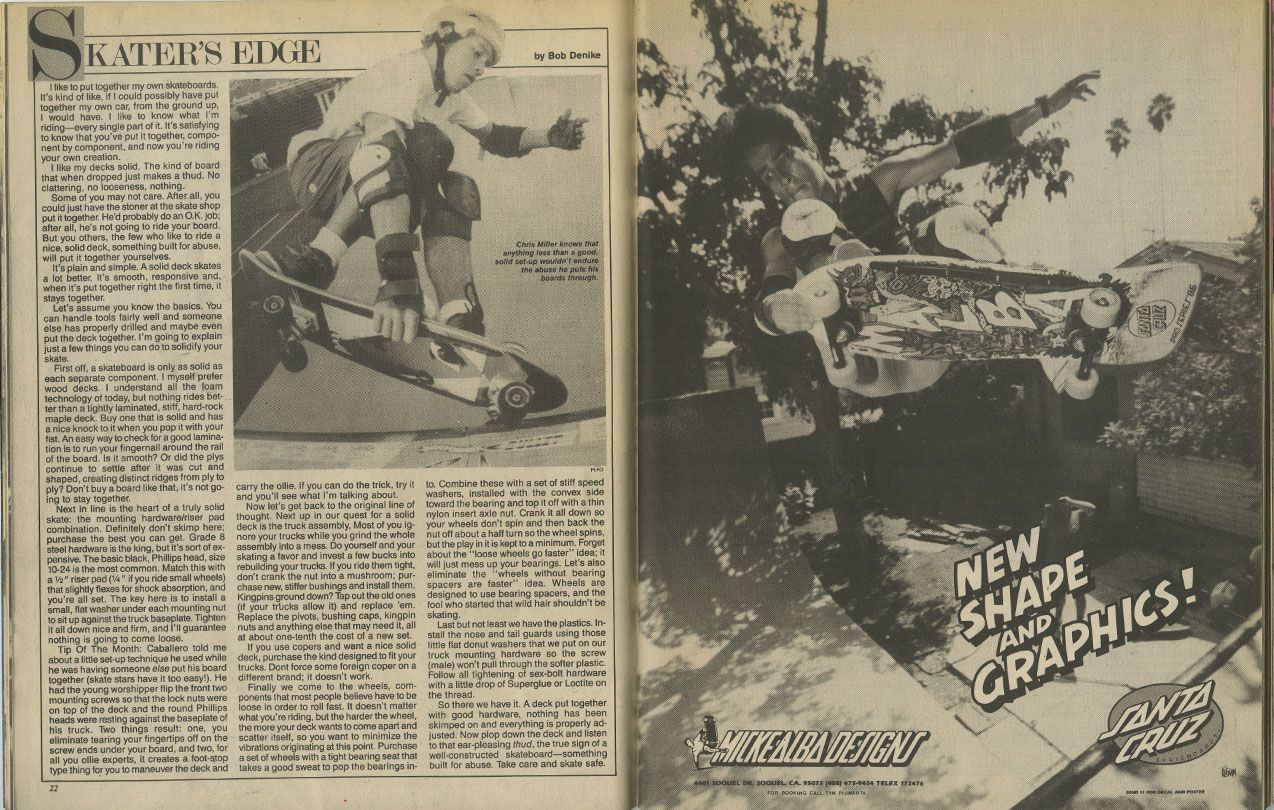
Chris Miller knows that
anything less than a good,
solid set-up wouldn't endure
the abuso he puts his
boards through.
Ню
to. Combine these with a set of stiff speed
washers, installed with the convex side
toward the bearing and top it off with a thin
nylon insert axle nut. Crank it all down so
your wheels don't spin and then back the
nut off about a half turn so the wheel spins,
but the play in it is kept to a minimum. Forget
about the "loose wheels go faster" idea; it
will just mess up your bearings. Let's also
eliminate the wheels without bearing.
spacers are faster" idea. Wheels are
designed to use bearing spacers, and the
fool who started that wild hair shouldn't be
skating.
Last but not least we have the plastics. In-
stall the nose and tail guards using those
little flat donut washers that we put on our
truck mounting hardware so the screw
(male) won't pull through the softer plastic.
Follow all tightening of sex-bolt hardware
with a little drop of Superglue or Loctite on
the thread.
So there we have it. A deck put together
with good hardware, nothing has been
skimped on and everything is properly ad-
justed. Now plop down the deck and listen
to that ear-pleasing thud, the true sign of at
well-constructed skateboard-something
built for abuse. Take care and skate safe.
MILKEMBA DETENT
4401 SOQUEL DE SOQUEL CA. 95073 1608) 475-9434 TELEX 172476
ron BOOKING CALL TIM PEMANTA
NEW
SHAPE
AND
GRAPHICS!
JANTA
CRUZ
DECAL AND PORTER