Page Text
            in the
CROWD
FRANK
HAWK
THE MAN FROM N.S.A
by Keith Stephenson
on.
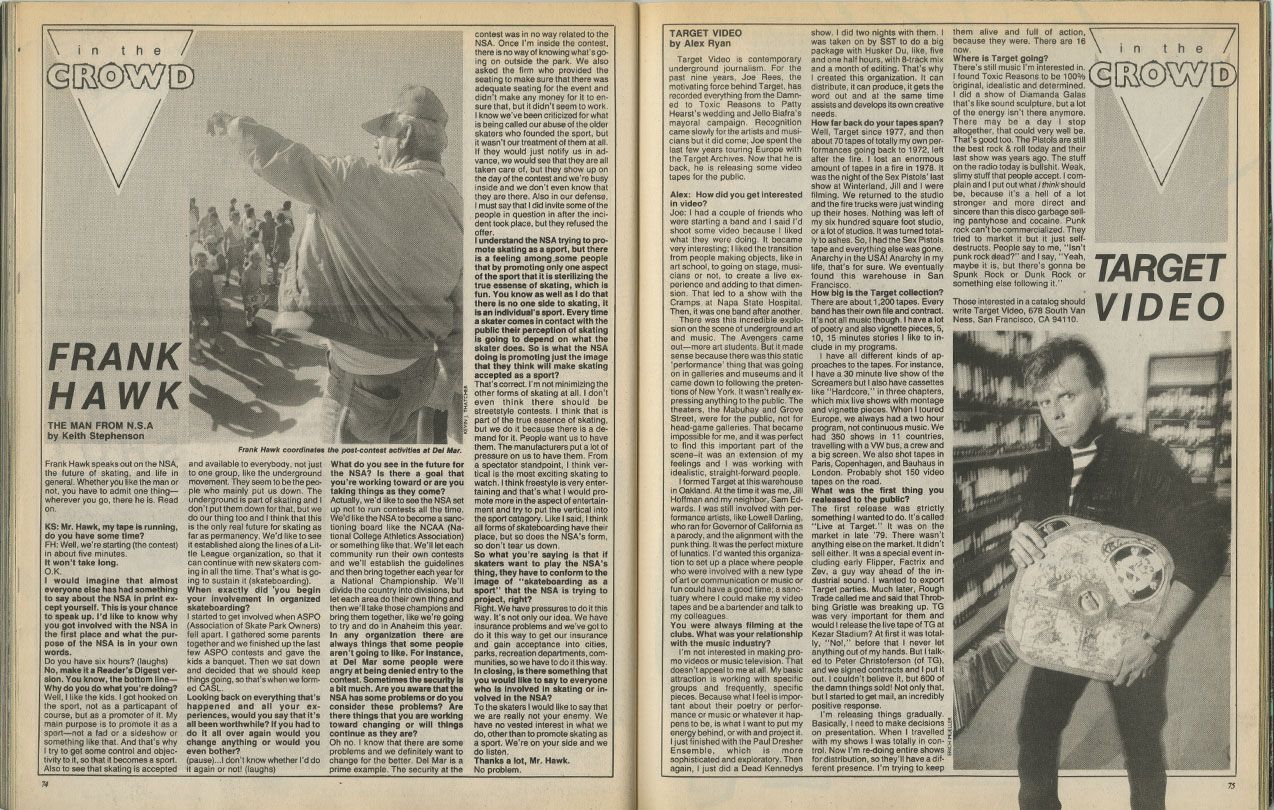
Frank Hawk coordinates
Frank Hawk speaks out on the NSA, and available to everybody, not just
the future of skating, and life in to one group, like the underground
general. Whether you like the man or movement. They seem to be the peo-
not, you have to admit one thing-ple who mainly put us down. The
wherever you go, there he is. Read underground is part of skating and I
don't put them down for that, but we
do our thing too and I think that this
is the only real future for skating as
far as permanency. We'd like to see
it established along the lines of a Lit-
tle League organization, so that it
can continue with new skaters com-
ing in all the time. That's what is go-
ing to sustain it (skateboarding).
When exactly did 'you begin
your involvement in organized
skateboarding?
KS: Mr. Hawk, my tape is running,
do you have some time?
FH: Well, we're starting (the contest)
in about five minutes.
It won't take long.
O.K.
I would imagine that almost
everyone else has had something
to say about the NSA in print ex-
cept yourself. This is your chance
to speak up. I'd like to know why
you got involved with the NSA in
the first place and what the pur-
pose of the NSA is in your own
words.
Do you have six hours? (laughs)
No, make it a Reader's Digest ver-
sion. You know, the bottom line-
Why do you do what you're doing?
Well, I like the kids. I got hooked on
the sport, not as a particapant of
course, but as a promoter of it. My
main purpose is to promote it as a
sport-not a fad or a sideshow or
something like that. And that's why
I try to get some control and objec-
tivity to it, so that it becomes a sport.
Also to see that skating is accepted
74
I started to get involved when ASPO
(Association of Skate Park Owners)
fell apart. I gathered some parents
together and we finished up the last
few ASPO contests and gave the
kids a banquet. Then we sat down
and decided that we should keep
things going, so that's when we form-
ed ČAŠL
Looking back on everything that's
happened and all your ex-
periences, would you say that it's
all been worthwhile? If you had to
do it all over again would you
change anything or would you
even bother?
(pause)...I don't know whether I'd do
it again or not! (laughs)
the post-contest activities at Del Mar.
What do you see in the future for
the NSA? Is there a goal that
you're working toward or are you
taking things as they come?
Actually, we'd like to see the NSA set
up not to run contests all the time.
We'd like the NSA to become a sanc-
tioning board like the NCAA (Na-
tional College Athletics Association)
or something like that. We'll let each
community run their own contests
and we'll establish the guidelines
and then bring together each year for
a National Championship. We'll
divide the country into divisions, but
let each area do their own thing and
then we'll take those champions and
bring them together, like we're going
to try and do in Anaheim this year.
In any organization there are
always things that some people
aren't going to like. For instance,
at Del Mar some people were
angry at being denied entry to the
contest. Sometimes the security is
a bit much. Are you aware that the
NSA has some problems or do you
consider these problems? Are
there things that you are working
toward changing or will things
continue as they are?
Oh no. I know that there are some
problems and we definitely want to
change for the better. Del Mar is a
prime example. The security at the
contest was in no way related to the
NSA. Once I'm inside the contest,
there is no way of knowing what's go
ing on outside the park. We also
asked the firm who provided the
seating to make sure that there was
adequate seating for the event and
didn't make any money for it to en-
sure that, but it didn't seem to work.
I know we've been criticized for what
is being called our abuse of the older
skaters who founded the sport, but
it wasn't our treatment of them at all.
If they would just notify us in ad-
vance, we would see that they are all
taken care of, but they show up on
the day of the contest and we're busy
inside and we don't even know that
they are there. Also in our defense.
I must say that I did invite some of the
people in question in after the inci-
dent took place, but they refused the
offer.
I understand the NSA trying to pro-
mote skating as a sport, but there
is a feeling among some people
that by promoting only one aspect
of the sport that it is sterilizing the
true essense of skating, which is
fun. You know as well as I do that
there is no one side to skating, it
is an individual's sport. Every time
a skater comes in contact with the
public their perception of skating
is going to depend on what the
skater does. So is what the NSA
doing is promoting just the image
that they think will make skating
accepted as a sport?
That's correct. I'm not minimizing the
other forms of skating at all. I don't
even think there should be
streetstyle contests. I think that is
part of the true essence of skating.
but we do it because there is a de-
mand for it. People want us to have
them. The manufacturers put a lot of
pressure on us to have them. From
a spectator standpoint, I think ver-
tical is the most exciting skating to
watch. I think freestyle is very enter-
taining and that's what I would pro-
mote more in the aspect of entertain-
ment and try to put the vertical into
the sport catagory. Like I said, I think
all forms of skateboarding have their
place, but so does the NSA's form,
so don't tear us down.
So what you're saying is that if
skaters want to play the NSA's
thing, they have to conform to the
image of "skateboarding as a
sport" that the NSA is trying to
project, right?
Right. We have pressures to do it this
way. It's not only our idea. We have
insurance problems and we've got to
do it this way to get our insurance
and gain acceptance into cities,
parks, recreation departments, com-
munities, so we have to do it this way.
In closing, is there something that
you would like to say to everyone
who is involved in skating or in-
volved in the NSA?
To the skaters I would like to say that
we are really not your enemy. We
have no vested interest in what we
do, other than to promote skating as
a sport. We're on your side and we
do listen.
Thanks a lot, Mr. Hawk.
No problem.
TARGET VIDEO
by Alex Ryan
Target Video is contemporary
underground journalism. For the
past nine years, Joe Rees, the
motivating force behind Target, has
recorded everything from the Damn
ed to Toxic Reasons to Patty
Hearst's wedding and Jello Biafra's
mayoral campaign. Recognition
came slowly for the artists and musi
cians but it did come; Joe spent the
last few years touring Europe with
the Target Archives. Now that he is
back, he is releasing some video
tapes for the public.
show. I did two nights with them. I them alive and full of action,
was taken on by SST to do a big because they were. There are 16
package with Husker Du, like, five now.
and one half hours, with 8-track mix Where is Target going?
and a month of editing. That's why There's still music I'm interested in.
I created this organization. It can I found Toxic Reasons to be 100%
distribute, it can produce, it gets the original, idealistic and determined.
word out and at the same time I did a show of Diamanda Galas
assists and develops its own creative that's like sound sculpture, but a lot
needs.
of the energy isn't there anymore.
There may be a day I stop
altogether, that could very well be.
That's good too. The Pistols are still
the best rock & roll today and their
last show was years ago. The stuff
on the radio today is bullshit. Weak.
slimy stuff that people accept. I com-
plain and I put out what I think should
be, because it's a hell of a lot
stronger and more direct and
and the fire trucks were just winding
up their hoses. Nothing was left of
my six hundred square foot studio,
or a lot of studios. It was turned total
ly to ashes. So, I had the Sex Pistols
tape and everything else was gone.
Anarchy in the USA! Anarchy in my
life, that's for sure. We eventually
found this warehouse in San
Francisco.
How far back do your tapes span?
Well, Target since 1977, and then
about 70 tapes of totally my own per-
formances going back to 1972, left
after the fire. I lost an enormous
amount of tapes in a fire in 1978. It
was the night of the Sex Pistols' last
show at Winterland, Jill and I were
Alex: How did you get interested filming. We returned to the studio
in video?
Joe: I had a couple of friends who
were starting a band and I said I'd
shoot some video because I liked
what they were doing. It became
very interesting: I liked the transition
from people making objects, like in
art school, to going on stage, musi-
cians or not, to create a live ex-
perience and adding to that dimen-
sion. That led to a show with the
Cramps at Napa State Hospital.
Then, it was one band after another.
There was this incredible explo-
sion on the scene of underground art
and music. The Avengers came
out-more art students. But it made
sense because there was this static
"performance' thing that was going
on in galleries and museums and it
came down to following the preten-
tions of New York. It wasn't really ex-
pressing anything to the public. The
theaters, the Mabuhay and Grove
Street, were for the public, not for
head-game galleries. That became
impossible for me, and it was perfect
to find this important part of the
scene-it was an extension of my
feelings and I was working with
idealistic, straight-forward people.
I formed Target at this warehouse
in Oakland. At the time it was me, Jill
Hoffman and my neighbor, Sam Ed-
wards. I was still involved with per-
formance artists, like Lowell Darling,
who ran for Governor of California as
a parody, and the alignment with the
punk thing. It was the perfect mixture
of lunatics. I'd wanted this organiza-
tion to set up a place where people
who were involved with a new type
of art or communication or music or
fun could have a good time; a sanc-
tuary where I could make my video
tapes and be a bartender and talk to
my colleagues.
You were always filming at the
clubs. What was your relationship
with the music industry?
I'm not interested in making pro-
mo videos or music television. That
doesn't appeal to me at all. My basic
attraction is working with specific
groups and frequently, specific
pieces. Because what I feel is impor-
tant about their poetry or perfor-
mance or music or whatever it hap-
pens to be, is what I want to put my
energy behind, or with and project it.
I just finished with the Paul Dresher
Ensemble, which is more
sophisticated and exploratory. Then
again, I just did a Dead Kennedys
How big is the Target collection?
There are about 1,200 tapes. Every
band has their own file and contract.
It's not all music though. I have a lot
of poetry and also vignette pieces, 5,
10, 15 minutes stories I like to in-
clude in my programs.
I have all different kinds of ap-
proaches to the tapes. For instance,
I have a 30 minute live show of the
Screamers but I also have cassettes
like "Hardcore," in three chapters,
which mix live shows with montage
and vignette pieces. When I toured
Europe, we always had a two hour
program, not continuous music. We
had 350 shows in 11 countries,
travelling with a VW bus, a crew and
a big screen. We also shot tapes in
Paris, Copenhagen, and Bauhaus in
London. Probably shot 150 video
tapes on the road.
What was the first thing you
realeased to the public?
The first release was strictly
something I wanted to do. It's called
"Live at Target." It was on the
market in late '79. There wasn't
anything else on the market. It didn't
sell either. It was a special event in-
cluding early Flipper, Factrix and
Zev, a guy way ahead of the in-
dustrial sound. I wanted to export
Target parties. Much later, Rough
Trade called me and said that Throb-
bing Gristle was breaking up. TG
was very important for them and
would I release the live tape of TG at
Kezar Stadium? At first it was total-
ly, "No!," before that I never let
anything out of my hands. But I talk-
ed to Peter Christoferson (of TG).
and we signed contracts and I put it
out. I couldn't believe it, but 600 of
the damn things sold! Not only that.
but I started to get mail, an incredibly
positive response.
I'm releasing things gradually.
Basically, I need to make decisions
on presentation. When I travelled
with my shows I was totally in con-
trol. Now I'm re-doing entire shows
for distribution, so they'll have a dif-
ferent presence. I'm trying to keep
sincere than this disco garbage sell-
ing pantyhose and cocaine. Punk
rock can't be commercialized. They
tried to market it but it just self-
destructs. People say to me, "Isn't
punk rock dead?" and I say, "Yeah,
maybe it is, but there's gonna be
Spunk Rock or Dunk Rock or
something else following it."
Those interested in a catalog should
write Target Video, 678 South Van
Ness, San Francisco, CA 94110.
in
the
CROWD
TARGET
VIDEO