Page Text
            IN THE CROWD
SFX
Story and Photos by Barrie Evans
I zoomed down to good ol' Hol-
lywood recently for a behind the
scenes look at Hollywood make-
up and special effects (sf/x). I had
the honor of interviewing three
very hot make-up men, Steve
Wang (19), Matt Rose (19), and
Mark Williams (20). They've done
work on films such as The
Hunter" and "Aliens," working with
greats like Stan Winston and Tobe
Hooper. So sit back and find out
just what nightmares are made of.
Barrie: Start by introducing your-
selves.
Steve: I'm Steve Wang, 5' 2" (ha
ha).
Mark: I'm Mark Williams and my
hobbies are stamp collecting and
mass murder.
B: How did you get into make-up?
S: I started when I was fourteen.
First I started collecting rubber
masks, then wanted to learn to
make them. I started buying
books, researching, and practic-
ing. Six years later and here I am,
Hollywood, Ca. from San Jose -
quite a step up.
M: When I was 13, I got into draw-
ing and make-up then decided to
draw comic book art. I drew for the
Champions role-playing game for
a few years, until I was sick of it,
and then decided to pursue make-
up as a career.
B: Why did you start? Was it for fun
or did you know it would be a
career?
S: Well, first because it was fun,
strictly out of interest. A hobby. I
would stay in my room all day,
every day for whole summers,
right now it's paying off.
B: You did amateur films, and
didn't you have a mask company?
S: Yes, Bizarre Creations. It was
an independent mask company
Matt and I did. We started by put-
ting ads in Fangoria and other
mags, and it turned out to be a
year long thing. People could
order custom masks, 3-D t-shirts
and other prosthetics from us.
B: What was your first job in Hol-
lywood?
M: "Aliens (the sequel to "Alien").
where I worked on the ship on the
planet. Then I brought Matt Rose
down and we worked on the movie
"Prison Ship."
B: With Kitten?
M: No, just a batch of B-grade ac-
tresses. We did work with Kitten
Natividad on a movie called "The
Tomb," but we never got to meet
her. Or her breasts.
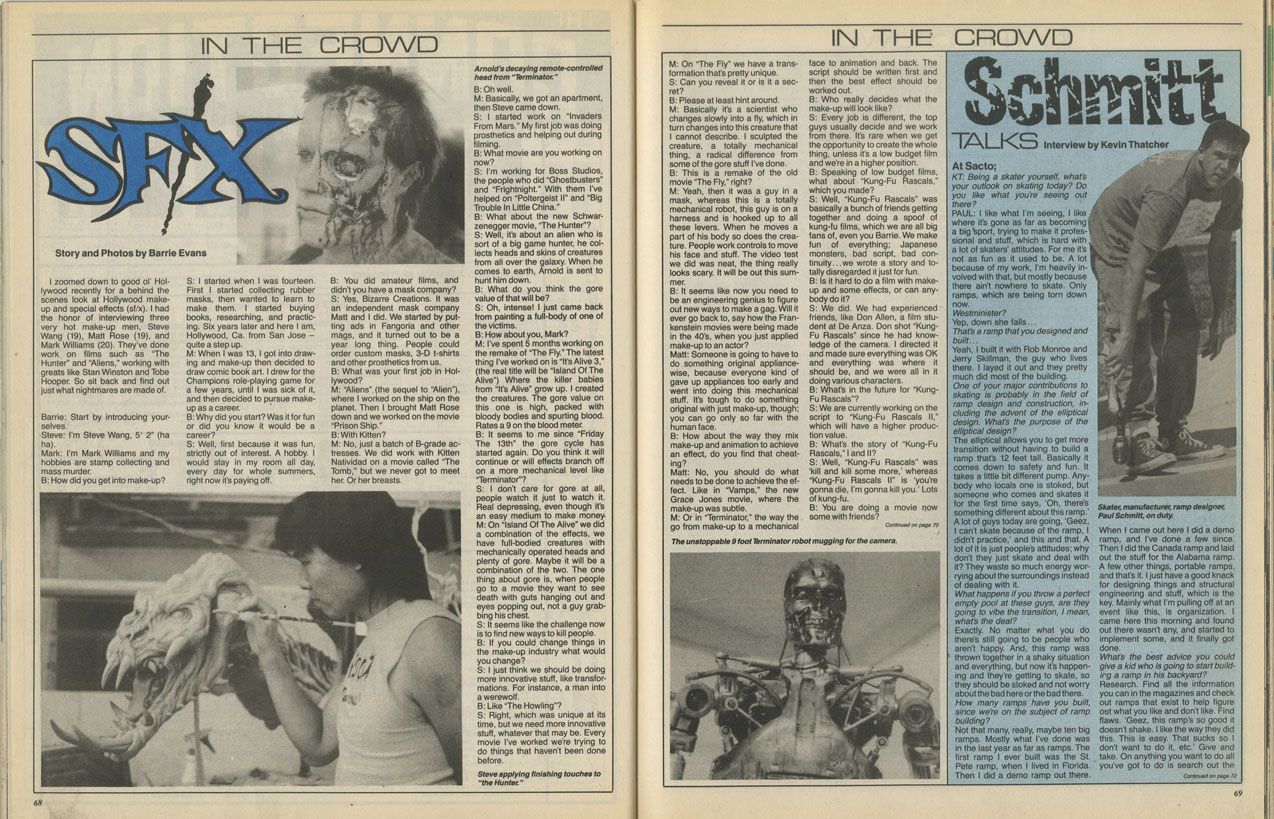
Arnold's decaying remote-controlled
head from "Terminator."
B: Oh well.
M: Basically, we got an apartment,
then Steve came down.
S: I started work on "Invaders
From Mars." My first job was doing
prosthetics and helping out during
filming.
B: What movie are you working on
now?
S: I'm working for Boss Studios,
the people who did "Ghostbusters"
and "Frightnight." With them I've
helped on "Poltergeist II" and "Big
Trouble In Little China."
B: What about the new Schwar
zenegger movie, "The Hunter"?
S: Well, it's about an alien who is
sort of a big game hunter, he col-
lects heads and skins of creatures
from all over the galaxy. When he
comes to earth, Arnold is sent to
hunt him down.
B: What do you think the gore
value of that will be?
S: Oh, intense! I just came back
from painting a full-body of one of
the victims.
B: How about you, Mark?
M: I've spent 5 months working on
the remake of "The Fly." The latest
thing I've worked on is "It's Alive 3,"
(the real title will be "Island Of The
Alive") Where the killer babies
from "It's Alive" grow up. I created
the creatures. The gore value on
this one is high, packed with
bloody bodies and spurting blood.
Rates a 9 on the blood meter.
B: It seems to me since "Friday
The 13th the gore cycle has
started again. Do you think it will
continue or will effects branch off
on a more mechanical level like
"Terminator"?
S: I don't care for gore at all,
people watch it just to watch it.
Real depressing, even though it's
an easy medium to make money.
M: On Island Of The Alive" we did
a combination of the effects, we
have full-bodied creatures with
mechanically operated heads and
plenty of gore. Maybe it will be a
combination of the two. The one
thing about gore is, when people
go to a movie they want to see
death with guts hanging out and
eyes popping out, not a guy grab-
bing his chest.
S: It seems like the challenge now
is to find new ways to kill people.
B: If you could change things in
the make-up industry what would
you change?
S: I just think we should be doing
more innovative stuff, like transfor
mations. For instance, a man into
a werewolf.
B: Like "The Howling"?
S: Right, which was unique at its
time, but we need more innovative
stuff, whatever that may be. Every
movie I've worked we're trying to
do things that haven't been done
before.
Steve applying finishing touches to
"the Hunter"
M: On "The Fly" we have a trans-
formation that's pretty unique.
S: Can you reveal it or is it a sec-
B: Please at least hint around.
M: Basically it's a scientist who
changes slowly into a fly, which in
turn changes into this creature that
I cannot describe. I sculpted the
creature, a totally mechanical
thing, a radical difference from
some of the gore stuff I've done.
B: This is a remake of the old
movie "The Fly," right?
M: Yeah, then it was a guy in a
mask, whereas this is a totally
mechanical robot, this guy is on a
harness and is hooked up to all
these levers. When he moves a
part of his body so does the crea-
ture. People work controls to move
his face and stuff. The video test
we did was neat, the thing really
looks scary. It will be out this sum-
mer.
B: It seems like now you need to
be an engineering genius to figure
out new ways to make a gag. Will it
ever go back to, say how the Fran-
kenstein movies were being made
in the 40's, when you just applied
make-up to an actor?
Matt: Someone is going to have to
do something original appliance-
wise, because everyone kind of
gave up appliances too early and
went into doing this mechanical
stuff. It's tough to do something
original with just make-up, though;
you can go only so far with the
human face.
B: How about the way they mix
make-up and animation to achieve
an effect, do you find that cheat-
ing?
Matt: No, you should do what
needs to be done to achieve the ef-
fect. Like in "Vamps," the new
Grace Jones movie, where the
make-up was subtle.
M: Or in "Terminator," the way the
go from make-up to a mechanical
IN THE CROWD
face to animation and back. The
script should be written first and
then the best effect should be
worked out.
B: Who really decides what the
make-up will look like?
S: Every job is different, the top
guys usually decide and we work
from there. It's rare when we get
the opportunity to create the whole
thing, unless it's a low budget film
and we're in a higher position.
B: Speaking of low budget films,
what about "Kung-Fu Rascals,"
which you made?
S: Well, "Kung-Fu Rascals" was
basically a bunch of friends getting
together and doing a spoof of
kung-fu films, which we are all big
fans of, even you Barrie. We make
fun of everything: Japanese
monsters, bad script, bad con-
tinuity...we wrote a story and to-
tally disregarded it just for fun.
B: Is it hard to do a film with make-
up and some effects, or can any-
body do it?
S: We did. We had experienced
friends, like Don Allen, a film stu-
dent at De Anza. Don shot "Kung-
Fu Rascals" since he had know-
ledge of the camera. I directed it
and made sure everything was OK
and everything was where it
should be, and we were all in it
doing various characters.
B: What's in the future for "Kung-
Fu Rascals?
S: We are currently working on the
script to "Kung-Fu Rascals II,
which will have a higher produc-
tion value.
B: What's the story of "Kung-Fu
Rascals,"I and II?
S: Well, "Kung-Fu Rascals" was
kill and kill some more,' whereas
"Kung-Fu Rascals II is you're
gonna die, I'm gonna kill you." Lots
of kung-fu.
B: You are doing a movie now
some with friends?
Continued on page 70
The unstoppable 9 foot Terminator robot mugging for the camera.
Schmitt
TALKS Interview by Kevin Thatcher
At Sacto;
KT: Being a skater yourself, what's
your outlook on skating today? Do
you like what you're seeing out
there?
PAUL: I like what I'm seeing, I like
where it's gone as far as becoming
a big sport, trying to make it profes-
sional and stuff, which is hard with,
a lot of skaters' attitudes. For me it's
not as fun as it used to be. A lot
because of my work, I'm heavily in-
volved with that, but mostly because
there ain't nowhere to skate. Only
ramps, which are being torn down
now.
Westminister?
Yep, down she falls...
That's a ramp that you designed and
built...
Yeah, I built it with Rob Monroe and
Jerry Skillman, the guy who lives
there. I layed it out and they pretty
much did most of the building.
One of your major contributions to
skating is probably in the field of
ramp design and construction, in-
cluding the advent of the elliptical
design. What's the purpose of the
elliptical design?
The elliptical allows you to get more
transition without having to build a
ramp that's 12 feet tall. Basically it
comes down to safety and fun. It
takes a little bit different pump. Any-
body who locals one is stoked, but
someone who comes and skates it
for the first time says, 'Oh, there's Skater, manufacturer, ramp designer
something different about this ramp.
Paul Schmitt, on duty.
A lot of guys today are going, 'Geez,
I can't skate because of the ramp, I
didn't practice,' and this and that. A
lot of it is just people's attitudes; why
don't they just skate and deal with
it? They waste so much energy wor-
rying about the surroundings instead
of dealing with it.
What happens if you throw a perfect
empty pool at these guys, are they
going to vibe the transition, I mean,
what's the deal?
Exactly. No matter what you do
there's still going to be people who
aren't happy. And, this ramp was
thrown together in a shaky situation
and everything, but now it's happen-
ing and they're getting to skate, so
they should be stoked and not worry
about the bad here or the bad there.
How many ramps have you built,
since we're on the subject of ramp
building?
Not that many, really, maybe ten big
ramps. Mostly what I've done was
in the last year as far as ramps. The
first ramp I ever built was the St.
Pete ramp, when I lived in Florida.
Then I did a demo ramp out there.
When I came out here I did a demo
ramp, and I've done a few since.
Then I did the Canada ramp and laid
out the stuff for the Alabama ramp.
A few other things, portable ramps,
and that's it. I just have a good knack
for designing things and structural
engineering and stuff, which is the
key. Mainly what I'm pulling off at an
event like this, is organization. I
came here this morning and found
out there wasn't any, and started to
implement some, and it finally got
done.
What's the best advice you could.
give a kid who is going to start build-
ing a ramp in his backyard?
Research. Find all the information
you can in the magazines and check
out ramps that exist to help figure
out what you like and don't like. Find
flaws. 'Geez, this ramp's so good it
doesn't shake. I like the way they did,
this. This is easy. That sucks so I
don't want to do it, etc. Give and
take. On anything you want to do all
you've got to do is search out the
Continued on page 72
69