Page Text
            FREESTYLE
N
ATICS
In the realm of what can be done on a
skateboard, freestyle has to be the most
critical, demanding, mind blowing and
misunderstood of all the skate arts.
Maneuvers which are practiced so
flawlessly by just a handful of practitioners
are far beyond average skate abilities and
bely the patience that these trick techni-
cians possess. As skateboarding pro-
gresses so does the level of prowess
demonstrated by these dedicated few who
persist and strive for more. As the numbers
grow so do the variety of ideas about what
can be done on a board.
Unlike the happy-go-lucky existence of
the everyday skate rat who sustains a diet
of ramp and street activity when and
where it can be found, the freestylist
spends long, sometimes solitary, hours
honing the art of shoving around a 27" x 7"
ply. The board itself is considered unride-
able for anything but the most delicate
footwork-oriented maneuvers. Freestylers
are the loneliest skaters. With the patience
to practice precise maneuvers over and
over again, the repetition is enough to
weed out the impatient, leaving only the
most dedicated to make up the exclusive
fraternity of freestyle-only skaters.
Certainly with all the talent in the skate
world these days there are skaters who
manage a transition between styles and
rip all. Steve Rocco has probably done
more for freestyle and street skating than
anyone else can claim. His wizardry on
banked surfaces is a refreshing combina-
tion of all styles. Bob Schmelzer adapted
his skate roots from the street to freestyle
and back again. Although not widely
known, Rodney Mullen was once headed
toward a career on vertical transitions
before he put his nose to the freestyle
grindstone. One can only imagine what
tricks the Mutt would be spinning on a
ramp if he had pursued that route.
Freestyle was born the first time
someone stepped on a platform with four
wheels under it and called it skateboard-
ing. So, it follows that a list of the best
reads like a historical who's who for the 25
year history of the sport. Innovators such
as Torger Johnson and Bruce Logan
bridged the gap between the foot-dragging
kickturns of the clay wheeled sixties with
space walks, wheelies and surf-styled
footwork leading the way into the
urethaned seventies. Russ Howell and
Skitch Hitchcock brought red-faced
maneuvers like finger-stands and gorilla-
gripping to the masses while a gang of
2-boys, led by Jay Adams and Stacy
Peralta, layed down their street smarts
with power tactics. Curt Lindgren was
responsible for the kick-flip and, along
with a magician named Ty Page, per-
formed car hops and table drops. By the
time Floridans Tim Scroggs and the young
Mullen were perfecting moves like 50/50
Caspers and fingerflips, freestyling had
earned its own individual niche within the
skate spectrum.
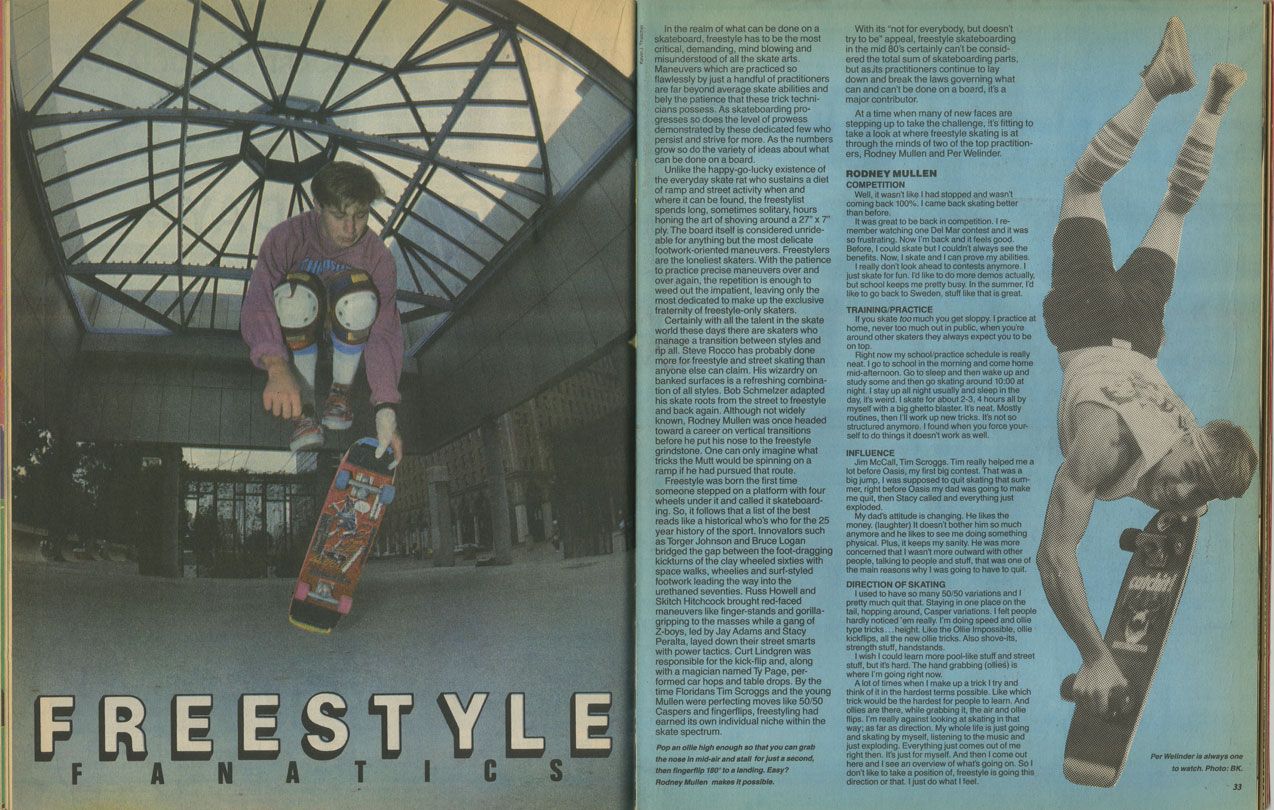
Pop an oille high enough so that you can grab
the nose in mid-air and stall for just a second,
then fingerflip 180 to a landing. Easy?
Rodney Mullen makes it possible.
With its "not for everybody, but doesn't
try to be appeal, freestyle skateboarding
in the mid 80's certainly can't be consid-
ered the total sum of skateboarding parts,
but as its practitioners continue to lay
down and break the laws governing what
can and can't be done on a board, it's a
major contributor.
At a time when many of new faces are
stepping up to take the challenge, it's fitting to
take a look at where freestyle skating is at
through the minds of two of the top practition-
ers, Rodney Mullen and Per Welinder.
RODNEY MULLEN
COMPETITION
Well, it wasn't like I had stopped and wasn't
coming back 100%. I came back skating better
than before.
It was great to be back in competition. I re-
member watching one Del Mar contest and it was
so frustrating. Now I'm back and it feels good.
Before, I could skate but I couldn't always see the
benefits. Now, I skate and I can prove my abilities.
I really don't look ahead to contests anymore. I
just skate for fun. I'd like to do more demos actually.
but school keeps me pretty busy. In the summer, I'd
like to go back to Sweden, stuff like that is great.
TRAINING/PRACTICE
If you skate too much you get sloppy. I practice at
home, never too much out in public, when you're
around other skaters they always expect you to be
on top.
Right now my school/practice schedule is really
neat. I go to school in the morning and come home
mid-afternoon. Go to sleep and then wake up and
study some and then go skating around 10:00 at
night. I stay up all night usually and sleep in the
day, it's weird. I skate for about 2-3, 4 hours all by
myself with a big ghetto blaster. It's neat. Mostly
routines, then I'll work up new tricks. It's not so
structured anymore. I found when you force your-
self to do things it doesn't work as well.
INFLUENCE
Jim McCall, Tim Scroggs. Tim really helped me a
lot before Oasis, my first big contest. That was a
big jump, I was supposed to quit skating that sum-
mer, right before Oasis my dad was going to make
me quit, then Stacy called and everything just
exploded.
My dad's attitude is changing. He likes the
money. (laughter) It doesn't bother him so much
anymore and he likes to see me doing something
physical. Plus, it keeps my sanity. He was more
concerned that I wasn't more outward with other
people, talking to people and stuff, that was one of
the main reasons why I was going to have to quit.
DIRECTION OF SKATING
I used to have so many 50/50 variations and I
pretty much quit that. Staying in one place on the
tail, hopping around, Casper variations. I felt people
hardly noticed 'em really. I'm doing speed and olie
type tricks... height. Like the Ollie Impossible, ollie
kickflips, all the new ollie tricks. Also shove-its,
strength stuff, handstands.
I wish I could learn more pool-like stuff and street
stuff, but it's hard. The hand grabbing (ollies) is
where I'm going right now.
A lot of times when I make up a trick I try and
think of it in the hardest terms possible. Like which
trick would be the hardest for people to learn. And
ollies are there, while grabbing it, the air and ollie
flips. I'm really against looking at skating in that
way; as far as direction. My whole life is just going
and skating by myself, listening to the music and
just exploding. Everything just comes out of me
right then. It's just for myself. And then I come out
here and I see an overview of what's going on. So I
don't like to take a position of, freestyle is going this
direction or that. I just do what I feel.
catchi
Per Welinder is always one
to watch. Photo: BK
33